
Trump asks Supreme Court to intervene in White House ballroom legal fight

▶ Watch Video: Trump to appeal White House ballroom ruling to Supreme Court

Washington — The Trump administration asked the Supreme Court on Friday to intervene and allow him to construct a new 90,000-square-foot ballroom in place of the demolished White House East Wing.

The request for emergency relief to the Supreme Court comes one week after a federal appeals court ruled the White House lacked authority to build the $400 million project without congressional approval. 

In a filing with the court, Solicitor General D. John Sauer asked the justices to pause a lower court ruling that blocked above-ground construction while the legal battle over the project plays out. The overhaul also includes an underground bunker, medical facilities and other features, and judges have allowed that work to continue.

“This case involves an extraordinary and unlawful injunction that will halt the ongoing construction of the integrated military complex, including a totally secure ballroom space, at the East Wing of the White House, which is vitally required by national security,” Sauer wrote.

Sauer wrote that the renovations are “absolutely required and should not be enjoined” because any delay threatens President Trump’s safety after recent domestic and international assassination plots against him. 

Earlier this month, a panel of judges on the U.S. Court of Appeals for the District of Columbia sided with the district court in finding that the White House “very likely” lacked authority to demolish and rebuild the East Wing, because Congress has “full constitutional control over federal property and the funding of its maintenance and development.”

The judges stayed their decision for two weeks to give the government time to appeal. 

In his filing with the Supreme Court, Sauer argued that the district court’s ruling “rests on glaring errors as to Article III standing, the merits, and the equities, and creates a needless interbranch collision.”

“In upholding it, a D.C. Circuit majority wrongly viewed the President as a mere ‘tenant’ of the White House … with the district judge as his de facto landlord,” the solicitor general wrote. “The President of the United States of America is not a tenant, but rather the sole, elected head of the Executive Branch, and Congress has authorized him to renovate, secure, and protect the White House and its grounds, as other Presidents have been allowed to do, without exception.”

Sauer wrote that the project is “65% complete in its entirety, and moving quickly toward total completion.”

“A concrete-and-steel superstructure stretches five stories deep and 70 feet high, and occupies nearly 50,000 square feet, with construction on and above the second-story level above ground,” he wrote.
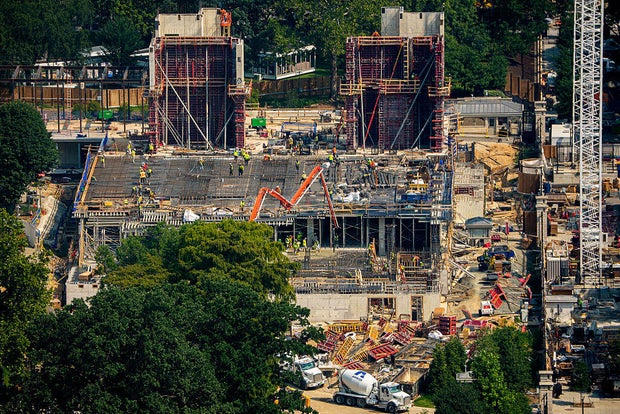
Construction continues on the East Wing ballroom at the White House on Aug. 10, 2026, in Washington, D.C.
Construction on the East Wing ballroom at the White House on Aug. 10, 2026, in Washington, D.C.

Andrew Harnik / Getty Images

Reacting to the appeals court’s decision, Mr. Trump wrote in a post on Truth Social that the administration “will be immediately appealing to the United States Supreme Court” and called the ruling “horrendous, politically motivated, and unlawful.” 

“This unjust decision must be overturned by the Supreme Court in its entirety,” the president wrote.

Mr. Trump has claimed to have raised the $400 million he says is necessary for construction from private donors and major corporations like Lockheed Martin, Amazon and Microsoft, many of which have business before the government. 

The funds were collected by a nonprofit organization, handed off to the National Park Service and then deposited into an account controlled by the president that is normally used for minor White House repairs and maintenance, according to court records. 

U.S. District Judge Richard Leon, the judge who oversaw the initial lawsuit, called the payment mechanism a “Rube Goldberg” machine, referring to the cartoonist and inventor who made complex contraptions to perform simple tasks.

While the legal challenge has played out, construction on the presidential bunker underneath the proposed ballroom has been permitted to continue, and the panel of appellate judges allowed work to continue as they decided the case. Had the White House not appealed the ruling, the construction would have been forced to stop unless Congress approved a proper funding mechanism. 

Luigi Mangione pleads guilty in federal case, admits shooting Brian Thompson

▶ Watch Video: Luigi Mangione pleads guilty to federal charges in killing of Brian Thompson Luigi Mangione entered a guilty plea in his federal case at a court appearance in Manhattan Friday morning, admitting to the judge that he shot and killed UnitedHealthcare CEO Brian Thompson outside a Midtown hotel in 2024.Mangione, 28, faced both federal and state trials in New York for the deadly shooting. He had previously pleaded not guilty in both cases.Sentencing in the federal case will take place on Dec. 18, with Mangione facing a maximum possible sentence of life in prison.His state trial is currently set to begin in September. Mangione's defense team said they've filed for state charges to be dismissed under New York's double jeopardy law, and the Manhattan DA's office said they're prepared to fight their move for dismissal. What happened in courtThompson's family arrived in the courtroom at around 10:50 a.m. The hearing, which had been set to start at 11 a.m., got started a bit late. The courtroom had filled press personnel as well as about two rows of members of the public. Mangione entered the court at around 11:10 a.m. with his feet shackled and his hands behind his back. He was wearing tan prison clothing with a white T-shirt underneath. Just before 11:15 a.m., Mangione's defense team told the judge Mangione "is prepared to plead guilty to the indictment at this time." The judge asked Mangione if that was correct. "Yes," Mangione told the judge. The judge then asked Mangione a series of questions about his background and use of medications and drugs. The judge then found Mangione to be fully competent to enter the plea. The judge told Mangione that the maximum possible sentence is life in prison followed by supervised release. The judge added that there's no parole in the federal system, although good behavior and other programs can impact how long he will spend in prison. He will be required to serve 85% of the sentence, the judge said. The judge pointed out that there's no plea agreement between the defense and prosecution, and Mangione's defense attorney said that's correct. Mangione's admission in courtMangione then told the court in his own words what he did. He told the court that he had for years endured severe pain for a broken back and had navigated the health insurance system. He told the court he learned about the UnitedHealthcare annual investor conference in New York even though it wasn't publicized, and traveled to it. He told the court he posed as an investor to find out more information about the conference. He told the court he used a 3D printer to make parts of the gun, and traveled to New York with the gun, silencer, and magazine with "the intent to shoot Brian Thompson." He said he shot Thompson in Manhattan knowing it would place him in fear of death or serious bodily injury. Prosecutors then spoke in court, reviewing the evidence against Mangione. They pointed to video capturing the shooting, as well as Mangione fleeing the scene on the bicycle, his arrest in Altoona, Pennsylvania, the recovered pistol and shell casings, as well as DNA found at the crime scene. Prosecutors said entries in Mangione's notebook expressed his desire to kill a health care executive. "Mr. Mangione, how do you now plead to counts one and two of the indictment," the judge asked. "Guilty," Mangione said. "I will accept your guilty plea," the judge said. About the chargesMangione initially faced four federal charges in Thompson's killing. Two of those charges against him, one of which brought the possibility of the death penalty — murder through use of a firearm and an additional firearms charge — were dismissed earlier this year, and federal prosecutors said they would not appeal that decision.That left federal stalking charges against him, which brought the possibility of life in prison without the possibility of parole.Jury selection in the federal case had been set to begin in January. Speculation about a possible plea deal had been rampant since Tuesday, when prosecutors and Mangione's defense team sent a letter to the court requesting a Friday conference regarding the federal case.Luigi Mangione's state trial and double jeopardy concernsMangione's attorney Karen Friedman Agnifilo spoke after Mangione entered his guilty plea to federal charges. "Despite this being a single isolated event, Mr. Mangione has been unfairly treated since the outset in every way, and has successfully fought off terrorism charges and the death penalty, while also fighting at the same time two simultaneous prosecutions in two jurisdictions who are trying to punish him twice for the exact conduct," Agnifilo said. "New York law does not permit a person to be prosecuted and punished twice for the exact same crime under a statute that covers successive prosecutions, it's also known as the double jeopardy law."Today's guilty plea triggers this statute, and we just filed our motion in state court explaining why the state charges must be dismissed under New York's double jeopardy protections," Agnifilo said. Manhattan District Attorney Alvin Bragg's office released a statement after the guilty plea saying they're going to fight to keep their prosecution going. "Since December 2024, the Manhattan D.A.'s Office has been tirelessly preparing to pursue a trial conviction in New York State Supreme Court for the alleged cold-blooded murder of Brian Thompson. We are encouraged that Mr. Thompson's family received a measure of accountability today.  While federal sentencing is pending, we are prepared to litigate the defense motions. The Manhattan D.A.'s Office remains committed to seeking justice for Mr. Thompson and his family," a spokesperson for the Manhattan DA's office said. Mangione's state trial is set to begin in September.The state case, in which he faces second-degree murder charges, among others, also carries with it the possibility of life in prison.Double jeopardy refers to a law stating "a person may not be twice prosecuted for the same offense," although there are a number of exceptions. "Luigi Mangione's defense team had made that argument in the state case prior, and this could revive it, because if you actually have a conviction on the federal case, it's a more robust double jeopardy protection in the New York state case. So we could see a motion there that could kick this state case back," CBS News legal contributor Caroline Polisi said on "CBS Mornings" Thursday. Legal expert Rich Schoenstein, however, said he thinks the double jeopardy argument is "open and complicated and subject to debate." Schoenstein said that's because the federal charges Mangione is pleading guilty to are related to interstate matters and stalking, which are quite different than the second-degree murder, weapons and forged instrument charges he's facing on a state level. "So the weapons and forged instrument charges would not be resolved by the federal plea, and arguably the intentional killing charge would not be resolved. I do think there's a serious question as to whether this would be double jeopardy," Schoenstein said.The plea deal, however, may "put some pressure" on New York prosecutors to reach a deal too, "and therefore it could resolve the case on a negotiated level." Thompson family reactsThe family of Brian Thompson released a statement following the guilty plea. "Today's guilty plea marks an important step toward justice for Brian and for our family. While nothing will ease the pain of losing him, we are grateful that the federal justice system has held the person responsible for this heinous act accountable. Now we look to the court to ensure that sentencing reflects the severity of this crime. We remain mindful that additional proceedings in New York and Pennsylvania are still to come, and we will continue to seek the justice Brian deserves." Evidence in the Luigi Mangione caseKey evidence seized during Mangione's Pennsylvania arrest had been expected to be admitted in the federal trial, including a 3D-printed handgun, loaded magazine, a notebook and more.Thompson, 50, was killed on Dec. 4, 2024, as he arrived at a hotel for UnitedHealth Group's annual investor conference. The killing  of the husband and father of two was caught on surveillance video, which showed Thompson being shot in the back as he walked down the street. Police say the words "delay," "deny" and "depose" were written on the ammunition, echoing a phrase used to describe how insurers avoid paying claims.Thompson's killing set off a frantic multistate manhunt that ended with Mangione's arrest at a McDonald's in Altoona, Pennsylvania, five days later.This is a developing story. Check back soon for more information. 
Read Next Story