
Spain to put containment fence around Ceuta after migrants rush border

▶ Watch Video: Why did a wave of migrants cross from Morocco into Spain’s Ceuta territory?

Spain said Saturday it will install a 1,600-foot containment fence on the aquatic border between the tiny territory of Ceuta and neighboring Morocco after tens of thousands of migrants breached the enclave earlier this week. At least 67 people died in the border rush, Spain’s Minister of the Interior said, including some who drowned and others killed in a stampede. 

Between 50,000 and 60,000 people crossed into Ceuta since Thursday morning. But Spanish Interior Minister Fernando Grande-Marlaska told reporters on Saturday that most of the migrants who arrived in Ceuta have already been sent back to Morocco.

“Almost all of them have already left Ceuta,” the minister said when asked about the tens of thousands of migrants who had crossed into the enclave. “The situation has been almost entirely reversed.”

Most who tried to cross the border are Moroccans. Seawalls and fences separate Morocco from Ceuta, a Spanish enclave that sits on Morocco’s Mediterranean coast. Ceuta and Melilla, another Spanish enclave farther east, have the only land borders the European Union shares with Africa. 
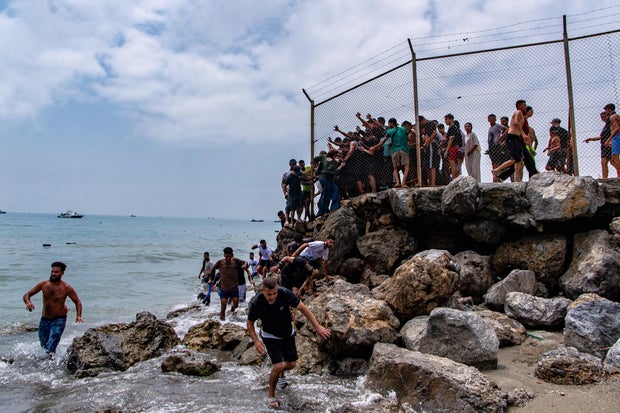
APTOPIX Spain Ceuta
Migrants go around a fence and cross from Morocco into the Spanish enclave of Ceuta, Thursday, July 30, 2026.

Antonio Sempere/AP Photo

Local officials have blamed the sharp increase in crossings on a recent Spanish Supreme Court ruling, which makes it harder to turn away migrants arriving from Morocco by sea. Vivas called the ongoing situation “absolutely unsustainable.” He also criticized the government’s response, saying that “action was taken too late and insufficiently.” 

Prime Minister Pedro Sánchez said in a Friday news conference that “all of Spain stands” with Ceuta, and called the increase in migrants “an attack” and “a violation of Spain’s territorial integrity.” He was expected to visit the city Friday. 

“Ceuta is a Spanish city, and what happened yesterday deserves our full reproach, our condemnation at the strongest possible level of rejection, condemnation and consideration as deplorable,” he said.

Some people who spoke to CBS News described rushing and overwhelming Moroccan police who tried to stop them. Videos and images from Ceuta showed crowds of people, mainly Moroccans, walking around the breakwaters at an urban beach near a border checkpoint with Morocco onto local roads. The majority looked to be young men, though there were also families with women and children.

Spain Ceuta
Spanish army soldiers block access to the beach for people crossing from Morocco into the Spanish enclave of Ceuta, Friday, July 31, 2026. 

Antonio Sempere/AP photo

Local workers association leader Rachid Sbihi called the situation a “serious humanitarian crisis.” He said thousands of migrants, including unaccompanied children, slept in parks and on sidewalks. 

“It’s chaotic,” said Sbihi, whose union represents Spanish Civil Guard officers, adding that some of the deceased had been trampled trying to cross a breakwater fence.

Sánchez said he asked that buoys be deployed to create a “physical barrier,” and said troop numbers have been increased. Spain’s government has also deployed its army and sent extra forces, including diver teams and Maritime Service vessels, to Ceuta. 

Sánchez said the Legislature is finalizing a system to “facilitate the repatriation of migrants who entered our country irregularly.” He said if necessary, the government may “modify certain aspects of the laws to guarantee those border repatriations as efficiently as possible.” He added that Morocco’s government is cooperating with Spain’s. 

Sánchez accused “human trafficking mafias” of exploiting the Spanish Supreme Court’s ruling. 
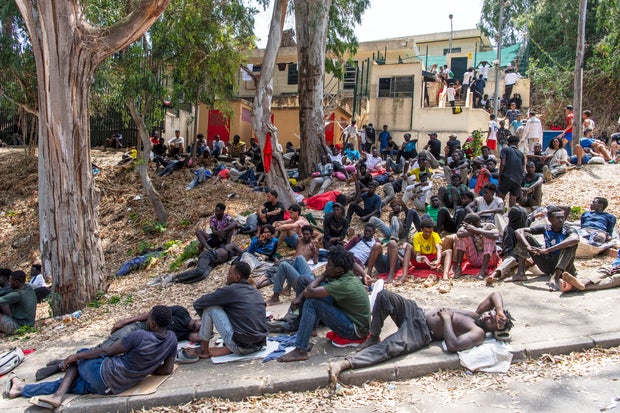
APTOPIX Spain Ceuta
Migrants rest outside the Temporary Center for Immigrants after crossing from Morocco into the Spanish enclave of Ceuta, Friday, July 31, 2026. 

Antonio Sempere/AP photo

“This demands one of the strongest condemnations, particularly of the human trafficking mafias that deceive many young people, many of whom find death, whether in the ocean or at this border,” he said. 

Why are Moroccans fleeing to Ceuta? 

Some Moroccan migrants told CBS News they saw social media posts stating, “Spain is an open door,” along with videos of people swimming from Morocco to Ceuta. One young man said the posts referenced the recent Spanish Supreme Court ruling.

The average demographic appeared to be young Moroccan men ages 14 to 25. Most said they were there for better jobs or money. One told CBS News he hoped to play soccer in Europe. Another said he wanted to see what Europe was like for the day, but understood why he now had to return to Morocco. 

The people who spoke to CBS News did not have premeditated plans to come to Spain, but instead made the spontaneous decision to swim when they saw others doing it. 

While Sánchez and others have linked the border crossings to the Supreme Court ruling, it was not immediately clear if that was specifically what prompted so many people to flock to Ceuta in recent days.

Moroccan resident Fatima Zahra told the AFP news agency that she joined the crowd attempting to enter Ceuta after hearing about others who had crossed the border successfully. She said she wanted to go to Europe because she works “under appalling conditions” in Morocco. Zahra was ultimately turned away at the Moroccan border town of Fnideq and did not enter Ceuta.  

“I was in Tangier, where I was working. I woke up in the morning and heard that Ceuta had opened,” Zahra told AFP. “At that point, I told the people with me, ‘Let’s go there for work… let’s try our luck too.'” 

Ceuta is often seen as a destination for those trying to reach Spain from Africa, but crossing the border from Morocco into Ceuta does not immediately grant migrants free movement across Europe. 
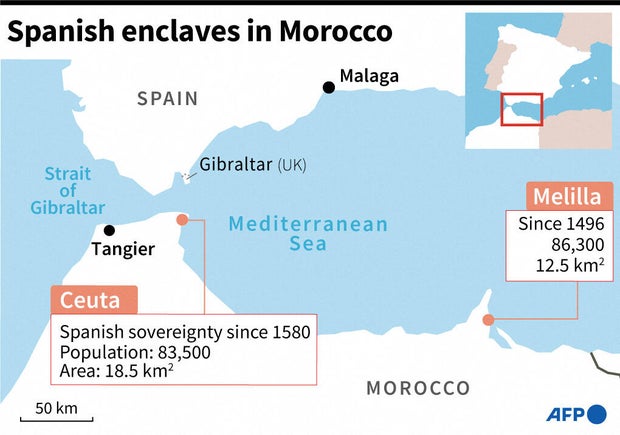
Map shows locations of the Spanish enclaves of Ceuta and Mellila in Morocco
Map shows locations of the Spanish enclaves of Ceuta and Melilla in Morocco. 

AFP via Getty Images

To cross the channel separating northern Africa and mainland Europe, migrants would have to pass additional border controls. Ceuta’s isolation from mainland Europe, with limited transportation to the rest of the EU, also makes such travel unlikely. 

Both Ceuta and Melilla are heavily fortified, and many migrants who arrive in the enclaves are immediately turned back. Others are held in migrant shelters until they are processed, at which point they can apply for asylum in Spain. 

Migrant arrivals to the two enclaves are generally much lower than in other Spanish areas, like the Canary and Balearic Islands. 

Ceuta is home to both Spanish and Moroccan residents and day workers. Morocco does not officially recognize Ceuta and Melilla as Spanish territory, and often refers to them as occupied lands. 

This is not the first time Ceuta has seen a sudden influx of Moroccan migrants. In 2021, Moroccan authorities relaxed border enforcement amid a diplomatic dispute with Spain, allowing 6,000 migrants to enter Ceuta in a single day

Morocco’s ambassador to Spain said the current situation had unfolded against the Moroccan government’s wishes. “We have always prioritized legal, orderly and safe migration for all,” Karima Benyaich said.

What were the dynamics between the military and the migrants?

CBS News witnessed local police making arrests of people trying to run away from the border, but the dynamic between police and migrants appeared more playful than hostile.

Throughout the day, teenagers would dash onto the beach, dodging officers before diving back into the water.

However, deeper inside the city of Ceuta, some migrants attempted to open the doors of locked shops and searched for places to get food, water and shelter. One woman described to CBS News people jumping on her parents’ house and stealing clothes that were hanging outside.

The Spanish military and local police presence was still large late Friday night, with authorities present on most residential streets in the city. 

European Union leaders react

The crossings drew quick condemnation from conservative leaders across Europe. 

Italian Prime Minister Giorgia Meloni called on the European Union to suspend the Schengen agreement, which allows freedom of movement within member states.

Meloni said her nation was prepared to “intervene with extraordinary measures to defend the borders and safety of citizens.” 

Finland’s minister of the interior, Mari Rantanen, said: “All European countries must support Meloni’s proposal.” 

European Commission President Ursula von der Leyen said the “images coming from Ceuta are unacceptable,” and said that officials “cannot allow anyone to come to our Union without abiding by our rules.” 

French Interior Minister Laurent Nunez said that he had given instructions to “immediately strengthen” controls at the border the nation shares with Spain. 

Trump gets a much-needed South Carolina win and other takeaways from Tuesday’s elections

(CNN) — President Donald Trump demonstrated his might with Republican primary voters Tuesday in South Carolina, as CNN’s Decision Desk projected that Darline Graham — the sister of the late Sen. Lindsey Graham and the president’s pick in the state’s special Senate primary runoff — will claim the GOP nomination.Now favored to win a full term in November, Darline Graham is, in many ways, a senator of Trump’s own making. The president lobbied South Carolina’s governor to appoint her to fill the remaining months in her brother’s term after he died in July. Then, he privately and publicly pressed her to run for a full six-year term.And when it looked like her rival in the runoff, Rep. Ralph Norman, might win, Trump visited Myrtle Beach to rally Republican loyalists to Graham’s cause, as his super PAC, MAGA Inc., disclosed spending more than $827,000 to support Graham.Graham’s win is narrow — she led by just a few percentage points Tuesday evening — but symbolically significant for the president in a month full of political setbacks, with six of his endorsed picks losing Republican primaries.Trump’s preferred candidate in the Oklahoma governor’s race, former state Sen. Mike Mazzei, meanwhile, was locked in a close Republican primary runoff against state Attorney General Gentner Drummond as ballots were being counted Tuesday night.And in a low-turnout special election runoff in Georgia, Democrats filled a vacancy in the narrowly divided House.Here are takeaways from Tuesday’s elections in South Carolina, Oklahoma and Georgia:A badly needed win for TrumpDarline Graham took to the stage at her victory party Tuesday night and declared: “South Carolina is truly Trump country.”Unlike her brother, who was close to the late Sen. John McCain and built a reputation as a foreign policy hawk independent from Trump, Darline Graham’s political profile was tied entirely to the president.“Our victory would not have been possible without you, and we are truly grateful,” she said in a message directed at Trump.For Trump, the win was badly needed — a victory in one of his highest-risk interventions in Republican primaries this year, after a string of several losses this month and with midterm elections just over two months away. It could serve to remind Republican lawmakers who might be looking to distance themselves from an unpopular president of the potential political costs of being at odds with Trump.Norman acknowledged Trump’s role in the race’s outcome, telling his supporters Tuesday night that “the president got involved. He has that right.”“I never understood why he got in this race,” Norman said as some members of the crowd booed the president. “But it is what it is, and I’ll accept it.”Graham is now set to face Democratic nominee Annie Andrews, a pediatrician, in November. Andrews on Tuesday challenged Graham to at least three televised debates, saying in a statement that “no appointment, endorsement, or family connection entitles anyone to six years” in the Senate. Still, Graham is heavily favored to win the deep-red state in the general election.A senator of Trump’s makingTrump has endorsed a slew of candidates this year, but rarely has he put his own political capital on the line like he did in South Carolina.When Trump initially talked up Darline Graham to fill the seat of her late brother, and Gov. Henry McMaster complied, it seemed like a short-term gig. The seat was already on the ballot for a full six-year term in November, so she’d have been a placeholder for a few months, until South Carolina voters nominated and elected one of the state’s myriad experienced Republicans who had been waiting decades for a Senate vacancy.But Trump doubled down three days after she was sworn in, urging her on social media to seek a full term. And, days later, she announced she would do so.The president’s “complete and total endorsement” wasn’t enough to clear the field. After all, Darline Graham had no political experience, and her brother wasn’t exactly beloved among conservative voters in South Carolina: He’d earned just 57% of the vote in his primary two months earlier against a handful of relative unknowns.The results of the August 11 primary suggested she could be defeated in the runoff. She finished first, but with just shy of 33% of the vote.There were reasons to believe Trump’s influence might be limited. After all, his choice in South Carolina’s GOP primary for governor, Lt. Gov. Pam Evette, lost to state Attorney General Alan Wilson — who Trump also endorsed at the last minute when it was clear his preference was on course for defeat.The president did not have the luxury of the same face-saving tack here: Norman had endorsed and campaigned with former Gov. Nikki Haley as she ran against Trump for the 2024 GOP presidential nomination.Graham’s inexperience was on display during a debate with Norman earlier this month, when she declined to answer a question about Taiwan and the South China Sea, saying that national security was “not my thing.”But Trump carried Graham over the finish line. He visited South Carolina on Friday, telling Republicans that he’d personally lobbied her to run for a full term. “Pretend, please, that I’m on the ballot,” he urged GOP voters.Another endorsement test in OklahomaAnother Trump-endorsed candidate, Mazzei, was locked in a tight race Tuesday night against Drummond in the hard-fought runoff for the Republican nomination for governor.The two are vying to take on Oklahoma House Minority Leader Cyndi Munson, the Democratic nominee, in the race to replace term-limited Republican Gov. Kevin Stitt in November.The race was another test of Trump’s influence — and there were significant questions over whether his endorsement would be enough for Mazzei, after Trump’s picks in Republican gubernatorial primaries in Georgia, Iowa and Minnesota all lost earlier this year.A key divide in the primary was a proposed $4 billion aluminum smelter at the Tulsa Port of Inola, estimated to bring about 1,000 jobs to the area. Trump touted the plant, claiming on Truth Social that it “will be one of the best projects ever conceived or built, not only in the Great State of Oklahoma, but in the United States, itself.” But, amid local concerns about pollution and damage to the livestock economy, Drummond has sued, asking a federal court to block the plant’s construction.Georgia Dems fill a House seatCNN projects that Democrat Everton Blair, a former Gwinnett County School Board chair, will win the special election for Georgia’s 13th District House seat vacated by the late Rep. David Scott’s death in April.But he won’t hold that seat for long.Blair, who will be the first out gay member of Congress from Georgia, defeated the longtime lawmaker’s daughter Marcye Scott in the special election runoff on Tuesday. He campaigned on a pledge to be a stronger opponent to Trump and advocate for a more progressive affordability agenda than both the late congressman and his daughter.However, Blair finished a distant third in the regular House primary earlier this year, so he won’t be on the ballot in November.State lawmaker Jasmine Clark is the Democratic nominee for a full two-year term in the deep-blue district in November. She did not run in the special election because under state law, she would have had to resign her seat in the Georgia House — costing Democrats a seat just as Republican Gov. Brian Kemp was launching an unsuccessful push for mid-decade redistricting.In the meantime, Blair’s win, and the special election of state Sen. Aisha Wahab in California last week, will help Democrats further narrow the already razor-thin GOP majority in the House.CNN’s Katie Doran and Adam Cancryn contributed to this report.The-CNN-Wire™ & © 2026 Cable News Network, Inc., a Warner Bros. Discovery Company. All rights reserved.
Read Next Story