
SpaceX rocket booster slams into moon, creating crater that could be 16 feet deep

▶ Watch Video: SpaceX rocket booster crashes into the moon

A wayward 8,800-pound SpaceX Falcon 9 rocket booster slammed into the moon very early Wednesday in a rare case of a man-made collision with the lunar surface, scientists confirmed.

The rocket, which was about 45 feet long and 12 feet wide, crashed with a force of nearly 3 tons of TNT, slamming into the lunar surface at 5,400 miles per hour. The crater it created could be 100 feet wide and 16 feet deep.

“There’s only so many times where events like this will occur, and it gives us a chance to understand how the atmosphere of the moon works,” said Carl Schmidt, a planetary scientist at Boston University’s Center for Space Physics. “It’s happened twice in my lifetime.”

Schmidt told CBS News a plume of sodium and lithium gas was observed by the Very Large Telescope in Chile using spectroscopy, indicating the collision had occurred. Schmidt said another scientist detected a sodium emission from his observation site in Sudbury, Massachusetts. 

The upper part of the rocket, which boosted two lunar landers into space in January last year, disengaged as the two spacecraft went on their way. Firefly’s Blue Ghost-1 ultimately made a successful landing on the moon, while Japan’s ispace Hakuto-R crash-landed on the surface. The upper stage, meanwhile, kept drifting, all the way to the moon’s Earth-facing side.

Julianna Scheiman, SpaceX’s director of NASA Science and Dragon Programs, said in a news conference Monday the company followed “the appropriate rules and regulations” for properly disposing of the Falcon 9 second stage after launching it last year, but “what has happened is essentially a mixture of solar activity and gravity forces have put it on a path towards the moon.”

According to NASA, independent astronomers first identified the booster’s trajectory using publicly available data, and its Center for Near Earth Object Studies at the Jet Propulsion Laboratory in Southern California later confirmed the second stage had “a 100% chance of impacting the Moon.”

Details on the impact, which was very quick, are not yet clear. The impact had been expected to occur near the moon’s Einstein and Bell craters and was not expected to pose any danger to Earth, NASA said.  

The impact was impossible to see with the naked eye. Even observers with very large telescopes had not been expected to be able to see anything, according to a study about the collision released by almost two dozen scientists.  
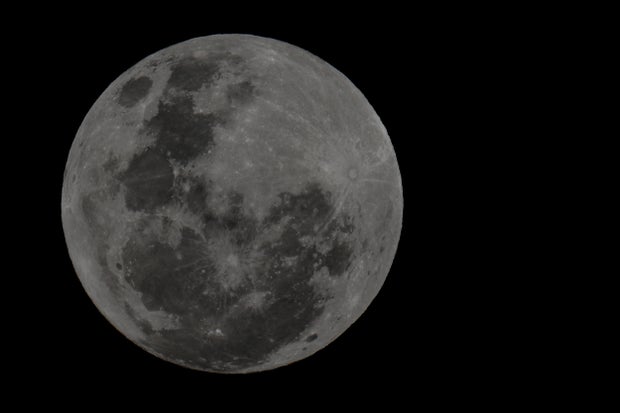
Full Moon
The full moon is seen over Sydney, Australia, on July 29, 2026.

Izhar Khan/Getty Images

It was expected to be challenging or impossible to detect the impact flash because the impact was to happen on the lit side of the moon, according to the study. To date, no natural or artificial impact flash has ever been observed on the lit side of the moon, researchers say.

Before-and-after photos were to be taken by the Lunar Reconnaissance Orbiter — a small satellite that orbits the moon — but it will likely take a week or two before they are seen, NASA confirmed. The space agency said its scientists “plan to collect lunar data from the event and refine techniques for tracking objects in space.”

“As a scientist, I also am very excited to see the observation,” Scheiman told reporters.

The moon is regularly pelted by objects, but they are usually natural occurrences, like meteoroids. The number of artificial impacts is relatively few.

This object was significantly more massive than most natural lunar impactors, but was also moving much more slowly, the study said.

“For comparison, a meteoroid with the same energy as the upper stage hits the Moon about every six days, so the lunar surface is constantly absorbing impacts with the same force,” NASA said. “Despite the disturbance, observing impacts gives scientists valuable insight by revealing how ejecta plumes behave, helping to understand the Moon’s geology and refine models that guide future exploration and science missions.”

The first man-made object to hit the moon was an intentional collision launched by the Soviet Union in 1959. A couple of U.S.-built spacecraft parts hit the moon during the Apollo missions from 1969 to 1972. A Japanese robotic probe hit the moon in 1993 and a European Space Agency satellite collided with the lunar surface in 2006.

In 2009, NASA intentionally crashed the upper stage of a rocket into a permanently shadowed crater at the moon’s south pole to determine if water ice existed there. The impact exposed a plume of material that might not have seen direct sunlight for billions of years. The mission confirmed the presence of water ice at the lunar south pole, one of the major reasons why countries like the United States and China want to build moon bases there.

Like that collision in 2009, in the minutes following the impact of the SpaceX rocket, a cloud of lunar dust and possibly gas/vapor was expected to be lofted above the surface. 

Schmidt, the Boston University scientist, told CBS News he hopes analyzing that data will enable him to determine how much water ice was hidden below the surface on that part of the moon.

Trump gets a much-needed South Carolina win and other takeaways from Tuesday’s elections

(CNN) — President Donald Trump demonstrated his might with Republican primary voters Tuesday in South Carolina, as CNN’s Decision Desk projected that Darline Graham — the sister of the late Sen. Lindsey Graham and the president’s pick in the state’s special Senate primary runoff — will claim the GOP nomination.Now favored to win a full term in November, Darline Graham is, in many ways, a senator of Trump’s own making. The president lobbied South Carolina’s governor to appoint her to fill the remaining months in her brother’s term after he died in July. Then, he privately and publicly pressed her to run for a full six-year term.And when it looked like her rival in the runoff, Rep. Ralph Norman, might win, Trump visited Myrtle Beach to rally Republican loyalists to Graham’s cause, as his super PAC, MAGA Inc., disclosed spending more than $827,000 to support Graham.Graham’s win is narrow — she led by just a few percentage points Tuesday evening — but symbolically significant for the president in a month full of political setbacks, with six of his endorsed picks losing Republican primaries.Trump’s preferred candidate in the Oklahoma governor’s race, former state Sen. Mike Mazzei, meanwhile, was locked in a close Republican primary runoff against state Attorney General Gentner Drummond as ballots were being counted Tuesday night.And in a low-turnout special election runoff in Georgia, Democrats filled a vacancy in the narrowly divided House.Here are takeaways from Tuesday’s elections in South Carolina, Oklahoma and Georgia:A badly needed win for TrumpDarline Graham took to the stage at her victory party Tuesday night and declared: “South Carolina is truly Trump country.”Unlike her brother, who was close to the late Sen. John McCain and built a reputation as a foreign policy hawk independent from Trump, Darline Graham’s political profile was tied entirely to the president.“Our victory would not have been possible without you, and we are truly grateful,” she said in a message directed at Trump.For Trump, the win was badly needed — a victory in one of his highest-risk interventions in Republican primaries this year, after a string of several losses this month and with midterm elections just over two months away. It could serve to remind Republican lawmakers who might be looking to distance themselves from an unpopular president of the potential political costs of being at odds with Trump.Norman acknowledged Trump’s role in the race’s outcome, telling his supporters Tuesday night that “the president got involved. He has that right.”“I never understood why he got in this race,” Norman said as some members of the crowd booed the president. “But it is what it is, and I’ll accept it.”Graham is now set to face Democratic nominee Annie Andrews, a pediatrician, in November. Andrews on Tuesday challenged Graham to at least three televised debates, saying in a statement that “no appointment, endorsement, or family connection entitles anyone to six years” in the Senate. Still, Graham is heavily favored to win the deep-red state in the general election.A senator of Trump’s makingTrump has endorsed a slew of candidates this year, but rarely has he put his own political capital on the line like he did in South Carolina.When Trump initially talked up Darline Graham to fill the seat of her late brother, and Gov. Henry McMaster complied, it seemed like a short-term gig. The seat was already on the ballot for a full six-year term in November, so she’d have been a placeholder for a few months, until South Carolina voters nominated and elected one of the state’s myriad experienced Republicans who had been waiting decades for a Senate vacancy.But Trump doubled down three days after she was sworn in, urging her on social media to seek a full term. And, days later, she announced she would do so.The president’s “complete and total endorsement” wasn’t enough to clear the field. After all, Darline Graham had no political experience, and her brother wasn’t exactly beloved among conservative voters in South Carolina: He’d earned just 57% of the vote in his primary two months earlier against a handful of relative unknowns.The results of the August 11 primary suggested she could be defeated in the runoff. She finished first, but with just shy of 33% of the vote.There were reasons to believe Trump’s influence might be limited. After all, his choice in South Carolina’s GOP primary for governor, Lt. Gov. Pam Evette, lost to state Attorney General Alan Wilson — who Trump also endorsed at the last minute when it was clear his preference was on course for defeat.The president did not have the luxury of the same face-saving tack here: Norman had endorsed and campaigned with former Gov. Nikki Haley as she ran against Trump for the 2024 GOP presidential nomination.Graham’s inexperience was on display during a debate with Norman earlier this month, when she declined to answer a question about Taiwan and the South China Sea, saying that national security was “not my thing.”But Trump carried Graham over the finish line. He visited South Carolina on Friday, telling Republicans that he’d personally lobbied her to run for a full term. “Pretend, please, that I’m on the ballot,” he urged GOP voters.Another endorsement test in OklahomaAnother Trump-endorsed candidate, Mazzei, was locked in a tight race Tuesday night against Drummond in the hard-fought runoff for the Republican nomination for governor.The two are vying to take on Oklahoma House Minority Leader Cyndi Munson, the Democratic nominee, in the race to replace term-limited Republican Gov. Kevin Stitt in November.The race was another test of Trump’s influence — and there were significant questions over whether his endorsement would be enough for Mazzei, after Trump’s picks in Republican gubernatorial primaries in Georgia, Iowa and Minnesota all lost earlier this year.A key divide in the primary was a proposed $4 billion aluminum smelter at the Tulsa Port of Inola, estimated to bring about 1,000 jobs to the area. Trump touted the plant, claiming on Truth Social that it “will be one of the best projects ever conceived or built, not only in the Great State of Oklahoma, but in the United States, itself.” But, amid local concerns about pollution and damage to the livestock economy, Drummond has sued, asking a federal court to block the plant’s construction.Georgia Dems fill a House seatCNN projects that Democrat Everton Blair, a former Gwinnett County School Board chair, will win the special election for Georgia’s 13th District House seat vacated by the late Rep. David Scott’s death in April.But he won’t hold that seat for long.Blair, who will be the first out gay member of Congress from Georgia, defeated the longtime lawmaker’s daughter Marcye Scott in the special election runoff on Tuesday. He campaigned on a pledge to be a stronger opponent to Trump and advocate for a more progressive affordability agenda than both the late congressman and his daughter.However, Blair finished a distant third in the regular House primary earlier this year, so he won’t be on the ballot in November.State lawmaker Jasmine Clark is the Democratic nominee for a full two-year term in the deep-blue district in November. She did not run in the special election because under state law, she would have had to resign her seat in the Georgia House — costing Democrats a seat just as Republican Gov. Brian Kemp was launching an unsuccessful push for mid-decade redistricting.In the meantime, Blair’s win, and the special election of state Sen. Aisha Wahab in California last week, will help Democrats further narrow the already razor-thin GOP majority in the House.CNN’s Katie Doran and Adam Cancryn contributed to this report.The-CNN-Wire™ & © 2026 Cable News Network, Inc., a Warner Bros. Discovery Company. All rights reserved.
Read Next Story