
Rescuers race to find Colombia earthquake survivors as death toll rises

▶ Watch Video: Search for survivors after powerful earthquake in Colombia

Rescue workers and volunteers rushed to clear rubble as they searched for survivors in Colombia early Tuesday after the country was struck by its strongest earthquake on record.

At least 169 people died and more than 600 were injured in the earthquake, according to a tally released Tuesday by the Association of Mayors.  

By Monday night, more than 2,700 people had been reported missing. Many families posted information about loved ones online, hoping for information about their fate.

The 7.4-magnitude quake struck cities across Colombia’s western region shortly after 7:30 a.m. local time Monday, sending panicked residents onto the streets.
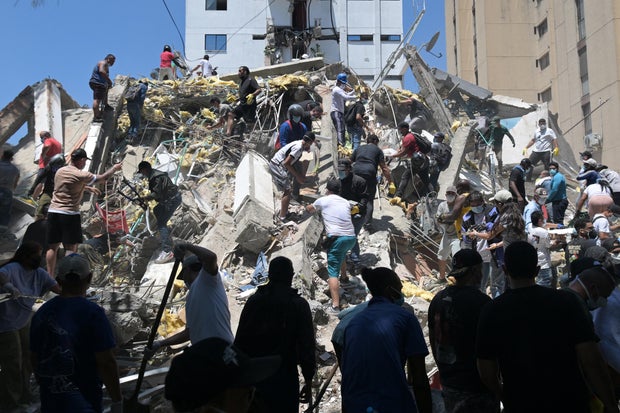
TOPSHOT-COLOMBIA-EARTHQUAKE
People look for survivors amid the rubble of a collapsed building after an earthquake in Cali, Colombia, on Aug. 10, 2026.

Joaquín SARMIENTO /AFP via Getty Images

The city of Pereira, one of the hardest hit, was plunged into darkness Monday evening as volunteers combed through the remains of collapsed buildings searching for survivors.

“We’re without power. This seems honestly like a zombie city,” resident Juan David Gaitan told French news agency AFP.

At the airport in Pereira, videos showed pieces of ceiling falling down on travelers taking shelter and screaming, and people running through rubble in a panic. 

The country’s president, Abelardo de la Espriella, who had been on the job for only three days, declared a state of emergency and vowed a concerted rescue effort.
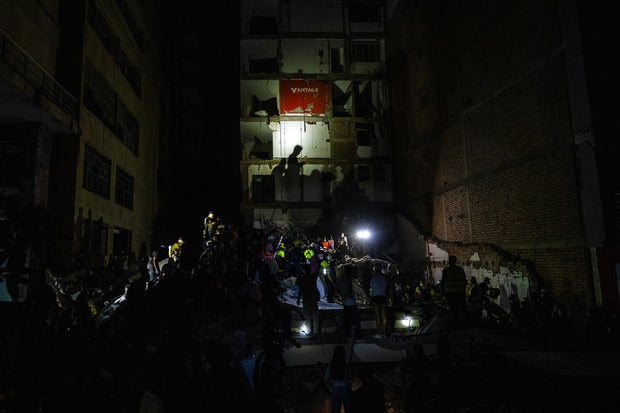
TOPSHOT-COLOMBIA-EARTHQUAKE
Rescuers are joined by local residents to clear the rubble while searching for survivors at a collapsed building after an earthquake in Pereira, Colombia, on Aug. 10, 2026.

Luis ACOSTA/AFP via Getty Images

Around 1,600 buildings across the country were reported damaged or collapsed, with rescue workers and volunteers seen clearing rubble by hand in some places. The mayors association said 165 structures collapsed.

The Vatican said Tuesday that Pope Leo XIV is “deeply saddened” by the earthquake.

“The Holy Father, deeply saddened to learn the painful news of the earthquake that has seriously affected several areas of Colombia … offers prayers for the eternal rest of the deceased and raises his prayers to the Lord for the prompt recovery of those affected by this tragedy,” the Vatican’s secretary of state, Pietro Parolin, wrote in a note to the archbishop of Cartagena, Francisco Javier Munera Correa. 

Dana Carolina Zamora posted an image of her missing 60-year-old uncle, Miguel Ángel Zamora, cradling his dog. The farmer was living in a rural area of El Cairo, not far from the quake’s epicenter in San Jose Del Palmar.

“We are afraid. We hope that is not the case, that he is all right and that it is only a communication failure. But we haven’t heard anything from him,” Zamora said.

De la Espriella announced Monday night that he had mobilized “the entire military and police apparatus” to respond to the temblor.
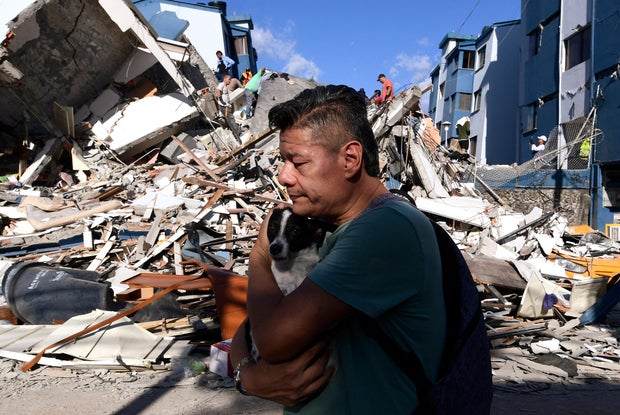
TOPSHOT-COLOMBIA-EARTHQUAKE
A man carries a dog as he walks past the rubble of a collapsed building after an earthquake in Pereira, Colombia on Aug. 10, 2026.

Jaime SALDARRIAGA /AFP via Getty Images

U.S. Secretary of State Marco Rubio said in a social media post on Monday that the Trump administration was closely monitoring the earthquake response and “stands ready to support the people of Colombia.”

South Florida organizations are among U.S.-based humanitarian groups mobilizing to send aid to Colombia. 

“There’s a lot of damage, and we are waiting for information as to what the needs are. The first is rescue and recovery,” Fabio Andrade, a Weston city commissioner and a Colombian American, told CBS News Miami.

A tropical depression could soon form in the Atlantic — but can it survive El Niño’s hostile conditions?

(CNN) — El Niño has been hitting the snooze button on Atlantic hurricane season for weeks, largely preventing the basin from waking up and churning up storms, but at least one potential tropical troublemaker has a chance to shake the season out of its slumber.The National Hurricane Center is outlooking an area in the tropical Atlantic that has about a 70% or “high” chance of becoming at least a tropical depression late this week. There’s also another area in the northern Atlantic that has a much lower chance to develop, and only in the next day or two.The next tropical storm that forms anywhere in the basin will be named Cristobal.🌤️ Get your local forecast in the CNN Weather appMid-August is typically when the tropics enters its busiest stretch, but any upcoming contenders for tropical development are going to be fighting an uphill battle to form and stay alive against El Niño’s influence.Toe-to-toe with El NiñoThe main challenge these systems face is El Niño’s abundant storm-killing wind shear. It’s a force that’s more likely to stick around as El Niño grows into a potentially record-breaking Super El Niño in the coming months.Wind shear is a change in wind speed or direction at different levels in the atmosphere that can prevent storms from forming in the first place, keep them from strengthening or tear them apart completely. It’s now firmly in place over what should be the most active parts of the Atlantic.This is the exact setup that prompted numerous predictions for a below-average season in the first place. Hurricane season has certainly been living up to those expectations so far: It’s been the least active start to the season since 2009.Arthur and Bertha have been the only tropical storms to date. Both came alive right along the Gulf Coast and were battered by wind shear every step of the way, which prevented them from strengthening significantly and limited their impacts overall.Development chancesThe upcoming tropical chances may face a similar story, just in different locations.The area outlooked with the high chance in the eastern Atlantic marks the first time all season a system could actually form somewhere other than near the United States’ coastline.This area of the Atlantic — called the main development region — should be getting very active at this point in a typical season as wind shear relaxes and ocean temperatures soar, providing tropical systems with ample fuel.But thanks to El Niño, that wind shear remains stubbornly in place and has recently become record strong, according to Phil Klotzbach, a hurricane expert with Colorado State University.There could be a window after Wednesday for the potential system with a high chance of development to get enough of a boost of energy to overcome some of the shear.It could become a tropical depression as soon as Thursday as it tracks west across the tropical Atlantic. But it’s unclear how much stronger it could become.Computer forecast models are also still uncertain exactly where the system could track from there. Some take it toward the eastern Caribbean late this weekend, where it would face more wind shear. Others curve the system northeast of the region, where it could eventually escape the worst shear and head toward the open Atlantic if it survives that long.The other potential development area has a slimmer time frame to spin to life before conditions get more hostile around midweek.Season to dateA normal Atlantic hurricane season typically has at least three tropical storms by August 3 and four by August 15. Bertha — the season’s second storm and the last to roam anywhere in the basin — impacted the US Gulf Coast in late July.The season is also behind on hurricanes: The first hurricane of the season typically forms around August 11. Hurricane Erin formed just a few days after that threshold in 2025 and 2024 had already seen two hurricanes by that point.Mid-August to mid-October is when most tropical storms and hurricanes form, so there’s still plenty of time for tropical systems to make an attempt. However, multiple groups including the National Oceanic and Atmospheric Administration and Colorado State University are growing increasingly confident in their forecasts for a muted season overall.NOAA released a forecast update last week that upped their chances of a below-average season from 55% to 75%. That forecast also notably dropped its range for the overall number of major hurricanes — Category 3 or greater — from one to three to zero to two.If the 2026 season ends without a major hurricane, it would be the first time without such a powerful storm since 2013.The-CNN-Wire™ & © 2026 Cable News Network, Inc., a Warner Bros. Discovery Company. All rights reserved.
Read Next Story