It was a grisly scene when police arrived at a Minneapolis apartment complex on June 13, 1993, to investigate the murder of 35-year-old Jeanie Childs. Her body was found partially under her bed, her bedroom was in disarray, and there was blood spatter across the walls and floor. Childs had been stabbed more than 60 times. As investigators tried to piece together what unfolded, they found a rare clue in the bedroom: bloody, bare footprints.
“That drew my attention right away … I mean, wow,” Bart Epstein, a retired forensic scientist, told “48 Hours” correspondent Erin Moriarty in “The Footprint,” now streaming on Paramount+. “You don’t see this at crime scenes in general, bare feet that have stepped in blood,” said Epstein.

WCCO
Investigators knew the footprints had to belong to Childs’ killer because she was wearing socks at the time of her death. Those footprints had to have been left there after the perpetrator stepped in her wet blood after the murder. Investigators documented and photographed the footprints.
“So the footprints, beyond being something that would tend to show guilt, also was important to show to clear people who might have been under any suspicion,” said retired FBI agent Chris Boeckers, who would later join the investigation.
According to the case file, investigators compared the footprints left at the crime scene to multiple people, including a man named Arthur Gray, whom Childs lived with at the time of her murder. According to police reports, authorities found hairs stuck to Childs’ left hand and one of those hairs matched Gray.
But Boeckers says the case against Gray started to fall apart pretty quickly. “He had a really solid alibi that he was out of town that weekend that was corroborated by others.” Gray, who enjoyed riding motorcycles, told authorities he was in Milwaukee. Forensic scientists also examined Gray’s footprints and determined he did not leave those footprints at the crime scene.

Hennepin County District Court
Days turned into years and then decades without finding the individual who left those footprints. In 2015, forensic scientist Andrea Feia, who was asked to do DNA testing on items collected at the crime scene, determined there was an unknown DNA profile that kept repeating itself. It was found on the comforter, a towel, a washcloth, a T-shirt and on the bathroom sink.
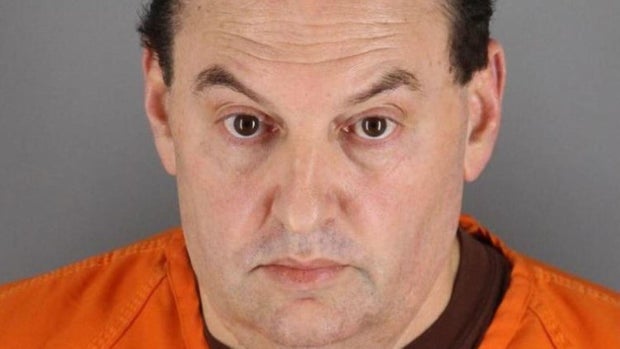
Investigators then turned to investigative genetic genealogy for answers. A forensic genealogist submitted the unknown DNA profile to genealogy websites. “The forensic genealogist indicated she had a match to potentially two brothers here in Minnesota,” Boeckers said. One of those brothers was businessman and hockey dad Jerry Westrom.
Investigators were anxious to confirm that the unknown crime scene DNA was indeed Westrom’s, but to do that, they needed to track him down. In January 2019, investigators followed Westrom to his daughter’s college hockey game in Wisconsin and obtained a napkin and food container he had used after eating at the arena. They took the items to the lab for testing and the results revealed there was a match.
Hennepin County Sheriff’s Office
The following month, in February 2019, Westrom was arrested for the murder of Childs. During his police interview, Westrom denied being at the apartment and knowing Childs. The next day, authorities collected his footprints for comparison.
Although Westrom’s DNA was at the scene, it was important to confirm the footprints belonged to him because there was other male DNA found at Childs’ apartment that did not belong to Westrom.
Mark Ulrick, a supervisor with the Minneapolis Police Forensic Division, examined the footprints. “In Minnesota here, people are not committing crimes a lot of times with the socks and shoes off,” he told “48 Hours.” He says he focused on the friction ridge skin — the arrangement of ridges and furrows — unique to every person. “Friction ridge skin is found on … your fingers, your palms, and the soles of your feet,” Ulrick explained. During his examination, he compared the unknown footprints to Westrom’s prints and to those of alternate suspects.
Westrom’s defense team hired its own forensic scientist, Alicia McCarthy, to verify Ulrick’s work. What would the experts conclude about the footprints?