
Progressive Abdul El-Sayed projected to win Michigan Democratic Senate primary

▶ Watch Video: Abdul El-Sayed beats Haley Stevens in Michigan’s Democratic Senate primary, CBS News projects

Washington — Former Michigan health official Abdul El-Sayed defeated Rep. Haley Stevens in the Democratic Senate primary in Michigan, CBS News projects, in a closely watched contest that represented the latest test of the party’s divisions.

El-Sayed, 41, ran on a leftist platform and secured the backing of prominent progressives like Rep. Alexandria Ocasio-Cortez and independent Sen. Bernie Sanders in the primary, which became a distinct choice between diverging factions of the Democratic Party after a third candidate, state Sen. Mallory McMorrow, dropped out of the race last month. Stevens, a 43-year-old who has represented Michigan in the House since 2019, was recruited by Senate Minority Leader Chuck Schumer and took a more moderate lane, securing an endorsement from outgoing popular Michigan Gov. Gretchen Whitmer last month.

The pivotal primary contest opened up after Democratic Sen. Gary Peters announced he wouldn’t seek reelection, setting up a competitive race in the state.

With the primary victory, El-Sayed is set to take on former Rep. Mike Rogers in November. Rogers ran unopposed in the Republican primary, after narrowly losing to Sen. Elissa Slotkin in the 2024 race for Michigan’s other Senate seat, giving him months to home in on his general election pitch while Democrats’ primary fight grew increasingly ugly.

Stevens congratulated El-Sayed on Wednesday morning, while offering her support as he prepares to take on Rogers in November.

“Donald Trump and Mike Rogers want us to come out of this primary tired and divided, so their billionaire backers can come in and let multimillionaire Mike Rogers walk away with this Senate seat,” Stevens said, while warning of the broader implications for the Senate should the GOP flip the seat. “I’m not going to let that happen.”
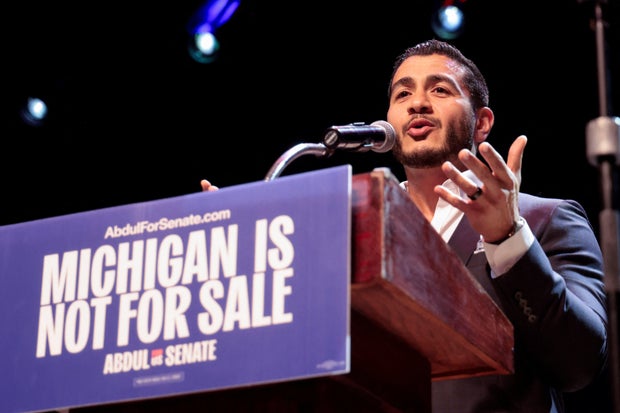
Abdul El-Sayed
Michigan Democratic U.S. Senate candidate Abdul El-Sayed appears onstage at a primary election night rally in Detroit early on Aug. 5, 2026.

Reuters/Rebecca Cook

The seat in Michigan is considered among the most vulnerable for Democrats this cycle in a state that has flipped between supporting Democrats and Republican presidents in recent elections. National Democrats, who backed Stevens, pitched her as the more electable candidate, citing El-Sayed’s more left-leaning views and arguing that they are out of step with the battleground state.

Asked about the dynamic, El-Sayed told CBS News’ Ed O’Keefe ahead of the primary that “it’s always funny to me that people want to say that this state votes for moderates when it voted for Donald Trump twice.”

“It may just be that the better explanation is not that the state wants moderates, it’s that it’s so sick and tired of the establishment bought off by corporations on both sides of the political aisle, that it was willing to hold its nose and vote for Donald Trump twice,” he added. “Now, what happens if the alternative to the bought-off establishment happens to be instead of a narcissistic, megalomaniacal billionaire, a doctor who rebuilds health departments to eliminate medical debt and put glasses on kids’ faces? I’m willing to test that proposition.”

El-Sayed’s victory comes after a series of primary wins by insurgent Democrats in places like New York City and Colorado in recent months, as progressives and democratic socialists seek changes to the party. The dynamic has been a defining feature of the primary cycle so far. But how it will play in November — especially in battleground states like Michigan — remains to be seen. 

El-Sayed, who is not a member of the Democratic Socialists of America but has welcomed its members into his coalition, has run on progressive policies like Medicare for All, and he’s been an outspoken critic of Israel’s government and the war in Gaza. The issue has been central to the campaign in the Great Lakes State, which is home to the largest concentration of Arabs in the U.S. And he hammered Stevens throughout the campaign for receiving an influx of funding from pro-Israel groups, while receiving criticism himself for campaigning with left-wing podcaster Hasan Piker.

The seat in Michigan is among a handful that Democrats are defending this cycle, while they look to flip seats elsewhere to secure control of the upper chamber. With 53 Republicans in the Senate, Democrats need to flip four seats, while fending off GOP inroads in Michigan and elsewhere to take the majority.

Schumer and Sen. Kirsten Gillibrand, the chair of the Democratic Senatorial Campaign Committee, praised El-Sayed in a joint statement following his projected victory for running an “energetic campaign that inspired thousands of Michiganders across the state.”

“Democrats are united by a common purpose: putting a check on Donald Trump by defeating his Republican enablers and taking back the Senate,” the Democrats said. “We look forward to working with Abdul and Democrats across Michigan to win this seat in November.”

‘Decades in Sports’: How the 1980s Miami Hurricanes became one of the most hated teams in sports history

(CNN) — Editor’s note: Watch CNN Original Series “Decades in Sports” on the CNN app. Across six episodes, the series explores the defining moments, athletes and cultural shifts that shaped sports over the past six decades, from the television revolution and Civil Rights Movement of the 1960s, right up to the impact of social media on today’s biggest stars.There have been plenty of dominant teams in the 150-plus-year history of college football, but few have left a bigger mark on the sport than the Miami Hurricanes did during the 1980s.The Canes were a team that went against the grain, trash-talking in a way that constantly got under their opponents’ skin, celebrating wildly after big plays and dancing in the end zone after touchdowns with a swagger that stood out as much as their bright orange jerseys.“That made them such a phenomenon,” says John U. Bacon, author of Fourth and Long: The Fight for the Soul of College Football, as the Hurricanes’ bold, brash and arrogant style transformed college football into something closer to theater.As Bacon also highlights in the series, “The Hurricanes were the bad boys of college football.” However, their impact was felt far beyond the gridiron, as the 1986 squad was even labeled the most hated team of all time by Sports Illustrated.For context, the 25-team list devised by Sports Illustrated featured some of the most polarizing teams in US sports history, such as the 1988-89 Detroit Pistons (widely known as the “Bad Boys”), the 2010-11 Miami Heat (universally recognized as the team that kickstarted the “superteam” era in the NBA) and the 2007 New England Patriots (who became the ultimate villains of the NFL after the infamous “Spygate” scandal.But it was this college football program which topped them all. As Bacon says, “They were more popular in Miami than the Dolphins, and the Dolphins had (1984 NFL MVP) Dan Marino.”Why Miami was so hatedThe Canes’ boisterous antics were not just empty calories – they backed it up when they stepped onto the field.Like many polarizing sports teams throughout history, Miami garnered attention because it won. Winning made the Hurricanes easy to root against, but also impossible to ignore.However, what truly set them apart is how they embraced the role of the villain.Before facing defending national champion and top-ranked Oklahoma in September 1986 in front of over 70,000 fans at the Orange Bowl, the Hurricanes famously defied protocol and refused to shake hands with the Sooners, sparking a heated exchange between the top two teams right in front of the TV cameras.Game officials intervened and even threatened to throw a penalty flag if Miami snubbed the pre-game handshake. But the Hurricanes didn’t budge and backed up their pre-game antics by beating the Sooners 28-16.Their “style ruffled a lot of feathers,” says Dr. Todd Boyd, Professor of Cinema and Music Studies at USC. But the more people disliked Miami, the more the team seemed to embrace it.Later that same season, they took it a step further.When landing in Tempe, Arizona, for the 1987 Fiesta Bowl against Penn State, which served as the national championship game, the Hurricanes famously stepped off their plane wearing full camouflage military fatigues in an attempt to intimidate the Nittany Lions.It didn’t work on that occasion, as Miami fell 14-10 in the title game. But the following year, the “Bad Boy” Hurricanes came out on top, going unbeaten and taking down the Oklahoma Sooners – again – 20-14 to win the national championship.As Van Lathan – journalist and podcaster at The Ringer – says in the series, “The 80s were an anti-hero decade.”Lathan went on to highlight that, during that time, “We are re-examining what is OK in the name of coming out on top. This is a post-Watergate America … and whatever it takes, we are going to win.”No one embodied that shift more than this group from South Florida: It was win by any means necessary.As sports journalist and podcaster Bomani Jones highlights: “It became the dominant culture of the sport.”However, none of this would have been possible without a coach who not only allowed his players the space to go about their business in such a controversial manner, but one who encouraged the brash and boisterous behavior they took to stadiums across the country: Jimmy Johnson.The Jimmy Johnson effectWhen Johnson arrived in South Florida in 1984, he had pretty big shoes to fill.Howard Schnellenberger – who helped build Miami’s college football program into one of the elite programs over five seasons – had just departed after leading the Hurricanes to their first national championship, upsetting the unbeaten, top-ranked Nebraska Cornhuskers 31-30 at the Orange Bowl.However, despite Schnellenberger being the original architect of Miami’s success, it was under Johnson that the Hurricanes truly peaked.After going 18-7 in his first two seasons, Miami went 34-2 in his final three, winning the national championship in 1987 and narrowly losing one 14-10 to Penn State in 1986 after Johnson led the Hurricanes to the first undefeated regular season in program history.But it was the culture Johnson cultivated in South Florida that made his tenure so memorable.There was a shift happening in sports in the 1980s, with players becoming more brash and expressive. It is something that is celebrated today but was highly frowned upon at the time.Johnson’s genius was not only in recognizing that shift, but also in allowing his players to be their authentic selves out on the field, because as Jones highlights in the series: “The Florida boys are different, (and) they have a really good time when they play their football.“Normally, when you get a lot of players who like to dance when they score a touchdown and like to talk a bunch of sh*t when they play, you have a coach who is trying to tamp that down and get them to behave a little bit more respectably…“Jimmy Johnson loved it! He loved it as much as they did. He’s like, ‘As long as we win, you can do whatever you want.’”On its face, it sounds simple, but it was highly effective and it was an era that redefined what a college football powerhouse could look like. They were rough around the edges, bold, brash and arrogant – but that’s what made them who they were.Better to be remembered for something than not remembered at all. And no one will forget the 1980s Miami Hurricanes, the “Bad Boys of college football.”The-CNN-Wire™ & © 2026 Cable News Network, Inc., a Warner Bros. Discovery Company. All rights reserved.
Read Next Story