
Potentially historic El Nino takes shape, with far-reaching US and global impacts expected

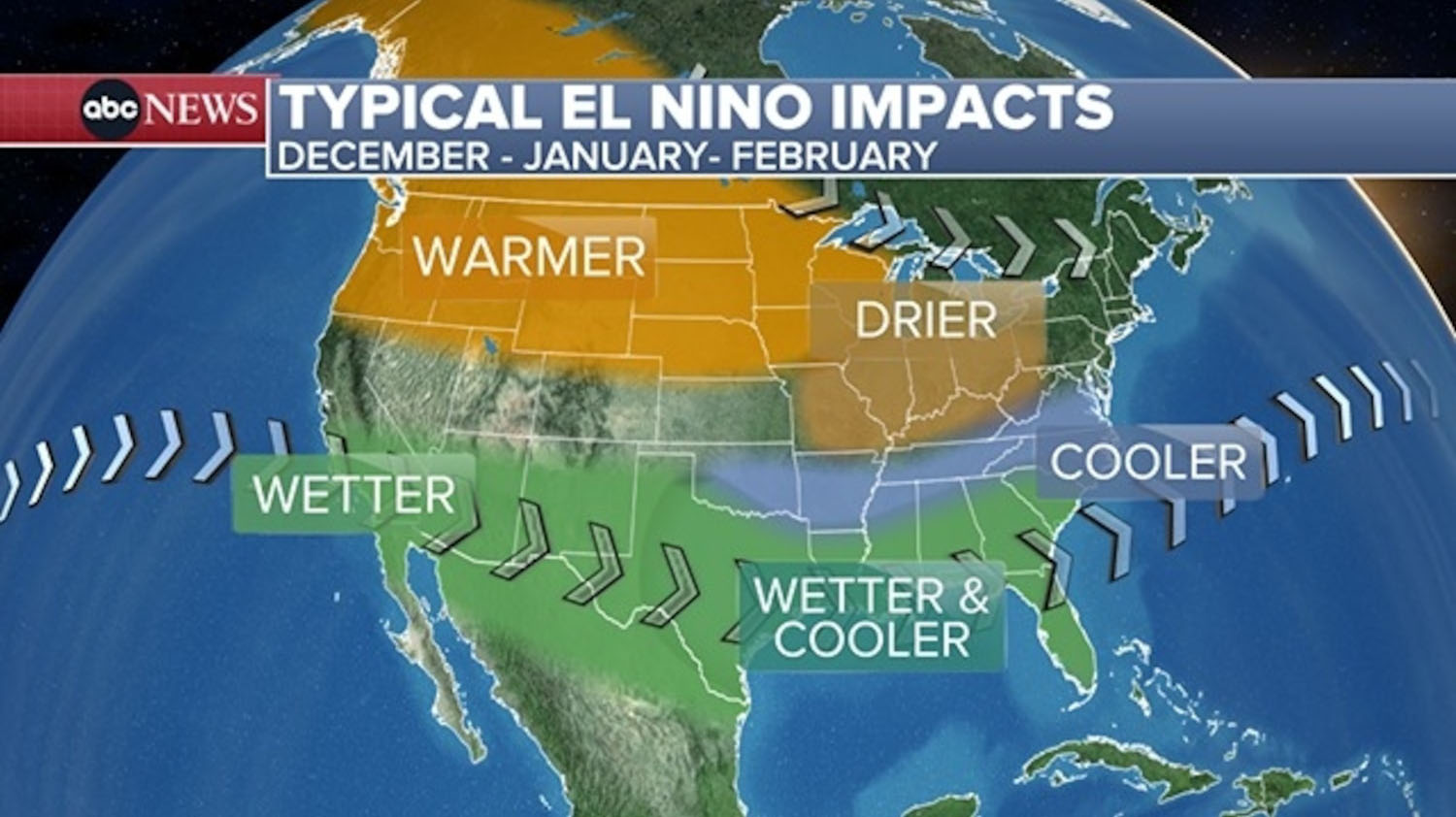
Typical El Nino impacts in winter months. (ABC News)

(NEW YORK) — El Nino conditions continue to intensify and are likely to be very strong, resulting in a potentially historic event in the coming months that could significantly influence our weather, the hurricane season and global temperatures, according to the latest forecast from the National Oceanic and Atmospheric Administration (NOAA).

The agency is now highly confident there will be a very strong El Nino during the upcoming Northern Hemisphere fall and winter seasons.

NOAA’s latest forecast says that between October and December, there is a 69% chance of a historic event that would exceed the strength of all previous El Nino events on record, dating back to 1950. The current event ranks as the second strongest on record for this time of the year, behind 1997.

“Our team has become more confident in the possibility of a very strong El Nino by the end of this year,” Michelle L’Heureux, a physical scientist at NOAA’s Climate Prediction Center, told ABC News.

“There is a greater than 90% chance of a ‘very strong’ El Nino, which is the highest chance to date, and expresses our confidence in the growth and development of a potentially historic El Nino event,” L’Heureux added.

NOAA noted that with an event of this magnitude, while the chances of experiencing impacts consistent with El Nino are greater, they are not guaranteed.

El Nino refers to the warmer-than-average phase of the El Nino–Southern Oscillation (ENSO), a natural cycle where sea surface temperatures across the central and eastern equatorial Pacific Ocean rise and fall. The cooler-than-average phase is called La Nina, while near-average conditions are known as ENSO-neutral.

NOAA ranks the strength of El Nino events by measuring the sea surface temperature departure from average (anomaly) across this region, classifying events as weak, moderate, strong or very strong.

While adjectives such as “super” and “extreme” are popular ways of describing the strength of an El Nino event on social media, NOAA and the WMO classify the strength as weak to moderate, strong and very strong. The WMO noted in a recent statement that “the term [[super]] is not part of standardized operational classifications.”

Typical El Nino impacts across the United States

Impacts from El Nino, similar to La Nina, tend to be most consistent and pronounced from late autumn through early spring following the event’s onset, NOAA said. There is usually a delay between the onset of the event and many of the associated effects.

Experts caution that the impacts on weather patterns are nuanced. Each season is different, and typical El Nino conditions don’t always materialize.

“The data is very clear that we can be more confident in certain impacts occurring during strong and very strong El Nino, but it is really important to emphasize that even if this ends up being a historic El Nino, there will be impacts in some locations that do not align with the expected El Nino impact,” L’Heureux added. “This is why our seasonal forecasts are expressed in terms of probabilities.”

Northeast: Typically, during El Nino, warmer-than-average temperatures are favored across the northern half of the United States during the winter months. However, its influence is less pronounced in the Northeast, compared to the Upper Midwest and Northwest.

El Nino typically increases the odds of above-average snowfall in the mid-Atlantic and coastal areas of the Northeast as storms often move up the coast. Farther inland, drier-than-average conditions and less snow are more likely.

South: Near- to below-average temperatures are favored along the southern tier of the U.S., especially from Texas to the Southeast.

For precipitation, wetter-than-average conditions are typically observed along the southern tier of the U.S., including parts of the Gulf Coast and Southeast. Below-average precipitation is frequently observed across parts of the south-central Mississippi Valley.

Midwest: Warmer-than-average temperatures are favored from the northern Plains into the Great Lakes. Drier-than-average conditions are frequently observed across parts of the Ohio Valley and Great Lakes regions.

El Nino typically increases the odds of above-average snowfall in the south-central Plains, with below-average snowfall favored in the northern Plains and Great Lakes regions.

West: During the winter months, warmer-than-average temperatures are likely across much of the Northwest. For precipitation, wetter-than-average conditions are typically observed across southern California and much of the Southwest, with below-average precipitation frequently observed across parts of the northern Rockies.

El Nino typically increases the odds of above-average snowfall in the southern Rockies, with below-average snowfall favored in the northern Rockies.

Meanwhile, above-average tropical activity in the eastern Pacific increases the likelihood of indirect impacts to the southwestern United States, such as sending more rain to the region and more frequent flash flood concerns.

Alaska: El Nino impacts in Alaska tend to be more pronounced than across much of the contiguous United States, with the strongest effects typically occurring during the winter and spring months. During winter, warmer- and drier-than-average conditions are more likely, with less snowfall and reduced snowpack.

Above average temperatures often persist into spring, while precipitation trends closer to average. However, warmer conditions typically mean more precipitation falls as rain rather than snow, prolonging snow deficits.

Hawaii: Rainfall is typically above average across Hawaii the year an El Nino event develops before conditions become drier during the winter months and remain dry well into the following year. The shift toward drier weather can increase the likelihood of drought and elevate the risk of wildfires.

Meanwhile, above-average tropical activity in the eastern Pacific increases the risk of impacts from tropical systems across the Hawaiian Islands.

How El Nino influences hurricane season activity

While El Nino is only one of several key factors that influence tropical activity, forecasts now indicate it will be a strong event through the peak of the hurricane season, making it the primary driver of activity in both the Atlantic and eastern Pacific in the coming months.

El Nino conditions often suppress tropical activity during the Atlantic hurricane season by producing unfavorable atmospheric winds. In the Eastern Pacific, the opposite occurs, with favorable conditions supporting above-average hurricane season activity.

Other factors, such as sea surface temperatures, also play an important role in tropical cyclone development and strength. Unseasonably warm ocean waters can partially offset the effects of unfavorable atmospheric winds, according to forecasters.

Global temperature records will likely be challenged

2024 ranked as the planet’s warmest year on record, following the last El Nino event, which emerged in mid-2023 and persisted through spring 2024, according to NOAA. However, the return of El Nino means global temperature records will likely be challenged again in the near future, especially since a very strong event is unfolding.

Record highs in global average temperature often occur during El Nino years, combined with the long-term global warming trend driven primarily by human-caused greenhouse gas emissions.

“Warmer ocean temperatures associated with El Nino, together with its tendency to favor warmer conditions in many areas, often contribute to warmer than normal global annual temperatures,” Jon Gottschalck, chief of the Operational Prediction Branch at NOAA’s Climate Prediction Center said.

According to the latest outlook from NOAA’s National Centers for Environmental Information, it’s virtually certain that 2026 will rank among the five warmest years on record, with a 99.9% chance.

However, the probability of it becoming the warmest year currently stands at less than 1%. These odds will likely rise significantly for 2027, based on the latest forecasts.

There is usually a delay between the onset of El Nino and its peak impact on global temperatures, NOAA says. As with the most recent event, its greatest influence often occurs in the months after it peaks, which can keep global temperatures elevated into the following year.

Copyright © 2026, ABC Audio. All rights reserved.

Florida voters choose in governor, Senate primaries, and more races to watch

▶ Watch Video: Florida holds high-stakes primaries with multiple far-left candidates in the mix Three states are holding primaries on Tuesday, with Florida deciding its nominees for both governor and for Senate. In Alaska, Sen. Dan Sullivan is facing several competitors — including one who shares his name — in the nonpartisan top-four primary.Floridians will also be voting in primaries in new congressional districts after GOP Gov. Ron DeSantis pushed through new district boundaries to give Republicans an advantage in 24 of the state's 28 districts.There will also be a special election in California to fill out the remainder of former Rep. Eric Swalwell's term. Swalwell resigned earlier this year after facing allegations of sexual assault and other misconduct. Here are the major races to watch today: Florida governorFlorida hasn't elected a Democratic governor since 1994 and DeSantis is prevented from running again due to term limits. In 2018, DeSantis won by less than a single point. By 2022, he won by 20 points — transforming Florida from being seen as a swing state to being solidly Republican. Rep. Byron Donalds, first elected in 2020 to represent Naples, Fort Myers and the surrounding area, is backed by President Trump and has long branded himself as a "Make America Great Again" member of the House. He is a prominent member of the House Freedom Caucus and in 2023, challenged Kevin McCarthy in the race to become speaker, forcing 15 rounds of voting. Donalds also put his name in the bid to replace McCarthy 10 months later when he was ousted from the speakership. In addition to Mr. Trump's backing, Donalds has amassed a significant war chest, having raised $90 million so far. He has also held a commanding lead in polls. There are 10 other Republicans seeking the nomination, with Lt. Gov. Jay Collins and far-right activist James Fishback as the leading challengers to Donalds. While DeSantis has not endorsed in the race, Collins has branded himself as "DeSantis-appointed," but it's likely a race for second place given Donalds' lead.Collins tried earlier this summer to get Fishback booted from the ballot, alleging Fishback had not met the state's seven-year minimum residency requirement. The case was ultimately thrown out by a judge. Fishback, a 31-year-old Florida native, has gained momentum among young men in the inflammatory alt-right "groyper" movement online and has support of white nationalist Nick Fuentes as well as Tucker Carlson. Fishback has taunted Donalds with racist comments, calling him a "slave to donors," a "token Black" in Congress and accusing him of wanting to turn Florida into a "Section 8 ghetto."As the well-funded front-runner, Donalds generally does not acknowledge Fishback's comments. Fishback has raised little money and does not stand much of a chance of succeeding on Tuesday, but he has pushed white nationalism into the governor's race and caused a splinter in the GOP. Across the aisle, there are six Democrats seeking the nomination on Tuesday, with former Republican Rep. David Jolly as the front-runner. Jolly represented the St. Petersburg area from 2014 to 2016, and is the second prominent Republican-turned-Democrat to run for governor in Florida in two cycles. In 2022, former Gov. Charlie Crist — who served as a Republican as governor before becoming a Democrat and defeating Jolly in the 2016 election — lost to DeSantis by nearly 20 points. Crist is now running for St. Petersburg mayor. Florida Senate raceWhen Marco Rubio became secretary of state, DeSantis appointed Ashley Moody to his Senate seat, and she is now running to serve out the remainder of his term. Moody was elected the state's attorney general twice, defeating her Democratic challenger in 2022 by more than 20 points. Moody faces three Republican challengers on Tuesday, although she is expected to win the nomination. Democrats Alex Vindman and Angie Nixon are duking it out for the Democratic nomination. Vindman, a retired lieutenant colonel, served on the National Security Council as an expert on Ukraine during Mr. Trump's first term. He became a key witness in Mr. Trump's first impeachment, testifying he heard Mr. Trump on a phone call pressure the Ukrainian president to investigate Joe Biden. Vindman was later forced out at the NSC. His brother, Eugene, who also reported the phone call as being improper, was elected to Congress in 2024 from Virginia. Nixon, a state representative from Jacksonville, led the Democratic protest against DeSantis' new congressional map. A labor organizer, she is touting her progressive support, including from unions and progressive Rep. Maxwell Frost, who represents the Orlando area. Florida House Earlier this year, DeSantis pushed through a new congressional map to favor Republicans in four more districts after the Supreme Court decision that narrowed the section of the Voting Rights Act that required the creation of majority Black voting districts in some states. Rep. Darren Soto's district, which was protected by the Voting Rights Act, was redrawn to become more favorable to Republicans. Soto is running unopposed for the Democratic nomination, and seven Republicans are running on Tuesday to take him on. Republican Thomas Chalifoux Jr., Soto's challenger in 2024 who won more than 40% of the vote under the old lines, is running again, as is Marcus Carter, who ran in 2024 on the general election ballot as an NPA candidate. Republican Dan Green, who worked in the first Trump administration, is touting his ties to the president. He has been endorsed by seven members of Congress, although none from Florida. Democratic Rep. Debbie Wasserman Schultz's current district was also affected. She's now running in the neighboring 20th District, which is still a majority Black district and has been represented by a Black representative since the 1980s. Wasserman Schultz was sharply criticized by Black community leaders and the other four candidates, who are all African American, for running in this district. The seat is currently vacant after former Rep. Sheila Cherfilus-McCormick resigned earlier this year moments before the House Ethics Committee was set to determine whether she should be sanctioned for allegations of theft and other misconduct. But despite resigning less than six months ago, Cherfilus-McCormick is running again this year. There are three other candidates: Luther Campbell, Dale Holness and Elijah Manly. Moderate Democratic Rep. Jared Moskowitz's district was also redrawn to favor Republicans. Moskowitz faces a challenger to the left, Oliver Larkin, a democratic socialist. Younger and usually progressive challengers have pulled off upsets in New York, Colorado and Connecticut, and Larkin has cast Moskowitz as being pro-Israel and being tied to AIPAC. Florida's 25th District has one of the heaviest concentrations of Jewish voters in the country. Republican Rep. Cory Mills, who represents the 7th District in central Florida, has three GOP primary challengers. Mills faces a House Ethics Committee probe for allegations related to federal contracting violations, stolen valor and assault. He has been accused of assault by a woman who filed a police report last year, and a former girlfriend filed a restraining order against him. He has not been charged and denies any wrongdoing.Two Republicans in Florida's House delegation have endorsed Mills' challenger, Ryan Elijah, a former local television anchor. There have also been calls for him to be censured or even expelled by other members of Congress, especially in the wake of several high-profile accusations of misconduct in the House. Alaska Senate raceDemocrats have to flip four seats to take control of the Senate, in addition to holding all their current seats. Although Alaska hasn't elected a Democratic senator since 2009, Democrats believe Alaska could be a long-shot target in the right political environment. Former Rep. Mary Peltola has opted to take on incumbent two-term Republican Sen. Dan Sullivan. Alaska has nonpartisan primaries, so the top four finishers in Tuesday's primary will be on the ballot in November. Peltola won a surprise victory in a special election to represent Alaska's at-large congressional district in 2022 and won a full term that November, but she lost to Republican Nick Begich in 2024. Mr. Trump won Alaska by 13 points in that election.There are 13 candidates on the ballot on Tuesday, and there is another candidate named Daniel J. Sullivan, whom the Alaska Division of Elections attempted to take off the ballot earlier this summer. The Alaska Supreme Court determined that Daniel J. Sullivan can appear on the ballot, saying his candidacy appears to be in good faith. On Friday, Mr. Trump accused Democrats of trying to "trick" Alaska voters, since Daniel J. Sullivan is also on the ballot as a Republican. The money raised in the race shows the front-runners: Peltola has raised more than $18 million so far, while the incumbent Sen. Sullivan has brought in more than $11 million. The other Daniel J. Sullivan has raised $18,000.Despite the large sums already raised by Peltola, her campaign has raised some eyebrows in the past week. Former Vice President Kamala Harris sent around a fundraising email for Peltola, but her campaign told national media that they had not approved the fundraising pitch as she seeks to distinguish herself as an independent. WyomingOne-term Republican Sen. Cynthia Lummis is not running for reelection, leaving open one of the safest GOP seats in the country. Mr. Trump has endorsed Harriet Hageman, whom he also backed to unseat former Rep. Liz Cheney in 2022 for the state's at-large House seat. Hageman is facing four other primary candidates. There are also two Democrats vying to take on the winner of the GOP race. With Hageman vacating her seat, nine Republicans are vying for the GOP nomination and two Democrats are competing for their nomination.California 14th District special electionA special election for Swalwell's California seat is being held Tuesday as well. Two Democrats advanced in the nonpartisan June primary, state Sen. Aisha Wahab and Bay Area Rapid Transit Director Melissa Hernandez, to fill out the remainder of Swalwell's term. The two will face each other again in November for the San Francisco Bay Area seat.The race between Wahab and Hernandez has become unexpectedly nasty, with the San Francisco Chronicle reporting that the pro-Israel group AIPAC has put millions into the race against Wahab.
Read Next Story