
Poll: Most believe extraterrestrial life exists – and some think it’s already here

▶ Watch Video: What’s inside the latest UFO file release by the Pentagon?

We are not alone in space – and maybe not even on Earth. At least that’s what the public believes.

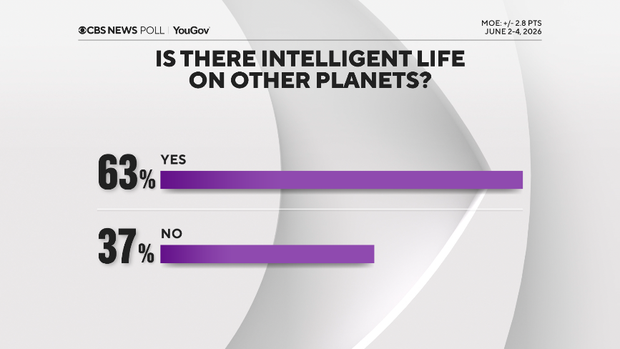
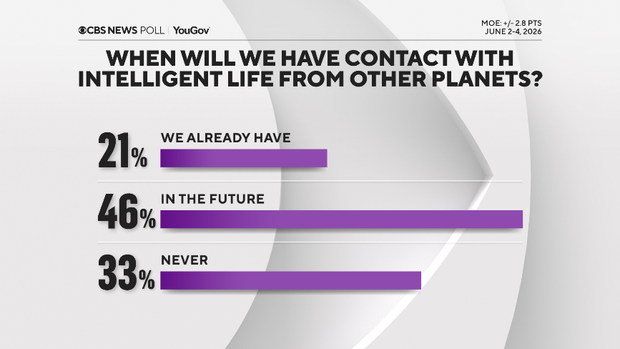
Most Americans believe intelligent life exists on other planets, and one in five think they’ve already made contact with us. 

For those who don’t think that’s happened yet, many expect contact at some point in the future. 

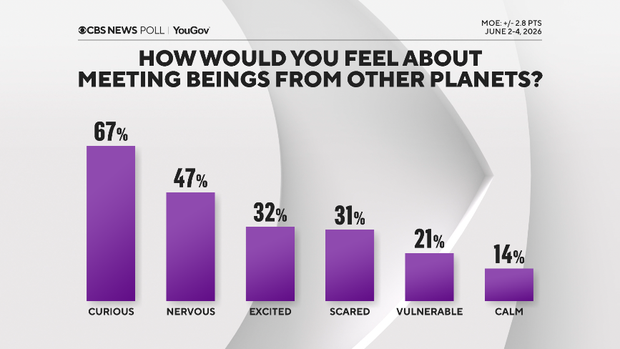
If such face-to-face encounters were to take place on Earth, Americans say they would greet the alien visitors with more fascination than fear, along with some unease. 

The government’s recent release of UFO files has some Americans saying we’ve already been visited by extraterrestrial life. This is especially the case among those who have watched the videos in the UFO files.

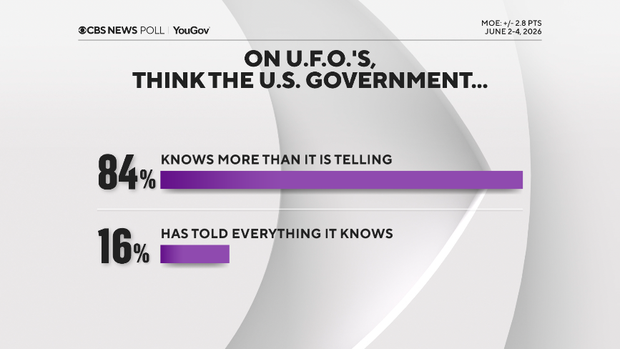
And people suspect there’s still more to come. Eight in 10 think the government knows more about UFOs than it is telling.
believe-alien-life.png
contact-with-aliens.png

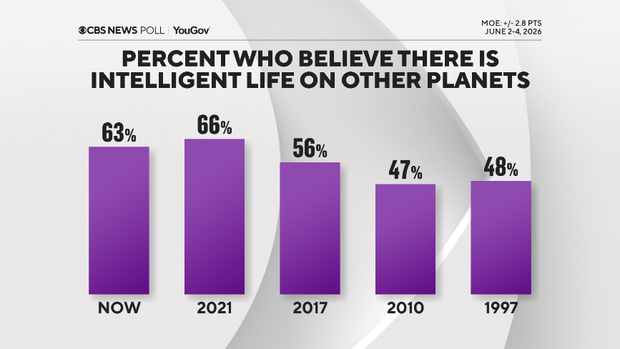
The percentage who believe intelligent life exists on other planets has become more widespread in recent years. Looking back just to 2010, fewer than half of Americans believed that. Since that time, higher numbers of men, women and people across age groups and education levels now believe in the existence of intelligent life.   
believe-alien-life-trend.png

People say they would be more curious than scared about the prospect of meeting extraterrestrials should they come to Earth. But such contact also generates some anxiety — more would be nervous than calm.
feel-about-mtg-aliens.png

Ever seen a UFO?

The debate about whether UFOs have visited Earth continues. 

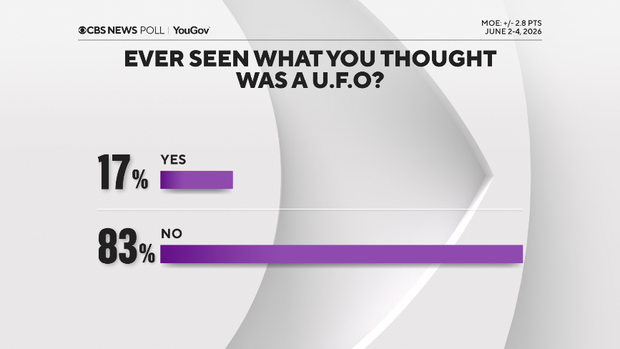
Seventeen percent of Americans report having personally seen something they thought was a UFO. This is similar to what Gallup polling has shown in recent years, but a higher percentage than what their polling found in the 1970s.

More men than women report having seen a UFO. 

People who say they have seen what they believe was a UFO overwhelmingly think intelligent life exists, and most would be curious upon meeting such beings, with many also saying they would feel nervous and excited about the prospect. 
seen-ufo.png

So, what are they?

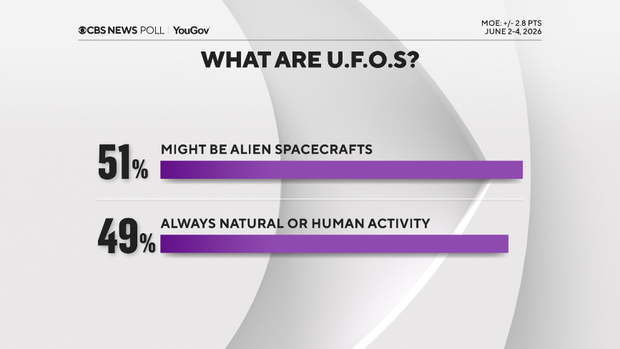
Americans are split on whether reports of UFOs might sometimes be caused by alien spacecrafts visiting Earth, or are always the result of human or natural activity that comes from Earth. 

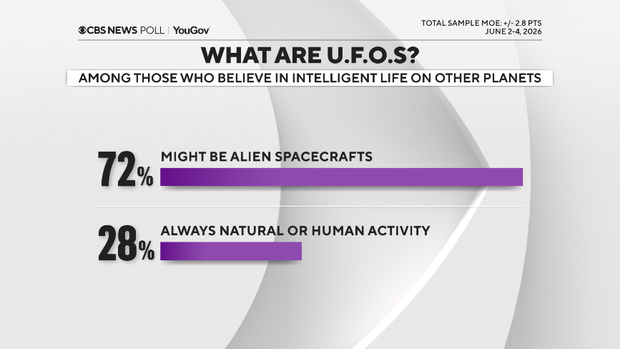
Those who believe intelligent life exists out there overwhelmingly think reports of UFOs are at least sometimes the result of alien spacecraft visiting. But those who don’t believe in intelligent life think the more likely explanation is human or natural activity.
what-are-ufos-all.png
what-are-ufos-believe-aliens-exist.png

Most Americans have heard or read at least something about the federal government’s release of files and videos related to Unidentified Anomalous Phenomena, or UAP, also known as Unidentified Flying Objects, and four in 10 report watching videos that were released

Three in 10 say this material has made them more likely to believe that aliens visited Earth, a figure that rises to four in 10 among those who have watched videos. 

govt-videos.png

Americans still think the U.S. government knows more.  

A big majority says the government is not telling all it knows about UFOs. It’s the predominant opinion among those who believe in extraterrestrial life, as well as those who do not. And there is agreement across party lines on this: Most Democrats, Republicans and independents don’t think the government is telling the public all it knows. 
govt-know-more.png

This CBS News/YouGov survey was conducted with a nationally representative sample of 2,023 U.S. adults interviewed between June 2-4, 2026. The sample was weighted to be representative of adults nationwide according to gender, age, race, and education, based on the U.S. Census American Community Survey and Current Population Survey, as well as 2024 presidential vote. The margin of error is ±2.8 points. CBS News polls cited in this analysis from 1997, 2010, 2017 and 2021 were conducted by phone. 


Inside DC’s historic heart, an IndyCar race backed by Trump kicks into gear

(CNN) — Spectators began pouring into the center of Washington, DC, on Saturday to catch the first day of the Freedom 250 Grand Prix, a two-day street racing event whose revving engines will echo amid the nearby US Capitol and the city’s neoclassic national museums.The portion of 3rd street that will serve as the start and finish line is painted cobalt blue, with a thick black-and-white checkered flag band overshadowing the more mundane stripes of a nearby crosswalk. Large metal fencing stands erected around the site to protect those who’ve flocked to the IndyCar event to watch the sleekly designed cars fly past at speeds up to 180 miles per hour.With a host of preliminary races on the schedule, the festivities on Saturday are a buildup to the main race on Sunday, which, according to the White House, President Donald Trump plans to attend. The 1.66-mile track caps off a summer of celebrations commemorating the nation’s 250th birthday.The president fast tracked the race with a January executive order, bypassing local bureaucratic hurdles and making the event that is expected to draw nearly 300,000 people over two days a reality less than a year after its pitch by Penske Corporation president, Bud Denker.Fans began pouring into the sprawling racing area under a light drizzle about 8 a.m. as the racing teams were preparing for the first practice rounds. The weather did not dampen the spirits of hardcore racing fans who traveled from across the country for the Grand Prix in DC.Tom Lantz brought his family, including his 12-year-old son, Levi Steele, from Altoona, Pennsylvania, for the event. Lantz has attended several previous races but this was Levi’s first.“I’m just glad I’m here,” Levi said.The racetrack starts along 3rd Street, along the National Mall across from the Washington Monument, and is followed by turns onto Pennsylvania Avenue, the street where the White House is located. From there, it goes along 9th Street — passing the National Gallery of Art and National Archives. Pennsylvania Avenue was crucial to the track because its width lent itself to a pit lane where IndyCars will stop for tire changes, fuel and repairs.The course then turns onto Constitution Avenue and cuts across 7th Street, bisecting the National Mall before turning onto Independence Avenue, past the Smithsonian Air and Space Museum. It then turns on Maryland Avenue and back onto 3rd Street, spanning less than 1.7 miles and seven turns.Drivers on Sunday will race around the monuments for 147 laps, a symbolic number to celebrate the nation’s semi-quincentennial with a 250-mile race.Many Washington, DC, residents will feel the race’s impact even if they don’t attend it, as officials plan extensive traffic and parking restrictions throughout the city in conjunction with the event. The Federal Aviation Administration also announced it will pause flights out of Ronald Reagan National Airport from 10:15 a.m. to 1:15 p.m. on Sunday, though those times may change.A few of the city’s iconic Smithsonian Museums are in the race’s path, and visitors will need a Freedom 250 Grand Prix event ticket to access them. The National Gallery of Art, which is next to the race’s pit lane, said it conducted an “extensive vibration study” and applied a set of safety measures to protect guests and its art collections from being damaged by the race.The Freedom 250 won’t be the first time a race was held in Washington to commemorate America’s anniversary. In 1801, President Thomas Jefferson celebrated America’s 25th birthday with a horse race near the same land where IndyCar’s track is built, according to the White House Historical Association.Hosting this race was a bit more complicated than it might have been back then.For a nation’s capital that frequently engages in logistical gymnastics for events like the presidential inauguration, the Grand Prix presented unique challenges, including repairing streets, constructing large heavy fencing and securing permits to bring the race to downtown.Ahead of Saturday’s qualifying races, Denker’s team smoothed nearly 50 manhole covers over with silicone to ensure the high-speeding cars don’t blow the covers off their places with the suction they create.Security will be a particular sticking point ahead of Sunday’s Grand Prix with the president and several members of his cabinet set to attend the race. Attendees will funnel through tall magnetometers, reminiscent of TSA-style screening before a flight.DC city officials had asked the federal government to designate the event as a National Special Security Event – a status reserved for the nation’s highest-profile and highest-risk gatherings, such as the State of the Union and state funerals. The Trump administration denied the request, opting instead to follow a Special Event Assessment Rating Level 1 – the highest designation below a National Special Security Event.Another challenge for organizers was accommodating DC residents who live in the middle of the action. Denker, the Penske president, anticipated concerns about disruption and noise, meeting in May with residents who live or have office space near the course to pitch his plan and answer any questions.Most of the race’s extensive construction took place in the overnight hours but drew the ire of residents outraged at the large-scale disruption in downtown DC.The more-than-$35-million price tag, all paid for by IndyCar, bets on the race as a way to attract new fans and commemorate the nation’s birthday.“What’s primary for me, and it sounds corny, is to celebrate our country’s 250th anniversary in ways no one ever expected to see,” Denker said.The-CNN-Wire™ & © 2026 Cable News Network, Inc., a Warner Bros. Discovery Company. All rights reserved.
Read Next Story