
Police race to save murder evidence from being turned into scrap metal

▶ Watch Video: Sneak peek: Murder in the Parking Garage

Detective Devin Rigo knew the clock was ticking as he raced to a metal scrapyard just north of Portland, Oregon. Rigo, with the Hillsboro Police Department, had just learned about the discovery of a maroon minivan he believed contained evidence connected to the murder of 56-year-old Kenneth “Kenny” Fandrich, a contract pipe fitter.  

On Jan. 27, 2023, Kenny Fandrich was discovered in a parking garage at the Intel campus in Hillsboro. Police reviewed surveillance camera images and determined that Fandrich had been dragged into the minivan by a masked man. Police believed the killer had broken Fandrich’s neck and killed him inside the minivan, before staging his body back in the driver’s seat of his own vehicle.

From evidence found at the scene, investigators believed the murder suspect tried to cover his crime by spray-painting multiple security cameras in the parking garage with blue spray paint. Correspondent Natalie Morales covers the investigation into Kenny Fandrich’s murder and the hunt for the killer in “Murder in the Parking Garage.” An encore of the broadcast airs Saturday, August 15 at 10/9c on CBS and streaming on Paramount+.
fandrich-full.jpg
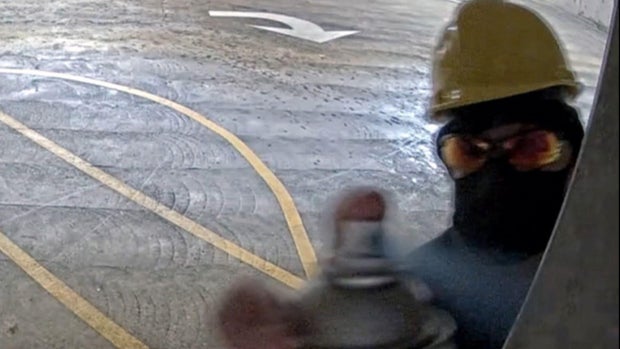
A suspect wearing a hard hat, tinted glasses and a face mask is captured spray-painting the security cameras around Kenny Fandrich’s car the morning of his murder to apparently conceal the crime

Washington County District Attorney’s Office

Soon after police arrived on the scene, Intel security personnel provided investigators with recordings from their hundreds of security cameras in the parking garage. Police soon had images of a suspect – wearing a hard hat, tinted glasses and a face mask – spray-painting the security cameras around Fandrich’s car early that morning, to apparently conceal the crime. At the time, the suspect had not been detected by Intel. But when police looked at the footage, they discovered that the spray paint didn’t cover everything the cameras recorded.

Kenny Fandrich and Dr. Steven Milner
Kenny Fandrich, left, and Dr. Steven Milner.

Washington County District Attorney’s Office

Police believed that whoever had killed Fandrich waited for him inside that minivan, then attacked Fandrich when he returned to his car after his shift. The killer left the garage in the maroon minivan soon after.

The night that Fandrich’s body was found, his wife, Tanya Fandrich, told investigators Kenny had a stalker: a well-off former veterinarian named Dr. Steven Milner. Tanya Fandrich had worked for Milner at his vet clinic for years, and they had an affair, which Tanya Fandrich said was long over. Police found that Kenny Fandrich had filed several orders for protection against Milner, and that Milner had been warned by Hillsboro police officers to stop following Kenny Fandrich. Just months before Kenny Fandrich’s murder, Milner had been caught placing a tracking device on one of the Fandrichs’ vehicles and was criminally charged. After several days of investigation, police arrested Milner and charged him with the murder of Kenny Fandrich.

Once in custody, police were able to connect the minivan, and another vehicle, to Milner, who had left them at a Home Depot parking lot for long periods of time.

To prove the case against Milner, investigators felt they had to find that minivan. “Because it’s the minivan that we believe was really our main crime scene …” said Rigo. “We thought there was going to be forensic evidence … in that minivan.”

Rigo and his partner, Detective Stephanie Winter, called the vehicles “burner cars.”

“Everybody kind of is more familiar with like a burner phone …” said Rigo, “where you have a phone that’s not … traced to you but, you know, you can use it for what you need, get rid of it … Essentially, he did the same thing, but with a car.”

The maroon minivan had been flagged at the Home Depot parking lot and the VIN number had been recorded. Security footage showed the van leaving the Home Depot parking lot shortly before Fandrich was murdered.

“We are sending flyers to every agency in the area,” said Rigo about the minivan’s VIN number.

fandrich-scrapyard.jpg
The maroon minivan, pictured left, moments before it was crushed. Hillsboro, Oregon, police believed the vehicle contained evidence connected to the murder of 56-year-old Kenneth “Kenny” Fandrich.

Washington County District Attorney’s Office

The first alert they got was from the Oregon Department of Transportation. The minivan had been towed off the side of the busy I-5 highway in North Portland just days after Fandrich was murdered. Detectives believe it had been dumped there by Milner. Rigo called the tow company and found out the minivan had been sold to a scrap metal company. That’s when he started racing to the scrapyard to see if they could retrieve the minivan, and the key crime scene evidence it may have held. But he was too late. When Rigo arrived and asked about the minivan, he was shown a video of the crime scene being picked up and smashed to pieces. “I was able to watch one of my key pieces of evidence be crushed and taken away,” said Rigo, “before my very eyes … exactly a week too late.”

Discover how the investigation unfolded, and Milner’s defense at trial, on this week’s “48 Hours,” “Murder in the Parking Garage.”

Book excerpt: ‘The Serviceberry’ by Robin Wall Kimmerer

Scribner We may receive an affiliate commission from anything you buy from this article. Robin Wall Kimmerer, an Indigenous botanist, became a #1 New York Times bestselling author with her 2013 book "Braiding Sweetgrass," about the value of complementing our understanding of Western science with Indigenous knowledge about nature and humanity. In her most recent book, "The Serviceberry" (Scribner), Kimmerer writes about embracing gratitude and reciprocity in our dealings with nature, and the importance of recognizing and sharing the many gifts the world gives us. Read an excerpt below, and don't miss Martha Teichner's conversation with Robin Wall Kimmerer on "CBS Sunday Morning" August 23!Prefer to listen? Audible has a 30-day free trial available right now.I have no claim to these berries, and yet here they are in my bucket, a gift.This pail of Juneberries represents hundreds of gift exchanges that led up to my blue-stained fingers: the Maples who gave their leaves to the soil, the countless invertebrates and microbes who exchanged nutrients and energy to build the humus in which a Serviceberry seed could take root, the Cedar Waxwing who dropped the seed, the sun, the rain, the early spring flies who pollinated the flowers, the farmer who wielded the shovel to tenderly settle the seedlings. They are all parts of the gift exchange by which everyone gets what they need.Many Indigenous Peoples, including my Anishinaabe relatives and my Haudenosaunee neighbors, inherit what is known as "a culture of gratitude," where lifeways are organized around recognition and responsibility for earthly gifts, both ceremonial and pragmatic. Our oldest teaching stories remind us that failure to show gratitude dishonors the gift and brings serious consequences. If you dishonor the Beavers by taking too many they will leave. If you waste the Corn, you'll go hungry.Enumerating the gifts you've received creates a sense of abundance, the knowing that you already have what you need. Recognizing "enoughness" is a radical act in an economy that is always urging us to consume more. Data tell the story that there are "enough" food calories on the planet for all 8 billion of us to be nourished. And yet people are starving. Imagine the outcome if we each took only enough, rather than far more than our share. The wealth and security we seem to crave could be met by sharing what we have. Ecopsychologists have shown that the practice of gratitude puts brakes on hyper-consumption. The relationships nurtured by gift thinking diminish our sense of scarcity and want. In that climate of sufficiency, our hunger for more abates and we take only what we need, in respect for the generosity of the giver. Climate catastrophe and biodiversity loss are the consequences of unrestrained taking by humans. Might cultivation of gratitude be part of the solution?Paulie is surprised, too, that I know these berries since they are new to most people around here. As a forager, I'm accustomed to following the voices of Cedar Waxwings, only to find a disappointing handful that they have left me. Never have I seen so many as here, planted by my friend. She's excited to learn that they are an important cultural food for us, and I can see how my delight levitates her, too. If our first response to the receipt of gifts is gratitude, then our second is reciprocity: to give a gift in return. What could I give these plants in return for their generosity? I could return the gift with a direct response, like weeding or bringing water or offering a song of thanks that sends appreciation out on the wind. I could make habitat for the solitary bees that fertilized those fruits. Or maybe I could take indirect action, like donating to my local land trust so that more habitat for the gift givers will be saved, speaking at a public hearing on land use, or making art that invites others into the web of reciprocity. I could reduce my carbon footprint, vote on the side of healthy land, advocate for farmland preservation, change my diet, hang my laundry in the sunshine. We live in a time when every choice matters.Gratitude and reciprocity are the currency of a gift economy, and they have the remarkable property of multiplying with every exchange, their energy concentrating as they pass from hand to hand, a truly renewable resource.Can we imagine a human economy with a currency which emulates the flow from Mother Earth? A currency of gifts?When I speak about reciprocity as a relationship, let me be clear. I don't mean a bilateral exchange in which an obligation is incurred, and can then be discharged with a reciprocal "payment." I mean keeping the gift in motion in a way that is open and diffuse, so that the gift does not accumulate and stagnate, but keeps moving, like the gift of berries through an ecosystem. We ecologists think about the currency of ecosystems in terms of biogeochemistry — the cycling of life's materials, between the living and the not.     Adapted from "The Serviceberry: Abundance and Reciprocity in the Natural World" by Robin Wall Kimmerer. Copyright © 2024 by Robin Wall Kimmerer. Reprinted by permission of Scribner, an Imprint of Simon & Schuster, LLC.Get the book here:"The Serviceberry" by Robin Wall KimmererBuy locally from Bookshop.org For more info:robinwallkimmerer.com"The Serviceberry: Abundance and Reciprocity in the Natural World" by Robin Wall Kimmerer, illustrated by John Burgoyne (Scribner), in Hardcover, Large Print Trade Paperback, eBook and Audio formats
Read Next Story