
Morocco blames Ceuta border surge on misleading info spread online

▶ Watch Video: Death toll mounts after migrants rush into Spain from Morocco, find little help

Morocco is blaming last week’s massive surge of migrants into the Spanish enclave of Ceuta on various factors, including “malicious exploitation of digital platforms” and the spread of misleading information. Most of the migrants were sent back home by Spanish officials after the sudden — and deadly — border rush.

A Moroccan official said late Sunday that the surge of thousands of migrants last week into Ceuta, a small Spanish city on Morocco’s Mediterranean coast, was “not the result of circumstantial or spontaneous factors.”

“They were the outcome of the interaction of several overlapping factors, foremost among them the malicious exploitation of digital platforms, the dissemination of misleading information, the role of human trafficking networks, and the misinterpretation of legal and administrative information aimed at creating the false impression that entry into the European area could be achieved easily and without legal consequences,” said Ministry of Interior spokesman Rachid El Khalfi.

Some Moroccan migrants told CBS News they saw social media posts stating, “Spain is an open door,” along with videos of people swimming from Morocco to Ceuta. It was unclear who was behind the social media claims.

Spain’s Prime Minister Pedro Sánchez last week blamed the sharp increase in crossings on “human trafficking mafias” trying to exploit a recent Spanish Supreme Court ruling that makes it harder to turn away migrants arriving from Morocco by sea. 

One young man said he saw posts referencing the court ruling. The people who spoke to CBS News said they did not have premeditated plans to come to Spain, but made the spontaneous decision to swim when they saw others doing it. 
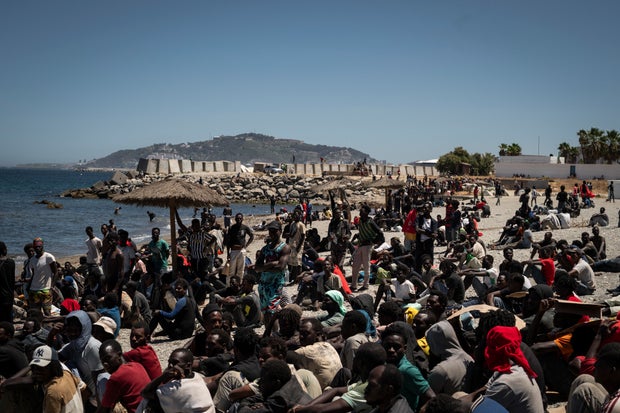
Spain Deploys Troops In Response To Border Breach In Ceuta
Migrants wait on the beach next to an immigrant center known as CETI (Centros de Estancia Temporal de Inmigrantes) on Aug. 2, 2026, in Ceuta.

Adri Salido/Getty Images

El Khalfi said about 40,000 people headed toward the city of Ceuta and another 1,135 people headed to Melilla, another Spanish enclave farther east. That’s lower than previous estimates of about 50,000 or 60,000 going to Ceuta.

Morocco’s interior ministry also released a death toll different from that given by Spanish authorities, who had said Sunday that at least 72 people died, including by drowning and in a stampede. El Khalfi said 11 people died, including one who fell from a rocky area near Ceuta and 10 due to drowning. 

He said Moroccan authorities are working with their Spanish counterparts to verify the numbers, identities and nationalities of those who died. Most of those who tried to cross were Moroccans. 

Most of the migrants who surged into Ceuta had returned to Morocco by Sunday, with many simply walking back across the border. El Khalfi also said all of those who reached Melilla “were returned immediately.” Spanish officials said they plan to add fencing around Ceuta.

Ceuta and Melilla have the only land borders the European Union shares with Africa.
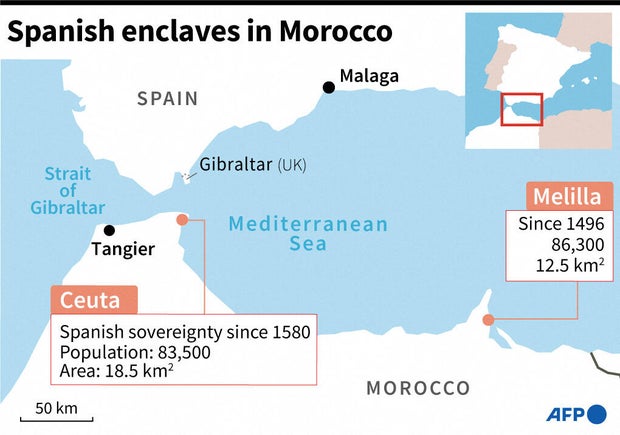
Map shows locations of the Spanish enclaves of Ceuta and Mellila in Morocco
Map shows locations of the Spanish enclaves of Ceuta and Melilla in Morocco. 

AFP via Getty Images

Ceuta is often seen as a destination for those trying to reach Spain from Africa, but crossing the border from Morocco into Ceuta does not immediately grant migrants free access to Europe. Additional border controls would be required to enter mainland Europe and transportation options are limited.

The scenes of chaos on Ceuta’s beaches and streets drew fierce condemnation from officials in Spain and conservative leaders across Europe. 

Italian Prime Minister Giorgia Meloni called on the European Union to suspend the Schengen agreement with Spain, which allows freedom of movement within member states. French Interior Minister Laurent Nunez said that he had given instructions to “immediately strengthen” controls at the border the nation shares with Spain. 
Trump will need China for his new economic war against Iran. Good luck getting Xi on side

Beijing (CNN) — When US Treasury Secretary Scott Bessent unveiled “Operation Economic Outcast,” threatening damaging new sanctions on countries that refuse to stop doing business with Iran, he didn’t name the one country that could decide its success or failure: China.The world’s second largest economy has long been a critical economic lifeline for Tehran, buying up the vast majority of its oil exports – worth an estimated tens of billions in US dollars last year – in addition to other trade.Bringing it on board with the White House’s latest effort to subdue an Iranian leadership stubbornly defiant after almost six months of war, however, is an extremely tall order.Beijing flatly rejects what it calls “unilateral” US sanctions and has long defended its right to regular trade with partners like Iran and Russia. It also surmises that Washington would be wary of triggering a broader economic confrontation that would hurt both countries, right ahead of the US midterms.On Tuesday, following Bessent’s presser, China’s Foreign Ministry vowed to “take all necessary measures” to safeguard its “own legitimate rights and interests” in the face of US sanctions threats.“Economic warfare and maximum pressure will not help resolve the issue; they will only further intensify tensions and conflicts, create spillover risks, disrupt the global economic and financial order,” ministry spokesperson Lin Jian said.Bessent’s threat also comes ahead of a highly anticipated visit by Chinese leader Xi Jinping to the US next month, where the two sides could make progress on extending a critical trade truce set to expire later this fall.Trump earlier said that he did not ask Xi “for any favors” on Iran during a May meeting between the two – a statement, which, if correct, will likely smell to Beijing of American desperation to end the conflict.What’s left now is a careful calculus for both countries in how they navigate what Bessent has said will be a period of “quiet diplomacy” – or privately issuing ultimatums to Iran’s economic partners, which the Treasury chief did not specifically name during his press conference.Chinese analysts suggest limited space for Washington’s demands: “China is unlikely to accept a situation in which Washington determines what Chinese companies can legally trade with third countries,” said Zhao Long, director of the Institute for International Strategic and Security Studies at the Shanghai Institutes for International Studies.“That would establish a precedent that US secondary sanctions can effectively determine China’s commercial relations with third countries,” he said.What Washington could doChina imports Iranian oil using a shadowy system that’s by design insulated from the US dollar system – and sanctions.Private, so-called teapot refineries, purchase and process US-sanctioned Iranian crude, relying on a network of ports, financial institutions and tankers that are often similarly firewalled from international exposure. China hasn’t recorded these purchases officially in years, since after the US re-imposed sanctions on Iran when the first Trump administration backed out of the Obama-era Iranian nuclear deal.But pressure points do exist, analysts say.“When you look at the upstream ownership of these entities, you’ll find many are directly or indirectly held by major Chinese state-owned entities that are heavily integrated into the US dollar system,” said Max Meizlish, a senior research analyst at the Foundation for Defense of Democracies think tank in Washington.“By sanctioning their subsidiaries, the US can apply pressure on the parents to divest at risk of being deemed as providing direct or indirect support to sanctioned entities,” he said.Bessent earlier this year said Washington has sent warnings to two unnamed Chinese banks about their role in Iran-linked transactions. When asked on Monday during his press conference what measures the US would take against non-compliant Chinese banks and shipping firms, he said “no one is above” facing US sanctions.Despite the tough talk, Beijing has seen the US threaten – and then back off – sweeping sanctions before. And it also knows Washington is acutely aware of China’s significant economic leverage over the US, especially in the form of its grip on the global supply of strategically critical rare earths.“If Washington crossed that threshold (of sanctioning major Chinese banks), Beijing would almost certainly respond, and the political atmosphere for a summit (between Trump and Xi) would deteriorate sharply,” said Sun Chenghao, a senior fellow at Tsinghua University’s Center for International Security and Strategy in Beijing.Such a move might not automatically cancel their meeting, but it would “shift the summit from stabilization toward damage control,” he said.Summit considerationsBoth sides will be weighing up the impact of escalation to that summit, expected to be the first state visit by Xi to the US in 11 years.While Beijing will not want to be seen to be cooperating with a sanctions regime it opposes, there are careful maneuvers it could take – such as quietly reducing oil purchases or elevating its political messaging to Tehran and efforts to encourage restraint.Chinese purchases of Iranian oil have already declined sharply compared to last year as the US blockade has constrained Iranian crude exports.Chinese analysts have also in recent weeks suggested there are overlaps between the interests of Washington and Beijing, especially in terms of seeing trade flows restored in the Strait of Hormuz, which has been choked by the conflict, and restoring broader regional stability, also conductive to trade.And Beijing has in recent days re-upped its messaging urging restraint and normal operations around the Strait.In a joint statement following a meeting with Jordanian King Abdullah II in Beijing on Monday, Xi called for the restoration of “normal passage” through the Strait and a “comprehensive solution” to the conflict.Chinese Vice Foreign Minister Miao Deyu said last week while hosting Iranian officials in Beijing that China was “actively committed to promoting peace talks.”Even still, Beijing has shown itself wary of playing a direct mediator role in the conflict, preferring a position where it protects its own economic interests – and plays up its image as a stable power that supports regional peace, in contrast to Washington’s vacillations.Any cooperation with the US in restoring regional peace “should not be reduced to ‘doing Trump a favor,’” said Zhao in Shanghai.“Beijing is willing to contribute to ending the crisis, but it is not willing to become an instrument of Washington’s maximum-pressure strategy.”The-CNN-Wire™ & © 2026 Cable News Network, Inc., a Warner Bros. Discovery Company. All rights reserved.
Read Next Story