‘Massive’ Russian strikes kill 17 in Kyiv, Zelenskyy says, as no missiles intercepted

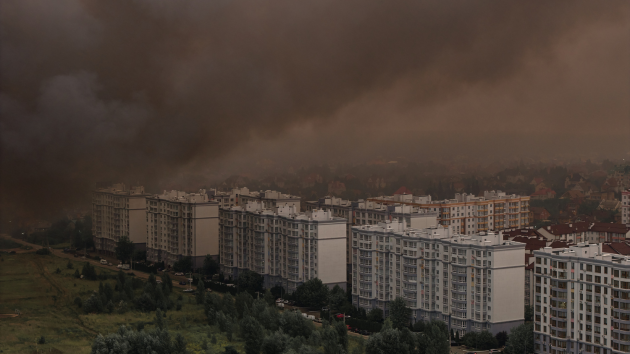
Thick black smoke engulfs buildings on the outskirts of Kyiv following a Russian ballistic missile attack on the capital on August 5, 2026 in Kyiv, Ukraine. (Photo by Kostiantyn Liberov/Libkos/Getty Images)

(LONDON) — Ukrainian President Volodymyr Zelenskyy said on Wednesday that at least 17 people were killed in Kyiv and the surrounding region in a massive overnight Russian missile and drone strike, with Ukraine’s air force failing to intercept any missiles amid a shortage of air defense munitions.

Ukraine’s air force said in a post to Telegram that Russia launched 115 drones and 28 missiles — 24 ballistic missiles and four anti-ship missiles — into the country overnight, of which 98 drones were intercepted.

None of the missiles were shot down, the air force said citing “preliminary data,” reporting missile and drone impacts across 26 locations.

Zelenskyy said in a post to Telegram that the “massive” and “devastating” attack killed at least 17 people. At least another 44 people were injured in the attack, Zelenskyy added.

“The main targets of the attack were storage facilities belonging to civilian enterprises, but there were also strikes on infrastructure and a railway station,” Zelenskyy said. “The targets included entities unrelated to the war: a brewery, warehouses for building materials and civilian logistics facilities.”

“Ballistic missile interceptors — these are what could have saved the lives of those who died today,” Zelenskyy wrote. “It is crucial that our partners understand that delays in their supply or a reluctance to provide anti-ballistic systems leads to precisely these horrific casualties and destruction.”

“A significant portion of Russian ballistic missile production is not currently under sanctions. This needs to change. New steps are needed from the G7, from the EU, from everyone who supports the protection of life,” Zelenskyy wrote.

The Russian Defense Ministry said in a statement posted to Telegram that its “massive strike” targeted what it said were “transport, logistics and distribution centers in the city of Kyiv and the Kyiv region.”

The ministry said that storage and distribution facilities for drone components and electronic warfare systems were among the targets struck, as were three cargo ships.

The ministry also said that Russian forces shot down at least 475 Ukrainian drones overnight into Wednesday morning.

Copyright © 2026, ABC Audio. All rights reserved.

Baby with heart defect at center of surrogate dispute receives first surgery

▶ Watch Video: Where the Texas surrogate dispute stands right now A baby born with a rare heart defect who is at the center of a dispute between a surrogate and the parents underwent the first in a series of surgeries, a lawyer representing the child's parents said Monday.The baby, whom the parents have named Rumi, was born Wednesday in Texas with hypoplastic left heart syndrome, a rare heart defect that requires a series of surgeries, with the first typically happening during the first weeks of life. Lee Budner, the attorney for parents Omar Ahmed and Nausheen Gilkar, said the baby's medical team determined Friday, "after thorough examination and imaging, that Rumi was eligible for a Norwood procedure, a complex palliative heart surgery that is the first of a series of three surgeries that are required within the first several years of life for babies born with HLHS."The procedure was performed Monday morning, Budner said, and "Rumi is now recuperating under the loving care of his parents and his heroic team of doctors, nurses, and medical staff." "This is the last update on Rumi's health that his family intends to share. His condition remains critical and complex, and his family seeks privacy in caring for their son on his long road to recovery," Budner added.The second surgery is usually performed at 4 to 6 months, and the third between 18 months and 5 years old, according to the Cleveland Clinic. The heart condition is rare and complex, the Cleveland Clinic says, and can cause lifelong complications. Several months before Rumi was born, when Gilkar and Ahmed learned of the heart defect, they asked the surrogate, McKenna West, to get an abortion, according to Texas Attorney General Ken Paxton, who intervened in the case last week. Gilkar and Ahmed are from California and West is from Alaska. West refused to get the abortion and instead went to Texas before the baby was born. Paxton had secured a court order saying the baby must receive lifesaving medical care after birth. The court also ruled that Gilkar and Ahmed are responsible for medical decisions within the requirements of the court order.As a result of those orders, West was not allowed any contact with the child after his birth, her attorney, Lincoln Davis Wilson, told CBS News last week. Wilson said West intended to continue efforts to gain custody of the child, whom she had been calling Gabriel."We are working on challenging those orders of parentage because we think that Texas law makes a woman who gives birth [to] a child, the mother of the child," he said last week.CBS News has reached out to Wilson for comment.Gilkar and Ahmed had previously asked a California court to order West to give birth there.Budner said Monday that West "continues to assert baseless claims for custody of Rumi, in violation of multiple courts orders out of both Alaska and California. We look forward to quickly defeating those claims as Rumi's parents continue to focus on his health and safety above all else."
Read Next Story