Human remains exhumed at WWII massacre site in Ukraine

▶ Watch Video: Extended interview: Polish Deputy Prime Minister Radek Sikorski on the war in Ukraine

Beneath two now-deserted villages in western Ukraine — the site of World War II-era massacres — archaeologists are uncovering the bones at the heart of a dispute that has strained relations between Warsaw and Kyiv for years.

Disagreements over what happened and who is responsible for the Volyn massacres have long cast a shadow over ties between the otherwise now close neighbors.

Between 1943 and 1945, tens of thousands of civilians were killed by the Ukrainian Insurgent Army (UPA) in territory occupied by Nazi Germany, according to Polish estimates of the toll.

Warsaw calls it a “genocide” against the Polish minority, while Ukraine hails the UPA as freedom fighters, sees the events as a wartime “tragedy” and says that Ukrainians were killed in retaliation.

The exact number of people killed at the time remains contested, but Poland’s Institute of National Remembrance (IPN) estimates that about 100,000 people died in the 1943-45 anti-Polish campaign in the Volhynia, Eastern Galicia and Lublin regions. The institute also estimates that at least 10,000 died in Polish attacks of retaliation.

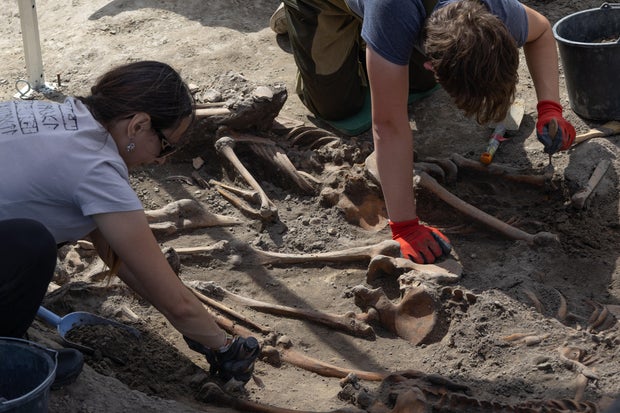
Amid sunflower fields and forests, joint Polish-Ukrainian teams of archaeologists have been carefully excavating the remains of victims.

“We want to restore their first and last names … to fulfil the duty that rests on us as heirs of those who were murdered here,” said Karol Polejowski, deputy president of the IPN.

The remains of over 50 people have been recovered in a series of exhumations taking place in the area, but they have yet to be identified.  
UKRAINE-POLAND-HISTORY-WWII
Archaeologists recover human remains at the exhumation site of the World War II Volhynia massacre near the destroyed village of Ostrivky, Volyn region on July 28, 2026. 

Serhii Okunev /AFP via Getty Images

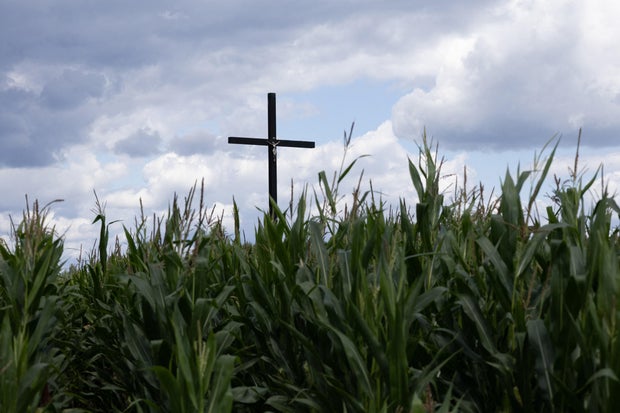
A handmade wooden cross, planted near the graves, is one of the few signs that the villages ever existed.

Political leaders in both countries believe the exhumations can be a first step in repairing relations, which have been strained this year by a rift triggered when Ukrainian President Volodymyr Zelenskyy named a military unit after the UPA.

“Driven to the field of death barefoot”  

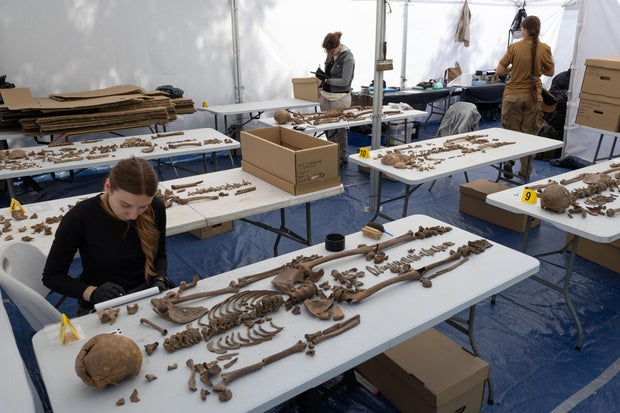
In a white tent around six miles from the Polish border, experts meticulously lay out the skeletons of recovered victims, measuring bones and carefully trying to match broken skull fragments.

A small number of other artefacts — rosaries, religious medallions and shoes — have also been unearthed under the field of yellow-and-black sunflowers, one of the national symbols of Ukraine.

“The remains were arranged in a highly disordered manner. Most of the bodies had been brought to the burial pit and simply dumped into it,” Olga Mineiko, an anthropologist at the Ukrainian Memorial and Search Center, told AFP on the site.

The victims were likely “driven to the field of death barefoot and without personal belongings,” said Polejowski.
UKRAINE-POLAND-HISTORY-WWII
Archaeologists work with human remains at the exhumation site of the World War II Volhynia massacre near the destroyed village of Ostrivky, Volyn region on July 28, 2026. 

Serhii Okunev /AFP via Getty Images

The genetic material is collected, with the IPN appealing to Poles who believe they may have lost relatives in the massacre to provide their own to help find matches.

Forensic specialists and anthropologists will also examine the bones to determine the approximate age, sex and cause of death of each of them.

It is believed that 30 to 40% of the 50 remains so far discovered at the site were children, according to Polejowski.

Diplomatic spat 

The massacres have been a recurring point of contention between Warsaw and Kyiv.

The UPA was a paramilitary organization tied to the Ukrainian independence movement that fought the Soviet Union’s Red Army.

But it collaborated with the Nazis when they first invaded the Soviet Union, clashed with the Polish resistance and killed Poles, Jews and other civilians.

Since Russia invaded in 2022, the UPA has been honored in Ukraine as a force that fought for independence from Moscow under the Soviet Union. Kyiv insisted Zelenskyy’s choice of name for the military unit was not directed against Warsaw.

But Polish President Karol Nawrocki withdrew Poland’s highest national honor from him in response. Three former Ukrainian presidents later returned their White Eagle awards to Poland in solidarity with Zelenskyy, BBC News reported.

In Poland, the issue has become even more politicized as nationalist parties seek to embolden their base ahead of parliamentary elections next year — part of a broader campaign to whip up anti-Ukrainian sentiment.

Poland is home to hundreds of thousands of Ukrainian refugees — with a backlash against their presence having surged during a divisive presidential election campaign last year, won by the right-wing Nawrocki.

The country is still the main hub for military and humanitarian aid deliveries to Ukraine, and Prime Minister Donald Tusk’s pro-European government has repeatedly called for a de-escalation.

Warsaw has welcomed efforts by Zelenskyy to cool the tension, including the promise of opening classified intelligence documents.

As Tusk and Zelenskyy try to bury the hatchet, in the Ukrainian fields near the Polish border, plans are underway for a proper farewell to those uncovered.

“We want them to be buried here, where they lived, where each of them had their dreams and plans, and wanted their life to unfold,” said Polejowski. “In this soil they should rest.”

Last month, Tusk announced the creation of a national memorial to the victims, BBC News reported.

“Truth is our duty toward the victims, but also a way to overcome a painful past for the sake of a better future,” he said. “Memory cannot be the servant of hatred. The answer to nationalism cannot be more nationalism.”
UKRAINE-POLAND-HISTORY-WWII
A cross is seen at the exhumation site of the World War II Volhynia massacre near the destroyed village of Ostrivky, Volyn region on July 28, 2026.

Serhii Okunev /AFP via Getty Images
Julián Álvarez fue silbado y se fue sin saludar a la afición: ¿qué sigue en la novela del argentino?

No fue un domingo cualquiera para Julián Álvarez. En realidad, no lo ha sido ningún día desde aquella frase que pronunció durante la Copa del Mundo: “lo mejor para todos es una transferencia”, cuando se hablaba de un fuerte interés del FC Barcelona por contratarlo. El fichaje no se hizo —porque el Atlético de Madrid no quiso negociar— y aquellas siete palabras, pronunciadas a un océano de distancia de España, le ganaron la enemistad de toda la afición del Atlético de Madrid, el club que pagó por él más de US$ 87 millones hace dos temporadas.La afición le hizo pagar esas palabras este domingo, en la primera vez que el delantero argentino pisó el estadio Metropolitano, cuando ingresó en el segundo tiempo de un partido que el Colchonero empataba 1-1. Pero ni la urgencia del resultado ni la necesidad por los goles de Álvarez —acaso su mejor centroatacante— para revertirlo le hicieron olvidar a las gradas rojiblancas las palabras del número 9, que recibió una silbatina generalizada al momento de ingresar al campo (ya había sido reprobado por el estadio durante el calentamiento).Álvarez no tuvo un buen ingreso y, aunque su equipo acabó rescatando un empate con 10 jugadores cerca del final, el goleador argentino se llevó la imagen final, sin participar del tradicional saludo que hace el Atlético, dando la vuelta al campo para agradecer a la afición. El delantero se fue a los vestuarios en soledad. Un gesto que, como dice el dicho, vale más que mil palabras.“Me comentaba la gente del club, que el club decidió que él no se acerque a saludar con sus compañeros a la gente. La decisión no fue de Julián Alvarez, fue del club, que tomó la decisión de alejarlo y separarlo para que se vaya hacia el vestuario”, dijo su director técnico, Diego Simeone, tras el juego.Queda exactamente una semana del mercado de fichajes en Europa, por lo que la presencia de Julián Álvarez en el Atlético de Madrid sigue estando en el aire para el resto de la temporada. El problema es que la reacción de la afición este domingo parece mostrar un punto de no retorno en la relación con el futbolista, que tampoco ha salido a expresar una disculpa o una explicación a sus dichos durante el Mundial.Un problema aún mayor es que, pese al deseo de ser transferido que tiene el jugador, el club no tiene ninguna intención de desprenderse de él y, conforme van pasando los días, el mercado se va achicando, porque al conocer las altas demandas de la directiva del Colchonero, los interesados salen a buscar alternativas, apurados por la fecha límite del 1 de septiembre.Por supuesto, el Atleti, a medida que pasan las horas, tiene cada vez menos deseos de abrirle la puerta de salida, porque se quedaría con muy poco tiempo para salir a buscarle un reemplazo al futbolista estrella que tiene la plantilla. Hallar un sustituto para el jugador que marcó 49 goles y dio 17 asistencias en 107 partidos con el club supondría muchos millones arriba de la mesa, posiblemente teniendo que pagar un valor más alto que de lo que dicta el mercado.Los destinos para Julián Álvarez son muy pocos. El Atleti ya dejó claro que no va a negociar con clubes españoles, porque no quiere reforzar a la competencia. Fuera de España, solo se conoció el interés del Arsenal y uno más pequeño del PSG. Ninguno prosperó, en parte por el deseo del jugador de vestirse de blaugrana.Los Gunners, campeones de la Premier League y subcampeones de la Champions League, podrían hacer el intento, a pesar de que en el ataque ya tienen muchas alternativas. Por eso se había barajado la idea de que los londinenses pusieran dinero y algún futbolista —como Viktor Gyökeres, por ejemplo— en la mesa de negociación, algo que le cerraría a la directiva española, ya que el jugador se iría a otra liga y tendría garantizado un nombre de reemplazo. Sin embargo, si la idea no prosperó es porque o no hubo acuerdo por el monto de dinero, o porque el futbolista no tiene grandes deseos de volver a una liga de la cual ya se fue —jugó en el Manchester City de 2022 a 2024—.La posibilidad de los parisinos se mencionó mucho al comienzo del mercado de fichajes, pero fue perdiendo fuerza con el correr de los días. Mucho más desde que los bicampeones de Europa se hicieron con los servicios de Ferran Torres, el héroe de la final del Mundial 2026, que ya empezó a pagar la confianza de Luis Enrique con goles, marcando un doblete en su presentación, también este domingo.Entonces, el futuro de Julián Álvarez parece estar entre tres destinos: quedarse en el Atlético, ya sea para revertir la situación o para esperar la ventana de transferencias de enero; reflotar la idea de volver a la Premier League, pero con la camiseta del Arsenal —un equipo que quizás tampoco seduce tanto por el estilo de juego que tienen los dirigidos por Arteta—; o que el FC Barcelona finalmente abra la chequera y ponga muchísimos millones arriba de la mesa, 500 millones de euros, para ser exactos, que es su cláusula de recisión. Una cifra jamás pagada por un futbolista, y por mucha diferencia.“Primero, juntos siempre somos más fuertes. Eso siempre nos caracterizó siendo el Atlético de Madrid distinto al resto. Julián es un jugador nuestro”, dijo Giuliano Simeone —autor del empate 2-2— a la prensa tras el partido.“Tenemos que estar todos juntos tirando para el mismo lado, porque, si no, nos vamos a dividir y eso no es bueno. Julián es jugador nuestro y vamos a apoyarlo siempre”, agregó el mediocampista.Su padre, el entrenador del equipo, también defendió a Julián Álvarez, pero con un poco más de cautela.“No estoy para dar consejos. Tengo que centrarme en mi trabajo, que es deportivamente hacer lo mejor para el Atlético de Madrid. Si el Atlético de Madrid quiere ganar algún título necesitamos estar juntos, tener delanteros importantes y para eso necesitamos trabajar en consecuencia todos de lo que necesitamos”, dijo en la rueda de prensa.“Creo que fui bastante claro. Necesitamos estar juntos. Cuando estuvimos juntos siempre hemos podido hacer cosas importantes”.The-CNN-Wire™ & © 2026 Cable News Network, Inc., a Warner Bros. Discovery Company. All rights reserved.
Read Next Story