Human remains exhumed at WWII massacre site in Ukraine

▶ Watch Video: Extended interview: Polish Deputy Prime Minister Radek Sikorski on the war in Ukraine

Beneath two now-deserted villages in western Ukraine — the site of World War II-era massacres — archaeologists are uncovering the bones at the heart of a dispute that has strained relations between Warsaw and Kyiv for years.

Disagreements over what happened and who is responsible for the Volyn massacres have long cast a shadow over ties between the otherwise now close neighbors.

Between 1943 and 1945, tens of thousands of civilians were killed by the Ukrainian Insurgent Army (UPA) in territory occupied by Nazi Germany, according to Polish estimates of the toll.

Warsaw calls it a “genocide” against the Polish minority, while Ukraine hails the UPA as freedom fighters, sees the events as a wartime “tragedy” and says that Ukrainians were killed in retaliation.

The exact number of people killed at the time remains contested, but Poland’s Institute of National Remembrance (IPN) estimates that about 100,000 people died in the 1943-45 anti-Polish campaign in the Volhynia, Eastern Galicia and Lublin regions. The institute also estimates that at least 10,000 died in Polish attacks of retaliation.

Amid sunflower fields and forests, joint Polish-Ukrainian teams of archaeologists have been carefully excavating the remains of victims.

“We want to restore their first and last names … to fulfil the duty that rests on us as heirs of those who were murdered here,” said Karol Polejowski, deputy president of the IPN.

The remains of over 50 people have been recovered in a series of exhumations taking place in the area, but they have yet to be identified.  

UKRAINE-POLAND-HISTORY-WWII
Archaeologists recover human remains at the exhumation site of the World War II Volhynia massacre near the destroyed village of Ostrivky, Volyn region on July 28, 2026. 

Serhii Okunev /AFP via Getty Images

A handmade wooden cross, planted near the graves, is one of the few signs that the villages ever existed.

Political leaders in both countries believe the exhumations can be a first step in repairing relations, which have been strained this year by a rift triggered when Ukrainian President Volodymyr Zelenskyy named a military unit after the UPA.

“Driven to the field of death barefoot”  

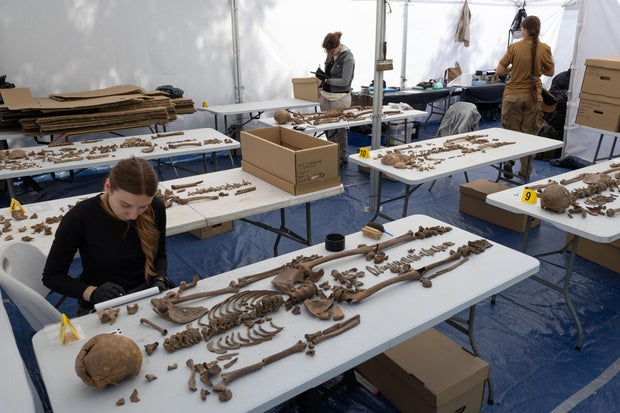
In a white tent around six miles from the Polish border, experts meticulously lay out the skeletons of recovered victims, measuring bones and carefully trying to match broken skull fragments.

A small number of other artefacts — rosaries, religious medallions and shoes — have also been unearthed under the field of yellow-and-black sunflowers, one of the national symbols of Ukraine.

“The remains were arranged in a highly disordered manner. Most of the bodies had been brought to the burial pit and simply dumped into it,” Olga Mineiko, an anthropologist at the Ukrainian Memorial and Search Center, told AFP on the site.

The victims were likely “driven to the field of death barefoot and without personal belongings,” said Polejowski.
UKRAINE-POLAND-HISTORY-WWII
Archaeologists work with human remains at the exhumation site of the World War II Volhynia massacre near the destroyed village of Ostrivky, Volyn region on July 28, 2026. 

Serhii Okunev /AFP via Getty Images

The genetic material is collected, with the IPN appealing to Poles who believe they may have lost relatives in the massacre to provide their own to help find matches.

Forensic specialists and anthropologists will also examine the bones to determine the approximate age, sex and cause of death of each of them.

It is believed that 30 to 40% of the 50 remains so far discovered at the site were children, according to Polejowski.

Diplomatic spat 

The massacres have been a recurring point of contention between Warsaw and Kyiv.

The UPA was a paramilitary organization tied to the Ukrainian independence movement that fought the Soviet Union’s Red Army.

But it collaborated with the Nazis when they first invaded the Soviet Union, clashed with the Polish resistance and killed Poles, Jews and other civilians.

Since Russia invaded in 2022, the UPA has been honored in Ukraine as a force that fought for independence from Moscow under the Soviet Union. Kyiv insisted Zelenskyy’s choice of name for the military unit was not directed against Warsaw.

But Polish President Karol Nawrocki withdrew Poland’s highest national honor from him in response. Three former Ukrainian presidents later returned their White Eagle awards to Poland in solidarity with Zelenskyy, BBC News reported.

In Poland, the issue has become even more politicized as nationalist parties seek to embolden their base ahead of parliamentary elections next year — part of a broader campaign to whip up anti-Ukrainian sentiment.

Poland is home to hundreds of thousands of Ukrainian refugees — with a backlash against their presence having surged during a divisive presidential election campaign last year, won by the right-wing Nawrocki.

The country is still the main hub for military and humanitarian aid deliveries to Ukraine, and Prime Minister Donald Tusk’s pro-European government has repeatedly called for a de-escalation.

Warsaw has welcomed efforts by Zelenskyy to cool the tension, including the promise of opening classified intelligence documents.

As Tusk and Zelenskyy try to bury the hatchet, in the Ukrainian fields near the Polish border, plans are underway for a proper farewell to those uncovered.

“We want them to be buried here, where they lived, where each of them had their dreams and plans, and wanted their life to unfold,” said Polejowski. “In this soil they should rest.”

Last month, Tusk announced the creation of a national memorial to the victims, BBC News reported.

“Truth is our duty toward the victims, but also a way to overcome a painful past for the sake of a better future,” he said. “Memory cannot be the servant of hatred. The answer to nationalism cannot be more nationalism.”

UKRAINE-POLAND-HISTORY-WWII
A cross is seen at the exhumation site of the World War II Volhynia massacre near the destroyed village of Ostrivky, Volyn region on July 28, 2026.

Serhii Okunev /AFP via Getty Images

¿Ver demasiada televisión es malo para tu cerebro? Es posible

¿Sospechas que pasar horas todos los días frente al televisor no le está haciendo ningún favor a tu cerebro? Un nuevo estudio sugiere que podrías estar en lo cierto.Los investigadores descubrieron que las personas que declararon ver más televisión en la mediana edad tenían un menor volumen cerebral décadas después en áreas relacionadas con el lenguaje y el pensamiento. Por otro lado, estar sentado en el trabajo se asoció con indicadores cerebrales más saludables.¿Qué podemos deducir de estos hallazgos? ¿Significa esto que es hora de apagar la televisión para siempre? Para ayudar a responder estas preguntas, hablé con la Dra. Leana Wen, experta en bienestar de CNN, médica de urgencias y profesora clínica asociada en la Universidad George Washington. Anteriormente fue comisionada de Salud de Baltimore.CNN: ¿Se asocia ver televisión con cambios en el cerebro años después?Dra. Leana Wen: Eso es lo que encontró este estudio, aunque es importante comprender exactamente qué midieron los investigadores y qué conclusiones podemos extraer.Investigadores analizaron datos de más de 1.700 participantes en un estudio de larga duración financiado por los Institutos Nacionales de la Salud. Los participantes, de mediana edad, informaron sobre la frecuencia con la que veían televisión y el tiempo que pasaban sentados en el trabajo durante el año anterior. En cuanto al tiempo dedicado a ver televisión, respondieron a un cuestionario estandarizado en el que indicaban la frecuencia con la que veían la televisión y clasificaban sus hábitos en una de cinco categorías: nunca, rara vez, a veces, a menudo o muy a menudo. Los participantes tenían entre 45 y 64 años al inicio del estudio, con una edad promedio de 53 años. Más de dos décadas después, se sometieron a resonancias magnéticas cerebrales.Las personas que informaron ver televisión “muy a menudo” a menudo tenían volúmenes más pequeños en varias regiones del cerebro, incluidas partes involucradas en el control cognitivo y el lenguaje, así como áreas que son especialmente vulnerables en las primeras etapas de la enfermedad de Alzheimer. Estos espectadores también presentaban más hiperintensidades de la sustancia blanca, que son cambios observados en la resonancia magnética que reflejan lesión en los pequeños vasos sanguíneos del cerebro y se han vinculado con el deterioro cognitivo y la demencia.CNN: Uno de los hallazgos más sorprendentes fue que la actividad sedentaria en otro contexto —el trabajo— no se relacionó con los mismos cambios cerebrales. ¿Por qué ver la televisión podría ser diferente a estar sentado en el trabajo?Wen: Este hallazgo interesante sugiere que no todas las actividades sedentarias son iguales. Ver televisión es una actividad cognitivamente pasiva porque los espectadores principalmente reciben información en lugar de procesarla activamente. Estar sentado en el trabajo suele implicar exigencias mentales muy diferentes. Puedes responder correos electrónicos, trabajar en proyectos e interactuar con colegas. Esas actividades activan múltiples redes cerebrales, aunque estés sentado.El estudio no demuestra que las actividades mentalmente estimulantes protejan el cerebro, pero los hallazgos coinciden con un creciente cuerpo de investigación que sugiere que el compromiso cognitivo ayuda a reducir el riesgo de demencia. Estudios previos también han encontrado diferencias entre comportamientos sedentarios pasivos, como ver televisión, y otros más mentalmente activos, incluidos resolver rompecabezas y estar mentalmente involucrado durante el trabajo.CNN: ¿Demuestra este estudio que ver la televisión causa cambios cerebrales negativos?Wen: No. Este fue un estudio observacional, lo que significa que puede identificar asociaciones, pero no establecer causa y efecto.Es posible que las personas que veían más televisión difirieran de las que veían menos en aspectos que los investigadores no pudieron explicar completamente, a pesar de haber ajustado por muchos factores, como la edad, la educación, la actividad física, el tabaquismo, el consumo de alcohol, la diabetes, la hipertensión y el índice de masa corporal.También es posible que cambios sutiles en la salud cerebral influyeran en los hábitos de las personas años antes de que se realizaran las resonancias magnéticas, de modo que las personas con alteraciones en la materia cerebral fueran más propensas a pasar sus días viendo televisión que los participantes que no presentaban dichas alteraciones.Aun así, este fue un estudio bien realizado que siguió a los participantes durante más de dos décadas y utilizó resonancias magnéticas cerebrales detalladas en lugar de pruebas subjetivas. Si bien los hallazgos no deben interpretarse como prueba de que la televisión daña el cerebro, se suman a la creciente evidencia de que el comportamiento pasivo y sedentario prolongado no es ideal para la salud cerebral a largo plazo.CNN: Los investigadores ajustaron por la actividad física. ¿Significa eso que ir al gimnasio no es suficiente para compensar las horas dedicadas a ver televisión?Wen: Es un punto interesante porque sabemos que mantenerse físicamente activo ayuda a reducir el riesgo de demencia. Pero el ejercicio regular no compensa todos los demás factores de riesgo.En este estudio, la asociación entre ver mucha televisión y los cambios cerebrales se mantuvo incluso después de que los investigadores tuvieran en cuenta la actividad física. En otras palabras, alguien que hace ejercicio con regularidad, pero también pasa muchas horas cada día viendo televisión aún tiene riesgos adicionales de peor salud cognitiva debido a su comportamiento pasivo y sedentario. Mantenerse físicamente activo y limitar este tipo de comportamiento pasivo y sedentario prolongado parecen ser importantes.CNN: ¿Deberían las personas renunciar a ver televisión? ¿Qué pasa con otras formas de tiempo de pantalla pasivo, como desplazarse en un teléfono o tableta?Wen: No creo que este estudio signifique que la gente deba dejar de consumir todo tipo de contenido en pantalla. Ver un evento deportivo, seguir un programa favorito o ver una película puede ser divertido y relajante; además, estos pasatiempos nos ayudan a conectar con familiares y amigos, lo cual es beneficioso para nuestra salud en muchos aspectos.En mi opinión, la conclusión clave es reflexionar sobre cuánto tiempo dedicamos a actividades pasivas frente a la pantalla y qué actividades sustituimos con ellas. Si pasamos varias horas viendo televisión o en las redes sociales en lugar de hacer ejercicio, interactuar socialmente en persona, leer o realizar otras actividades que estimulen la mente, eso no es lo ideal para la salud cerebral.La gente debe tener en cuenta que no todo el tiempo frente a la pantalla es igual. Por ejemplo, participar en una clase de idiomas en línea —en la que se aprende una nueva habilidad y se interactúa activamente con otras personas— estimula el cerebro de manera diferente a ver programas de televisión de forma pasiva o navegar por internet sin un propósito concreto. Y siempre es una buena idea evitar estar sentado durante períodos largos e ininterrumpidos levantándose periódicamente para estirarse y caminar un poco.CNN: Además de reducir el tiempo de pantalla pasivo, ¿cuáles son las formas basadas en evidencia para proteger la salud cerebral a medida que envejecemos?Wen: La actividad física regular es una de las intervenciones más sólidas respaldadas por la investigación. También lo es controlar la presión arterial, tratar afecciones crónicas como la diabetes, evitar fumar, limitar el consumo excesivo de alcohol, dormir lo suficiente y mantener un peso saludable. Un patrón de alimentación de estilo mediterráneo rico en frutas, verduras, cereales integrales, legumbres, frutos secos, pescado y grasas saludables también se ha asociado con una mejor salud cerebral.Mantenerse socialmente conectado es fundamental, al igual que tratar la pérdida auditiva, la depresión y otros factores que pueden impedir que las personas pasen tiempo con sus seres queridos. Ninguna actividad por sí sola puede garantizar la protección contra la demencia, pero la combinación de decisiones cotidianas —incluida la forma en que empleamos nuestro tiempo libre— puede marcar la diferencia a lo largo de las décadas.The-CNN-Wire™ & © 2026 Cable News Network, Inc., a Warner Bros. Discovery Company. All rights reserved.
Read Next Story