
▶ Watch Video: Dr. Anthony Fauci on pandemics and partisan attacks
Growing up on 13th Avenue in Dyker Heights, Brooklyn, in the 1940s and ’50s, Anthony “Tony” Fauci was the precocious son of the corner pharmacist. “They called him Doc,” he said. “The pharmacist back then served as the neighborhood psychiatrist, marriage counselor. So, it was serving the community.”
The Fauci Pharmacy is long-gone. But beneath the calm façade Dr. Anthony Fauci has shown the world for more than 50 years, he is still – as he says – “Brooklyn tough.”
Did he get into fights every now and then? “How could you not?” he said.
“How’d you do?” LaPook asked.
“Well, I’m not the biggest guy in the world.”
“But at 5’7”, you were the captain of the basketball team. How did you do that?“
“I was very fast and I had a really good shot,” Fauci said.
“What killed your NBA career?”
“I found out that a very fast, good shooting point guard who’s 5’7″ will always get destroyed by a point guard who’s 6’3″. That became very clear!” Fauci laughed. “So, I said, ‘Oh, let me just settle for science, whatever.'”
There are millions today who owe their lives to the work of the man who “settled” for science. And as he chronicles in his new memoir, “On Call: A Doctor’s Journey in Public Service,” Dr. Fauci’s career treating infectious diseases at the National Institutes of Health has been bookended by the two great pandemics of our time: AIDS and COVID-19.
When it first widely appeared in the early 1980s, a diagnosis of HIV/AIDS was a death sentence.
Dr. LaPook asked, “Looking at your background, you were brought up in Brooklyn in the ’40s, kind of a conservative family. You might not necessarily predict that you would then go on to treat a group of people who were kind of shunned by society. What went into that?”
“What it was that, one of the predominant themes in my home, which was fortified with the Jesuit education, was empathy,” Dr. Fauci replied. “My father was quite conservative, you know, an Eisenhower-type Republican, as was my mother. But my father was very, very much guided by empathy for anybody.”
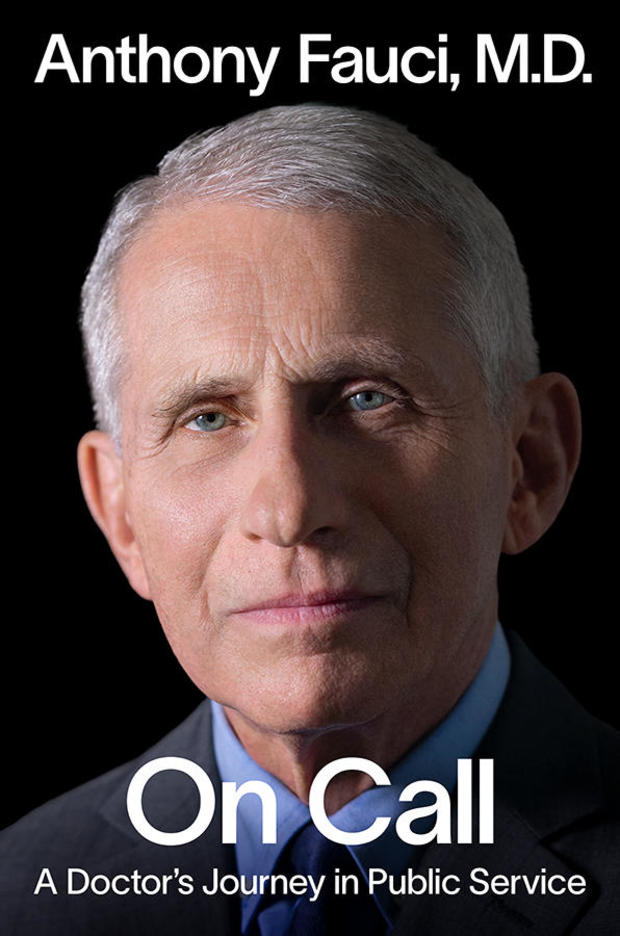
Viking Press
Although empathy for AIDS patients was in short supply, and he was criticized early on, Dr. Fauci used his position at the NIH to lobby the White House for funding – and for national attention.
He worked with seven presidents on AIDS, bird flu, swine flu, Ebola, Zika, and COVID. An AIDS program started with George W. Bush has saved an estimated 25 million lives worldwide.
With Bill Clinton, Dr. Fauci established the NIH’s Vaccine Research Center, which laid the groundwork for the record-breaking development of COVID vaccines during the Trump administration.
But that last collaboration hit a wall on April 3, 2020, the day President Trump held a press briefing in which he said the CDC was now recommending that people wear masks, and then he added, “This is voluntary. I don’t think I’m going to be doing it.”
Dr. Fauci said, “I was deeply disturbed by that, because he had the opportunity as the leader of the country with a very strong, devoted following to say, ‘The CDC has recommended masks, and I’m gonna wear a mask, because masks are gonna protect me and protect others.’ That really was a missed opportunity, because that was a signal to his devoted followers that you don’t really have to listen to the CDC, you don’t have to listen to the public health messages.”
As the country’s willingness to follow public health advice largely split along party lines, Dr. Fauci came under attack, and he received death threats.
Had that ever happened before? “No, not credible death threats where a person is arrested who was clearly intending to kill you,” Dr. Fauci said. “And that’s happened at least twice. We’re acting like, we have a virus that’s the common enemy and we’re fighting with each other.”
Earlier this month, Dr. Fauci was called before a Republican-led congressional committee to discuss pandemic origins and preparedness. But things quickly spun out of control, as Rep. Marjorie Taylor Greene (R-Ga.), said, “What this committee should be doing … we should be recommending you to be prosecuted.”
Dr. LaPook asked, “How did we go, as a country, from absolutely adoring Jonas Salk, who helped develop the polio vaccine, he was a national hero, to Dr. Anthony Fauci having to have security details to stop people from killing him?”
“It’s a reflection of the psyche of the country,” Dr. Fauci replied. “If the purpose of the hearing is to figure out how we can do better to prevent and respond to and prepare for the next pandemic, well, that [attack] doesn’t even begin to contribute to that.”
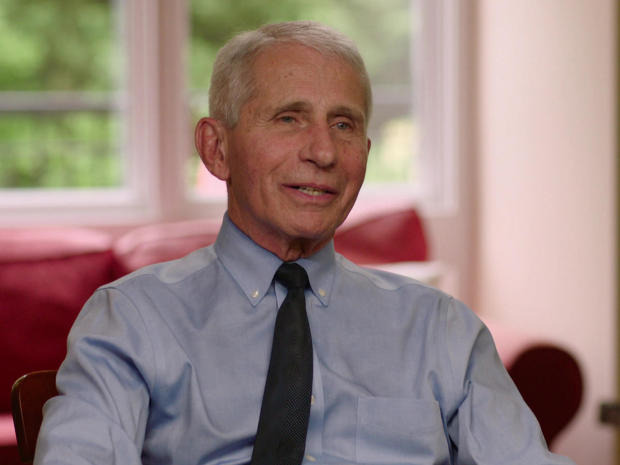
CBS News
One of the deepest points of controversy is the still-unknown origin of SARS-CoV-2, the virus that caused the COVID-19 outbreak. Because the NIH has funded research at the Wuhan Institute of Virology in China, there are accusations that American tax dollars could have paid to create SARS-CoV-2 through genetic manipulation, what’s called “gain of function.”
Dr. LaPook asked if this was biochemically and genetically possible. “No,” Dr. Fauci replied. “When you have a virus, if you’re gonna manipulate it in a way to make it a ‘dangerous’ virus, you have to start off with a precursor virus that’s close enough to the virus that you ultimately make, that it is molecularly possible to do that. What is absolutely 100% certain is that the viruses that were studied under the NIH grant, for the kinds of experiments that were done, molecularly were so far removed from SARS-CoV-2 that they could not have turned it into SARS-CoV-2 even if they tried, which they obviously didn’t do.
“But it was just so, what we call, phylogenetically distant … what it means is that, evolutionarily it’s so far, it would take 20 years of evolution to get it there. And that’s something that just slips between the cracks when people talk about it,” Dr. Fauci said. “What we’re talking about is what the NIH funded, was viruses that could not possibly have done that.”
COVID origins aside, Dr. Fauci has been subjected to other accusations, such as getting money from pharmaceutical companies. Dr. LaPook asked, “You have been offered money to leave the NIH, right, and join, say, pharma, right?”
“Right, or private equity,” Dr. Fauci replied.
“How many times your current salary have you been offered, about?”
“So, at the time that I was getting offered it, I was making $125,000, $200,000. Then I would get offered a job that would get me $5, $6, $7 million a year.”
“So, why didn’t you take it?”
“Because I really felt what I was doing was having an impact on what I cared about, which was the health of the country and, indirectly, the health of the world,” Dr. Fauci said. “And to me, that is priceless.”
“There’ve been ups, there’ve been downs. It’s been a lot of friction recently. Any regrets?”
“No. No,” Dr. Fauci replied. “I mean, when you say regrets, any regrets of what I did? My choices? No. Could we have done things better on multiple points, inflection points along the way? Of course. ‘Cause we’re not perfect. You try your best and you realize with humility that you’re not perfect. And you don’t pretend to be perfect. But you go with what your best is, and then if you make a mistake, you try to correct it.”
For more info:
- “On Call: A Doctor’s Journey in Public Service” by Anthony Fauci M.D. (Viking), in Hardcover, Large Print, eBook and Audio formats, available June 18 via Amazon, Barnes & Noble and Bookshop.org
Story produced by Ed Forgotson. Editor: George Pozderec.