
San Jose extradited one of Costa Rica’s top drug traffickers and a fellow cartel member to the United States on Thursday to stand trial in federal court, authorities said.
Costa Rican businessman Gilbert Bell Fernandez, known as “Macho Coca,” and Colombian Gabriel Lozano Bonilla, known as “Compadre,” were flown from Juan Santa Maria International Airport, northwest of San Jose, to New York.
Bell Fernandez, 63, is considered one of the biggest drug traffickers in Costa Rica by the U.S. Treasury Department, which says he is “known not only for the volume of drugs he moves but the violence with which he operates.”
Bell Fernandez was placed on its sanctions list in 2023.
“The DEA links them to the Gulf Clan,” Costa Rican Attorney General Carlo Diaz told reporters, referring to the U.S. Drug Enforcement Administration.
Both men allegedly took part in trafficking cocaine to the U.S. for the Colombian cartel, which Washington has labeled a Foreign Terrorist Organization.
“I thank the United States for taking me out of this country. They are saving my life,” said Bell Fernandez, who said he had been mistreated in prison.
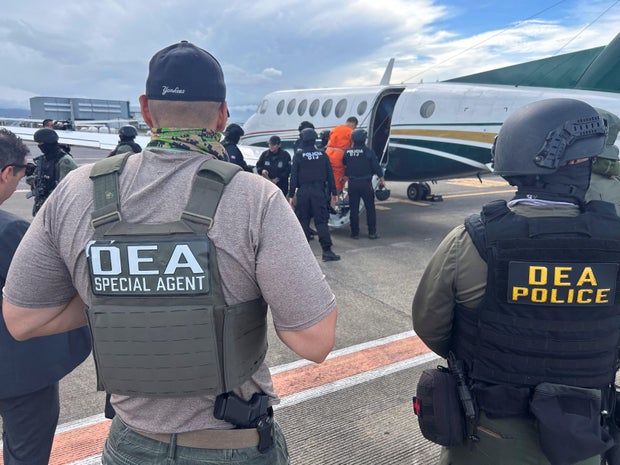
Ministerio de Seguridad Publica/Handout via REUTERS
Lozano Bonilla, a naturalized Costa Rican, is also allegedly linked to shipments of liquid cocaine to Europe and Asia.
Both Bell Fernandez and Lozano Bonilla were taken to the airport wearing bulletproof vests and helmets flanked by tight security, local media reported.
Costa Rica’s right-wing President Laura Fernandez, a key ally of President Trump, pledged a “firm hand” against drug trafficking during her May inauguration, saying her “hand will not tremble when confronting organized crime.”
Costa Rica, a country of 5.2 million people famous for its white-sand beaches, has long been seen as an oasis of stability and democracy in Central America.
But in recent years, it has developed into a logistical hub in the regional drug trade, fueling local turf wars that have caused the murder rate to soar. Last month, Costa Rica captured its most-wanted fugitive, known as “Diablo,” who was wanted by the U.S. for alleged drug trafficking and had a $500,000 bounty on his head.
Extraditions have been allowed in the country since a 2025 constitutional reform promoted by former President Rodrigo Chaves, Fernandez’s predecessor.
Since then, it has extradited former security minister and judge Celso Gamboa, who is accused of drug trafficking, and his alleged associate Edwin Lopez Vega, alias “Pecho de Rata,” among others to the United States.
Gamboa was indicted by the U.S. Justice Department on July 9, 2025, and charged with conspiring with other international drug traffickers to manufacture and transport significant quantities of cocaine.