
What you need to know about cyclosporiasis: How it spreads, how it’s treated

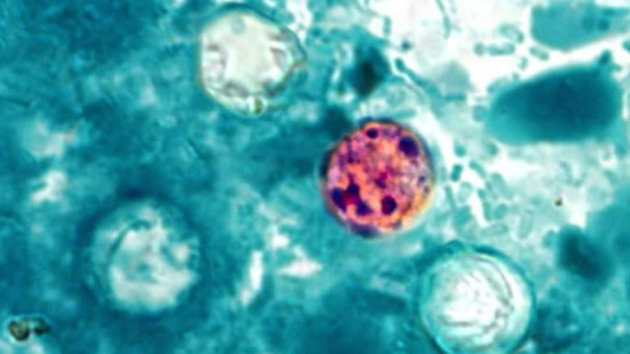
Cyclospora cayetanensis is a unicellular parasite that causes an intestinal infection called cyclosporiasis. (CDC)

(NEW YORK) — Multiple states are reporting an increase in cyclosporiasis cases, an intestinal infection caused by a parasite.

Health officials in Michigan have reported more than 1,200 cases and, in neighboring Ohio, cases have topped 170.

Here’s what you need to know about the infection, including how it spreads, how it’s diagnosed and how to treat it.

What is Cyclosporiasis?

Cyclosporiasis is an intestinal infection caused by the microscopic parasite Cyclospora cayetanensis, also known as Cyclospora, according to the Centers for Disease Control and Prevention (CDC).

The infection affects the small intestine and can cause watery diarrhea with sometimes “explosive” bowel movements, according to the federal health agency.

Other symptoms can include cramping, bloating, low-grade fever, nausea and vomiting.

The agency further said it takes about one week from the time of infection to become symptomatic, but that time can range from two days to two weeks.

How it spreads

The parasite usually spreads through food or water contaminated with feces, according to the CDC.

Foodborne outbreaks of cyclosporiasis have been linked to various types of imported fresh produce, such as raspberries, basil, snow peas, mesclun lettuce and cilantro, according to the CDC.

How the infection is diagnosed

A healthcare provider will diagnose cyclosporiasis by testing stool samples, according to the CDC.

Patients may have to submit several stool samples on different days to detect the parasite because laboratory tests may have a hard time detecting Cyclospora.

The CDC says a patient’s healthcare provider will need to specifically request testing for the parasite.

How cyclosporiasis is treated

Cyclosporiasis is treated with the oral antibiotic trimethoprim-sulfamethoxazole (TMP-SMX), commonly sold as Bactrim, Septra and Cotrim, and taken for 10 days, according to the CDC.

The CDC says most people with healthy immune systems will eventually recover without treatment, but if left untreated, patients may be sick for a few days to a month or longer.

How to prevent infection

It’s unclear exactly how Cyclospora contaminates food and water, according to the CDC.

The agency says people can prevent infection by thoroughly washing produce, cutting away bruised or damaged parts of fruits and vegetables, and refrigerating pre-prepared or pre-cut produce.

Additionally, the CDC recommends washing hands thoroughly with soap and water before handling or preparing raw fruits and vegetables.

Copyright © 2026, ABC Audio. All rights reserved.
Former US archivists warn that Trump’s effort to ignore records law jeopardizes national security and government continuity

(CNN) — Former leaders of the National Archives — which preserves and protects the nation’s most important documents — are urging a federal appeals court to reject the Trump administration’s effort to ignore the Presidential Records Act, a decades old law that requires presidents save all official records from their time in office.Six archivists, who served under both Republican and Democratic presidents, argue that the law is critical in maintaining “continuity of governance” and protecting national security.The archivists — a coalition covering every living person to have previously held the role before Marco Rubio’s brief appointment to the position at the beginning of Trump’s second term — filed an amicus brief Wednesday in support of a lawsuit from presidential scholars, historians and public transparency groups.The legal fight began after the Trump administration said it believed the president did not need to comply with decades-old record-keeping obligations set by Congress in the aftermath of the Watergate scandal. The law, which Trump’s Justice Department has claimed is unconstitutional, is intended to preserve documents so that future presidents, members of Congress, courts and the public can understand how an administration made critical decisions.“Preserving presidential records ensures that new leaders can have immediate and ongoing access to the data, strategy, and rationale behind past policy decisions,” the group said, noting that, in their experience, the most “frequent request for preserved presidential records comes from the incoming president’s national security advisors.”The archivists signed on to the brief are Trudy Huskamp Peterson, John W. Carlin, David S. Ferriero, Debra Steidel Wall, Colleen Shogan and William J. Bosanko — as well as Gary M. Stern, a former agency general counsel.The plea from the former archivists comes months after a federal judge in Washington said that White House staff must preserve their official records while the lawsuit plays out in court but declined to put any restrictions directly on the president, the vice president, the National Archives and archivist.In the May ruling, US District Judge John Bates concluded that the Presidential Records Act (PRA) was likely constitutional, rebuking the stance taken by the Justice Department earlier this year. The Justice Department has appealed the ruling to the US DC Circuit Court of Appeals. Oral arguments are slated for October 16.The PRA requires presidents and their staff to preserve White House records and turn those records over to the National Archives at the end of their administrations.It was instrumental in the chain of events that led to Trump’s prosecution for allegedly mishandling classified documents that he took from the White House at the end of his first term.The legal fight stems from a conclusion from Trump’s Office of Legal Counsel, a Justice Department office that gives advice to the executive branch, that the law was unconstitutional. The OLC memo was seen as an audacious move for a number of reasons, including for how it seemed to eschew Supreme Court precedent backing Congress’ power to regulate presidential record preservation. The guidance only addressed the preservation of email and text messages, rather than all electronic records, which the PRA covers.The American Historical Association and the left-leaning government transparency group American Oversight quickly filed a lawsuit, warning that presidential records they intend to use for their research “will be irretrievably lost” if the court didn’t intervene.The former archivists say the PRA “helps to bridge the gap between the outgoing and incoming administrations.”“Geopolitical tensions do not pause for an inauguration,” they wrote in the court filing. “Presidential records include the entire holdings of the National Security Council… such as sensitive intelligence assessments, treaty negotiations, and operational contingency plans. Ensuring that these files are preserved and seamlessly made available to new administration officials allows incoming national security advisors and cabinet officials to evaluate active threats, maintain diplomatic momentum, and make informed decisions during unexpected global crises.”The administration has rebuffed concerns, insisting that the “lion’s share” of presidential records are being preserved, because work being done by presidential staff on White House-issued phones is being kept.CNN’s Tierney Sneed contributed to this report.The-CNN-Wire™ & © 2026 Cable News Network, Inc., a Warner Bros. Discovery Company. All rights reserved.
Read Next Story