Video of Moroccan man dying while pinned down by police sparks anger in Italy

Rome — The death of a 42-year-old man as he was being detained by Italian police in Bologna during an encounter captured on video has sparked public outrage and a formal investigation, with calls for renewed scrutiny of police tactics.

The man, identified by Italian media as Moroccan-born Abderrahim Fakir, died Sunday after officers attempted to place him under arrest in the northern Italian city.

According to the Bologna police, officers responded to reports of a man behaving erratically and damaging parked cars. In a statement, the police said Fakir resisted the two officers, who sprayed him with pepper spray in an effort to subdue him. 

A screengrab from amateur video shared widely on social media, including by the family of Moroccan-born Italian Abderrahim Fakir, shows him being held down by two police officers and a third man on July 19, 2026, in Bologna, Italy, during an attempted arrest that ended with his death.

Social media

Videos recorded by witnesses from nearby apartment buildings, shared widely on Italian television and social media, show the two officers and a third man restraining Fakir on the ground, face down, after he was handcuffed.

Fakir can be heard repeatedly calling out for help and pleading for the officers to stop before he becomes unresponsive. Members of an emergency medical team are also visible, standing back during the struggle.

After Fakir falls silent, the officers finish binding his ankles and the medical personnel turn his body over and appear to check for vital signs.

The Bologna prosecutor’s office has ordered an autopsy to determine the cause of death and has opened an investigation into the circumstances surrounding the incident, a standard procedure in Italy whenever someone dies during a police operation.

Investigators are expected to examine whether the restraint contributed to Fakir’s death or whether other factors, including a possible medical emergency or drug intoxication, played a role.

The two officers involved will continue to work during the investigation.
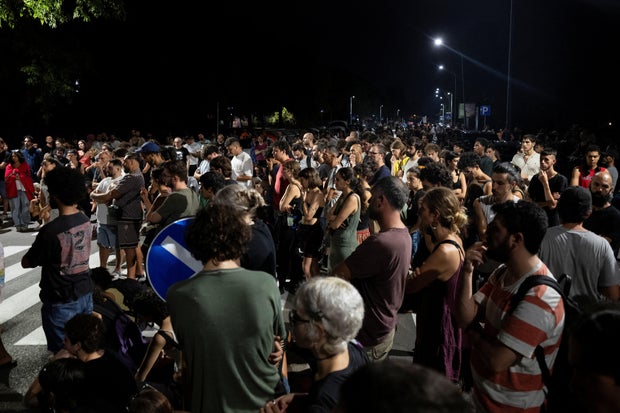
People gather near the scene where Abderrahim Fakir died while being held to the ground by police trying to arrest him in Bologna, Italy, July 19, 2026.

Reuters/Michele Lapini

The videos have drawn widespread attention across Italy, with civil rights advocates and opposition politicians calling for a full and transparent investigation.

“We can’t stay silent in the face of a death of this magnitude, which happened while a man in difficulty was in the hands of the Police,” Annalisa Corrado, a leading figure in the opposition Democratic Party, said in a statement. “We ask for full clarity on the matter: that the ongoing investigations determine what really happened and that all possible responsibilities are ascertained, and that serious work is done on the training of the Police when restraint maneuvers are necessary.”

Matteo Salvini, a deputy prime minister and head of the right-wing Lega Party, appeared to defend the police.

“I am counting on the judiciary to clarify the situation as soon as possible, to prevent mud-slinging by people who do not understand what happened and have no respect for those who risk their lives to protect ours,” he said. “Clearly, no one wanted anyone to die.”

The case has renewed debate over police use of force, particularly the use of prolonged prone restraint, in which a suspect is held face down on the ground.

According to Italian media reports, Fakir owned a moving and cleaning business and had a few employees. His sister Khadija Fakira said she would search for the truth about what happened.

“They killed my brother in cold blood, without pity,” she said in a message posted on social media. “We want justice for my brother.”

Fakir’s older brother Mohamad told Italian media he was “a good guy who never hurt anyone, and his death was ignoble.”

Attorney Barbara Spinelli, who says she met Fakir at the end of 2025 when he contacted her over fear that he could be deported, told Italy’s national ANSA news agency that he was “an extremely kind, polite, and respectful person.”

She said Fakir had lived in Italy since he was a child, and that he had nothing to fear regarding deportation as his documentation was in order.

“He is the last of my clients for whom I would have imagined such an end,” she said.

Italy has faced similar controversies in the past. The deaths of Federico Aldrovandi in 2005 and Stefano Cucchi in 2009, both in police custody, became defining cases that led to years of legal proceedings, calls for greater police accountability, and reforms in custody procedures.

Police unions have urged people not to draw conclusions based on the videos alone while investigators complete their work, noting that officers are often required to make rapid decisions in volatile situations.

Bologna’s Mayor Matteo Lepore, and the Democratic Party he’s a member of, issued calls for people to come together Monday evening in the city to “ask for truth and justice” over Fakir’s death.


Nigel Farage wins election in which his main rival was a trash can

(CNN) — When voters in the English seaside constituency of Clacton went to the polls on Thursday, they ostensibly had more choice than in any other election in British history.Thirty-four candidates stood in this by-election, the equivalent of a US special election, making the ballot paper 3 feet long. But almost all the country’s half-dozen major political parties declined to participate, with only the populist hard-right Reform UK party fielding a candidate – its leader Nigel Farage.Farage was ultimately re-elected by a substantial margin, winning 22,239 votes. He had declined to attend the results ceremony, citing a police warning about a campaign to disrupt it.His main opponent, Count Binface – a self-described intergalactic space warrior dressed as a trash can – won a creditable 9,455 votes.But this election, rather than helping to solve Farage’s problems as he perhaps hoped, has only added to them.The country’s chief anti-immigrant activist and Brexit architect, Farage was already the member of parliament (MP) for Clacton but resigned from parliament – triggering the by-election – after facing unprecedented scrutiny over his finances. Those challenging him were Binface and 32 other fringe or novelty candidates.The spectacle promptly became an object of ridicule, derided as a “circus” by commentators, while the claims over Reform’s finances refuse to go away. At the same time, Farage faces both a split in his natural coalition of voters and a more formidable opponent in Britain’s new center-left prime minister, Andy Burnham. Such headwinds are unfamiliar for Reform, which had previously been in the ascendancy, leading national opinion polls and enjoying historic gains in local elections.Novelty candidatesFarage resigned as Clacton’s MP six weeks ago, as a steady drumbeat of allegations surrounding his and his party’s financing forced him to confront questions he hadn’t previously had to answer in his political career.He has consistently denied any wrongdoing, and said: “I’ve decided the people of Clacton should be the judges of my actions” when triggering the by-election.Farage sought to frame the contest as him taking on the establishment. But, said Tim Bale, a professor at Queen Mary University of London who studies right-wing politics, “it’s not worked because the other political parties … declared they wouldn’t stand, meaning the … framing has been him versus a bunch of novelty candidates.”And holding an election has opened Farage to criticism over its cost, which is expected to be around £250,000 ($338,000). The public is legally bound to pay that, despite Farage’s protestations that Reform would foot the bill.Before Farage resigned, he was facing an investigation by the parliamentary standards committee and that inquiry will resume now he has been re-elected. If it finds he breached parliamentary guidelines, that will trigger a process which could ultimately lead to another by-election. The other major parties would be expected to field candidates in that vote.Challenge from the rightWhile Farage is caught in this election spin-cycle, the grip he holds over his voter base is also faltering. Reform is now facing a challenge from its right flank as the newly established party Restore Britain – founded by former Reform MP Rupert Lowe – siphons off a small but significant portion of voters.Lowe, who has a longstanding feud with Farage, was forced out of the party last year and subsequently started his own, egged on by US billionaire businessman Elon Musk. Now sensing an opening, Lowe has sought to form an alliance with Farage, conditioned on Farage accepting some of Restore’s more extreme policies. Farage has not so far appeared keen to bury the hatchet.“A pact would be tricky because Restore’s policies are so extreme that adopting them would make Reform less attractive to voters who aren’t really into the whole far-right package,” Bale told CNN.All this comes against the backdrop of a new national government. Labour leader Burnham is more popular than his predecessor Keir Starmer and has already proven his ability to take on Reform during his successful return to parliament earlier this summer.In this by-election, Farage has only proven his ability to defeat an intergalactic space warrior with an upturned trash can on his head. Of course, Count Binface is not actually from space; he is a satirical character created by the comedian Jon Harvey, and has stood in several other elections.“Until August 13th, I want it to be absolutely clear that there is nowhere at all that matters to me more in the cosmos than Clacton,” he told CNN’s Max Foster from his “starship,” which he said he had transformed using a holodeck “to create the precise look of a budget hotel in Clacton.” Farage did not respond to an interview request from CNN.Binface’s manifesto is packed with national in-jokes, like promising to “cut your taxes, and raise everyone else’s,” nationalize the singer Adele and impose a “windfall tax on cosy crime novels written (or ‘written’) by celebrities.”Outlandish costumesBinface is just one in a long line of satirical candidates dating back more than six decades, who have become a unique staple of British elections. Almost anyone can run for parliament in the UK – only a £500 ($675) deposit and 10 supporters of the bid are needed – allowing for people to make their joke, or point, without too much trouble.The tradition took hold in 1963, when a young musician later known as Screaming Lord Sutch stood in a by-election. He would contest 41 parliamentary seats in all, including against three sitting prime ministers, and founded the Official Monster Raving Loony Party in 1982, according to its website.None of the party’s candidates — think Nick the Incredible Flying Brick and its current leader, Howling Laud Hope — have ever been elected to Westminster. But it inspired others to follow in its footsteps, and its three candidates in Clacton together took 61 votes.Behind the jokes, some campaigns have carried serious messages, like a man dressed as a fox advocating for animal rights who stood shoulder-to-shoulder with Burnham when the former Manchester mayor returned to parliament in June.Several of the late Sutch’s policies, such as lowering the voting age from 21 to 18 and legalizing commercial radio, were eventually enacted. Still, some have derided the spectacle of novelty candidates.As for Binface, his vow to be a unity candidate was not enough to win, despite his pre-vote bravado.The-CNN-Wire™ & © 2026 Cable News Network, Inc., a Warner Bros. Discovery Company. All rights reserved.
Read Next Story