
Victims of Iranian-sponsored terror want restitution as part of peace deal

▶ Watch Video: Victims of Iranian-sponsored terror urge Trump to demand restitution in possible Iran deal

Washington — Victims of Iranian-sponsored terrorism and their families are in Washington this week to urge President Trump to demand Iran pay restitution as part of any potential peace deal.

The delegation of more than 100 people includes those who have successfully sued the Islamic Republic in U.S. federal court for tens of billions of dollars in damages for its role in either orchestrating, financing or providing other material support for major terror attacks around the world, including the 1983 Beirut Marine barracks bombing that killed 241 U.S. service members, and scores of suicide bombings that have killed American citizens in places like Israel.

“American victims have been entirely absent from the public and reported negotiating framework,” the group American Victims of State-Sponsored Terrorism United wrote in a letter to Mr. Trump first obtained by CBS News. “Our request is clear and grounded in longstanding U.S. policy: no agreement, interim or long-term, should release, transfer, unfreeze, or return Iranian assets, or lift or relieve sanctions, before the outstanding terrorism judgments owed to American victims are resolved.”

Angela Mistrulli, who spearheaded the two-day gathering in Washington, told CBS News the letter speaks for a coalition of more than 20,000 American victims directly affected by Iran-backed terrorism. She plans to deliver the letter to the president in a meeting at the White House scheduled for Tuesday.

Mistrulli’s father, Joseph, was killed while working at the World Trade Center on Sept. 11, 2001.

“If we can bankrupt terrorists, then there will be less American blood spilled,” Mistrulli asserted. “There should not be any funds returned to the terrorism regime.”
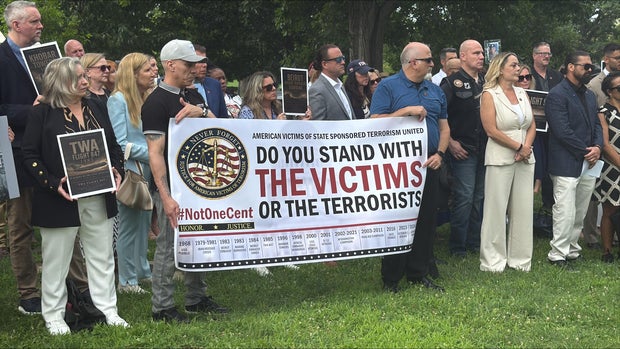
Victims of Iranian-sponsored terrorism and their families gathered in Washington
Victims of Iranian-sponsored terrorism and their families gathered in Washington to urge President Trump to demand Iran pay restitution as part of any potential peace deal.

CBS News

In recent days, fighting with Iran has resumed and the initial push toward a peace agreement has largely stalled. But the group’s effort comes at what would be the midway point of the initial 60-day Memorandum of Understanding signed by Mr. Trump and Iran’s leaders on June 17. 

The MOU, negotiated in large part by Vice President JD Vance, offered Iran the prospect of receiving hundreds of billions of dollars in frozen assets and sanctions relief if it complied with terms that include opening maritime traffic in the Strait of Hormuz and eliminating any nuclear threat.

“If it doesn’t get done in 60 days, that’s all right. We go back to bombing,” Mr. Trump said after signing the agreement. “I don’t want to do that, because it’s so good, but we might have to, because we’re never going to let them have a nuclear weapon.”

Vance called the MOU “fundamentally a good deal for the American people” and said it offered Iran an opportunity to be “reinvited into the world economy.”

But there has been little progress toward a longer-term agreement, and the U.S. resumed military strikes on Iran more than a week ago.

Iranian terror from October 1983 to Oct. 7, 2023

According to Mistrulli, Iran and other regimes like Syria and North Korea have been ordered to pay up to $156 billion in judgments dating back to the 1990s after Congress passed a law allowing terror victims to sue U.S.-designated state sponsors of terrorism. Iran has been ordered to pay the most of any country since the law was enacted.

Plaintiffs have included victims and families harmed in attacks spanning decades and continents, including 9/11, which a federal judge found Iran liable for in 2018, saying it provided assistance to the hijackers. 

In one recent case, a U.S. District Court in Washington awarded $573 million to plaintiffs representing American service members killed or injured by Iranian-supported insurgencies in Iraq from 2003 to 2015.

A current pending case focuses on Iran’s alleged role in the Hamas-led terrorist attacks in Israel on Oct. 7, 2023. Hamas is one of a number of militant groups in the region backed by Iran.

“As a community, the judgments that we pursue are not pursued out of compensation,” Mistrulli added. “The compensation has been the only justice we can receive — and we don’t want another group to lose loved ones like we have.”

Although victims have won billions of dollars in judgments against Iran, collecting those awards has proved far more difficult, as state sponsors of terrorism rarely pay judgments voluntarily. To provide some relief, Congress created the U.S. Victims of State Sponsored Terrorism Fund to provide partial compensation to eligible victims using money from qualifying federal penalties, forfeitures and other congressionally authorized sources.

According to the fund’s website, more than $10 billion has been paid out since its inception in 2015 — less than 10% of what’s been awarded in terrorism cases.

“There has been some relief,” Aryeh Portnoy, an attorney who has represented thousands of victims in terrorism cases and is currently litigating on behalf of Oct. 7 victims, told CBS News. “But even those in the fund that have been in it the longest and have received the most from it have only received pennies on the dollars of their judgments.”

Portnoy also pointed to limited enforcement, legal disputes and chronic underfunding as reasons for the shortfall.

“So there’s more work that needs to be done, but it can be done,” he said. “There’s opportunities for the government, for Congress, for the administration to help these victims, to fill the promise that Congress made when it allowed the victims to come and pursue these terrorist states in court for the horrors that they committed.”

And no country owes more than Iran, Portnoy said. In many of the state-sponsored terrorism cases he has litigated, Iran has repeatedly emerged as the foreign government accused of supporting the terrorist groups responsible for the attacks.

“In each of those cases, the actors themselves could be a terrorist organization,” Portnoy explained to CBS News. “It could be Hezbollah, it could be ISIS, it could be Al Qaeda. But behind those actors is always a state sponsor — and Iran is by far the biggest state sponsor of terrorism and has been for the last four decades.”

A spokesperson for the Iranian Embassy in Washington did not immediately respond to a request for comment.

Trump secretly switched planes in Turkey amid security concerns, official says

(CNN) — President Donald Trump secretly slipped out of Turkey last month on an alternate military plane, which he boarded while hidden inside a catering truck, as part of an elaborate ruse prompted by an Iranian threat, according to a US official.The clandestine security plan — first reported by the Washington Post and confirmed by CNN — underscored the lengths American officials went to in order to protect Trump from being assassinated by Iran.Trump had flown to Turkey on a new plane gifted by Qatar and meant to be used as Air Force One. But while he was on the trip, officials announced he would fly out on an older presidential plane, which CNN and others had previously reported was due to security concerns.That, though, was apparently part of the subterfuge. After boarding the older aircraft, a moment caught on camera, Trump secretly got off via the catering vehicle and moved to a smaller Air Force C-32A. The Qatari-gifted plane, the older aircraft used as Air Force One, and the C-32A then all departed separately for the UK. Once there, Trump got on board the Qatari-gifted plane and flew home.For the last month, much of the public discussion about the plane swap had been centered around the security capabilities of the Qatar-donated plane. Trump had boasted about the new aircraft — even though officials felt it was not as secure as other planes because it had to be retrofitted to serve as Air Force One — and the president seethed privately over coverage of its deficiencies, CNN previously reported.Now, attention is likely to shift to reporters and staffers unknowingly being aboard a decoy plane — and the nature of the threat that prompted such dramatic security measures.When asked about the reports of the secret plane switch, White House spokesperson Steven Cheung told CNN, “The new Air Force One is a state-of-the-art aircraft that has been fitted with high-level security protocols that ensure the safety of the President and his staff. As the President has said recently, there are many enemies of America who have their sights on him, and we use every tool at our disposal to address those threats.”Details from the presidential travel pool — a group of journalists who travel with the president and document his movements — provide a closer look at the unusual sequence of events surrounding Trump’s departure from Turkey following a consequential NATO Summit.Trump was aboard the old Air Force One in Ankara as of 8:26 p.m. local time, according to a pool report.Air Force One was wheels up at 8:43 p.m. local time, according to a subsequent pool report, 17 minutes later.The pool was also “advised to keep our window shades in the press cabin closed,” according to a print pool note from Politico’s Megan Messerly. This is extraordinarily unusual, and seemed indicative of a security situation; Trump would later say it was “because you’re probably on a dangerous flight because of the sleaze bags that we have to deal with.”A supplemental pool note from ABC’s Michelle Stoddart on Tuesday, sent in light of the secret plane revelation, noted that a Secret Secret agent came back to the press cabin to remind the media to keep the shades closed. When a photographer attempted to lift a shade, they were quickly told to lower it again. And when the press inquired with White House staff about why, they only said it was a request from Secret Service.Video shows what appeared to be a catering truck parked next to Air Force One at Ankara’s Esenboga Airport during that time, about seven minutes before the aircraft begins taxiing.The plane then was “wheels down” at RAF Mildenhall in England at 10:29 p.m. local time. But it wasn’t until roughly 20 minutes later that the pool notified news networks that an underwing shot — a camera angle from underneath the wing of the plane — was being set up to capture the president deplaning.That is an unusually long period of time — and it’s enough that Trump theoretically would be able to get off the smaller plane and back on Air Force One before cameras could capture it. For comparison, CNN was part of the pool on Sunday, when it took roughly eight minutes between wheels down and the underwing shot to be established.Trump was seen stepping off Air Force One about one minute after the pool alerted that the underwing shot was up.That timing was notably faster than what CNN crews typically experience. Usually, it takes several minutes for the president to deplane after the pool crew has assembled under the aircraft. The pool is generally in position before the first Air Force One door is opened and the stairs for the president are put into place.CNN reviewed pool video from Mildenhall that showed the stair car already in position and the aircraft door already open when the pool shot came up. There also appeared to be more security personnel on the tarmac than CNN crews are accustomed to seeing.Trump later boarded the new Qatari-gifted Air Force One at 11:01 p.m., according to pool notes. The pool captured video of the president walking from one aircraft to the other.CNN’s Kaitlan Collins and photojournalist Khalil Abdallah noted that when they traveled as part of the pool covering Davos and had to turn around and board a new aircraft due to what officials described as a minor electrical issue, the White House did not allow the CNN crew to film Trump transferring between planes. Instead, the crew was instructed to wait until he had boarded the new aircraft.During the flight on the Qatari gifted plane, Trump was asked what prompted the aircraft switch.Trump had said the change was to give US service members stationed at the base “a chance to tour the Aircraft.” Pressed on whether there were any other issues, Trump quickly responded, “no issues.”Trump was also asked why reporters had been instructed to lower the window shades on the aircraft.He said it was “because you’re probably on a dangerous flight.”“They didn’t ask me to close mine, but if they did, I would’ve done it,” Trump added.“But if I go, you go. Right?” Trump said. “Perhaps someday you want to change professions”Trump ultimately landed at Joint Base Andrews and deplaned Air Force One at 1:23 am ET.“He saluted and quickly loaded into the Beast,” a pool note said.This story was updated with additional reporting.The-CNN-Wire™ & © 2026 Cable News Network, Inc., a Warner Bros. Discovery Company. All rights reserved.
Read Next Story