USMNT captain speaks out on Folarin Balogun red card reversal ahead of Belgium showdown

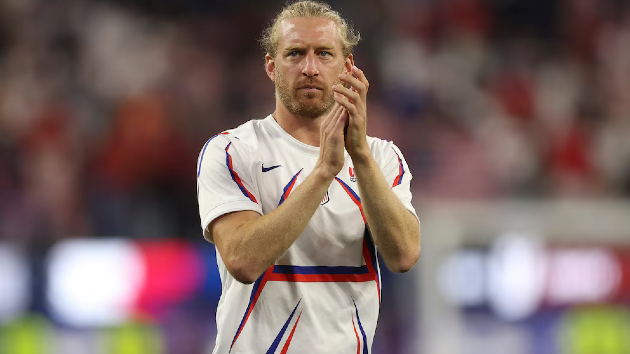
Tim Ream the United States applauds fans after their FIFA World Cup 2026 Group D match against Turkey, June 25, 2026 in Los Angeles. (Jamie Squire/Getty Images)

(NEW YORK) — U.S. Men’s National Team captain Tim Ream says the reversal of forward Folarin Balogun’s red card ban is a “boost of positivity” for the team ahead of their World Cup showdown on Monday against Belgium in the Round of 16.

“I think he’s excited that he can actually contribute on the field and not just be a cheerleader, but Balo, he’s got a big smile, and he’s been beaming ear to ear since we all found out the news,” Ream told “Good Morning America,” in an interview that aired Monday.

Balogun is now eligible to play in Monday’s game following a red card he received during the team’s July 1 match with Bosnia-Herzegovina for landing on an opposing player’s ankle.

Balogun was ejected mid-match and subsequently received a one-game ban. FIFA told ABC News at the time that the referee’s call was final and not able to be overturned or appealed.

USMNT head coach Mauricio Pochettino told reporters after the match, which the U.S. won 2-0, that Balogun was “disappointed” by the call, claiming the clash was not intentional, according to ESPN.

Following the July 1 game, President Donald Trump called FIFA president Gianni Infantino and discussed the red card suspension, which would have forced Balogun to miss Monday’s game, a U.S. official told ABC News on Monday.

The official said Trump wanted to better understand the reason the red card was given and why there was a suspension.

On Sunday, FIFA reversed course, announcing that “the implementation of the match suspension is suspended for a probationary period of one year” and adding that if Balogun “commits another infringement of a similar nature and gravity during the probationary period, the suspension shall be revoked and the sanction enforced without prejudice to any additional sanction imposed for the new infringement.”

FIFA’s about-face has sparked outcry from other groups, including the European and Belgian soccer associations.

“The Royal Belgian Football Association (RBFA) is astonished by FIFA’s decision to declare suspended United States player Folarin Balogun eligible to play” in Monday’s match, the RBFA said in part in a statement Sunday.

“In order to safeguard the legitimate rights of all participating teams and to protect the fundamental principles of fair play in our sport, both at this FIFA World Cup and at future editions of the tournament, the RBFA is investigating all potential options,” the group added.

In a follow-up statement on Monday, the RBFA said it was challenging FIFA’s decision to dismiss its earlier red card ban and reinstate Balogun ahead of Monday’s match.

The organization said it was “deeply concerned by the course of events” and pledged to fight the decision.

But FIFA said Monday afternoon it was rejecting the RBFA’s appeal.

“The request was rendered inadmissible on the grounds that the RBFA is not a party to the proceedings and, as such, has no standing to appeal the decision,” FIFA said in part.

The Union of European Football Associations, or UEFA, also expressed “disbelief at such an unprecedented, incomprehensible and unjustifiable decision” in a statement Monday.

“A minimum automatic suspension of one match following a red card is not a discretionary option and does not require the decision of a competent body to be enacted. It is a principle embedded in regulations, which cannot be made subject to exceptions, let alone in the middle of a tournament where several other players have been in the same situation and regularly served their suspension,” it said in part.

“When the certainty of rules is no longer guaranteed by its guardians, the integrity of the game is at stake and the credibility of a competition is undermined. Equally, such decision creates a precedent in the ongoing tournament, where similar situations will now require an equal treatment, to the detriment of the competition.”

U.S. Soccer, meanwhile, welcomed FIFA’s decision in a statement on Sunday.

“We accept the decision of the Disciplinary Committee and are pleased that Folarin Balogun is eligible to compete tomorrow. Our full attention is focused on the Round of 16 match against Belgium in Seattle, and we look forward to the continued support of our amazing fans,” the group said.

The U.S. official who spoke to ABC News on Monday said the process for appealing a red card ban is run by an independent board, adding that the U.S. government provided additional evidence that was used in the appeal process and saying the “correct and proper outcome was achieved.”

Copyright © 2026, ABC Audio. All rights reserved.
Alexander Lukashenko Fast Facts

(CNN) — Here is a look at the life of Belarusian President Alexander Lukashenko.PersonalBirth date: August 30, 1954 (some sources say August 31)Birth place: Kopys, BelarusFull name: Alexander Grigorievich LukashenkoFather: name unavailable publicly Mother: Yekaterina Lukashenko, milkmaidMarriage: Galina (Zhelnerovich) Lukashenko (1975-present)Children: with Galina (Zhelnerovich) Lukashenko: Viktor and Dmitry; with Irina Abelskaya: Nikolai “Kolya”Education: Mogilev Pedagogical Institute (now Mogilev State A. Kuleshov University), history, 1975; Belarusian Agricultural Academy, economics, 1985Military service: Soviet ArmyReligion: has called himself an “Orthodox atheist”Other FactsHas ruled Belarus, a small country between Russia and European Union member Poland and an essential east-west trade route, for more than a quarter of a century.Was elected president in Belarus’ first democratic election in 1994, but subsequent elections have been marred by allegations of strong-arm tactics and voting irregularities and were won by suspiciously wide margins.Has been described as “Europe’s last dictator.” Lukashenko has maintained his country’s close political ties to Russia, restricted opposition movements and censored media.Timeline1975-1977 - Drafted into the military and serves as an instructor in the border guard along the western border of Belarus.1980-1982 - Serves in the Soviet Army.1987-1994 - Head of the Gorodets state farm in the Mogilev region.1990-1994 - Member of the Belarusian Soviet Socialist Republic Supreme Council, where he becomes a deputy and later founds a faction called Communists for Democracy.1991 - Only member of the Belarusian parliament to vote against the agreement that leads to the dissolution of the Soviet Union.July 10, 1994 - Is elected president of Belarus with 80% of the vote, defeating Prime Minister Vyacheslav Kebich in the country’s first presidential election.May 1995 - Is behind a referendum that increases integration with Russia, including making the Russian language equal to Belarusian and replacing the national flag and state symbols with ones similar to those of the former Soviet Union. The referendum also gives Lukashenko the right to dissolve the parliament.November 1996 - Is behind a referendum that revises the Constitution to give more authority to the presidency, including limiting the authority of the Constitutional Court and extending Lukashenko’s presidential term. An impeachment effort fails, and Lukashenko signs a new constitution.1997-2021 - Head of the Belarusian Olympic Committee.1999 - Signs a treaty making Belarus a “union state” with Russia.September 9, 2001 - Is reelected president with 75% of the vote.October 2004 - A referendum is passed to eliminate presidential term limits.April 20, 2005 - US Secretary of State Condoleezza Rice refers to Belarus as “the last remaining true dictatorship in the heart of Europe,” in an interview with CNN.March 2006 - Is reelected president with over 80% of the vote.December 2010 - Is reelected president with almost 80% of the vote.October 2015 - Is reelected president with 83.5% of the vote. March 28, 2020 - Speaks about coronavirus after playing ice hockey in front of a packed stadium in Minsk, Belarus. Specifying no scientific evidence, he says the “fridge” like area is a “real anti-viral cure.”March 29, 2020 - Recommends that people not only drink vodka but wash their hands with it and take saunas to combat the coronavirus. August 9, 2020 - Lukashenko is reelected with 80% of the vote. His main opposition candidate, Svetlana Tikhanovskaya, receives about 10%.August 10, 2020 - Demonstrations over the presidential election result in dozens of people being injured during clashes with police, the interior ministry says in a statement seen by state-run news agency Belta. Tikhanovskaya rejects the preliminary election results and files a complaint with Belarus’ central elections committee demanding a recount of the votes. She leaves for Lithuania soon afterwards.August 16, 2020 - Lukashenko gives a speech claiming Belarus is being threatened by foreign interference.August 17, 2020 - Visits a factory in Minsk, Belarus, according to videos posted online by local news outlets and addresses the election. “You talk about dishonest elections and want to hold new elections,” he tells protesting workers. “We held the elections and until you kill me, there won’t be any new elections.” September 23, 2020 - Lukashenko is inaugurated for a sixth consecutive term as president in an unannounced ceremony in Minsk, according to state media reports. Opposition politicians describe the ceremony as a “thieves’ meeting” and a “farce.” The United States and a number of European Union countries issue statements rejecting the legitimacy of Lukashenko’s win.September 24, 2020 - The European Union releases a statement regarding the Belarus presidential election. “The European Union does not recognise their falsified results. On this basis, the so-called ‘inauguration’ of 23 September 2020 and the new mandate claimed by Aleksandr Lukashenko lack any democratic legitimacy.”December 7, 2020 - Following an investigation “Concerning athletes, officials and sports in Belarus,” the International Olympic Committee (IOC) suspends the Executive Board of the National Olympic Committee of Belarus “from all IOC events and activities, including the Olympic Games.” Lukashenko’s election of his son Viktor Lukashenko to be replace him as president of the Belarusian NOC is not recognized, according to a March 8, 2021, IOC statement.May 23, 2021 - A Ryanair flight traveling from Athens to the Lithuanian capital Vilnius is intercepted and forced to land in Minsk. When it lands, prominent opposition activist Roman Protasevich and his Russian partner Sofia Sapega, who are on the flight, are detained. Protasevich is one of dozens of journalists and activists campaigning in exile against Lukashenko’s 26-year rule. Lukashenko later claims that the flight was diverted because of a bomb threat that had originated in Switzerland, allegations that Swiss authorities refute. Lithuanian President Gitanas Nausėda later tells CNN that the email indicating a bomb threat was sent 30 minutes after Lithuanian officials received the signal from Minsk to land the plane.May 24, 2021 - The European Union calls on airlines to avoid Belarus’ airspace, responding to the forced landing of the Ryanair flight. European Commission President Ursula von der Leyen says the bloc is “closing our airspace to planes from Belarus” and calls on EU airlines not to fly over the country.May 24, 2021 - The US National Security Council releases a readout of a call between national security adviser Jake Sullivan and democratic opposition leader Tikhanovskaya. Sullivan “strongly condemned the brazen and dangerous grounding of a Ryanair flight between two EU member states on May 23 and the subsequent removal and detention of journalist Raman Pratasevich.” He demands Protasevich’s immediate release, fair elections and states “that the United States, in coordination with the EU and other allies and partners, will hold the Lukashenka regime to account.”May 27, 2021 - The International Civil Aviation Organization says it will carry out an investigation into the diversion of the flight, while at least two European carriers say they were refused permission to fly to Moscow by Russian authorities after they requested to fly an alternative route bypassing Belarusian airspace.May 28, 2021 - Russian President Vladimir Putin cements his support of Lukashenko in a meeting, saying the West’s reaction to the interception and forced landing of a passenger jet “was an outburst of emotion.” The same day, US aviation authorities warn airlines “to exercise extreme caution” when flying over Belarus.August 9, 2021 - While answering questions from local and foreign media, Lukashenko denies that state repression exists in Belarus. In response to a question on repression and the imprisonment of political opponents, Lukashenko accuses the US of “lawlessness,” citing the January 6 insurrection and invoking false claims about the US presidential election result.March 15, 2022 - The US sanctions Lukashenka and his wife for gross human right abuses, and playing a key role in aiding Russia’s attack on Ukraine. The US previously applied sanctions to members of Lukashenko’s family in December after a migrant crisis on Belarus’s border with Poland, which also led to accusations of human rights abuses.May 28, 2023 - An on-camera interview is released in which Lukashenko claims that nations who are willing “to join the Union State of Russia and Belarus” will be given nuclear weapons, days after confirming the transfer of some tactical nuclear weapons from Moscow to Minsk had begun.January 27, 2025 - Lukashenko extends his 31-year rule in Belarus after being declared the winner of a presidential election that his exiled opponents and Western countries have denounced as a sham.The-CNN-Wire™ & © 2026 Cable News Network, Inc., a Warner Bros. Discovery Company. All rights reserved.
Read Next Story