
US-Iran strikes ‘put into question’ key parts of MOU, Qatari official says

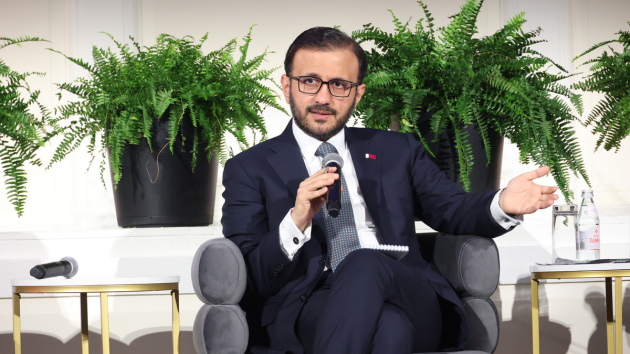
Dr. Majed al-Ansari, Advisor to the Prime Minister of Quatar and Official Spokesperson for the Ministry of Foreign Affairs, speaks onstage during Global Citizen NOW: Impact Sessions on September 24, 2025, in New York City. (Photo by Rob Kim/Getty Images for Global Citizen)

(LONDON) — Renewed fighting between the U.S. and Iran in the Middle East puts into question key elements of the memorandum of understanding (MOU) agreed by regional nations last month, a senior Qatari government official told ABC News on Thursday.

Majed al-Ansari, an adviser to Qatar’s prime minister and the spokesperson for the country’s Ministry of Foreign Affairs, said on the sidelines of the Chatham House think tank’s 2026 conference in London that Doha is hoping that intense rounds of reciprocal strikes between the U.S. and Iran do “not kill off the memorandum of understanding altogether.”

“But it does put into question a lot of other things that we have already agreed upon,” he said.

The past 48 hours, Ansari said, have been “quite tense.” He added that since the resumption of strikes, “We’ve seen again navigation through the Strait of Hormuz basically grind to a halt.”

“We are urging all sides to exercise restraint and give some more time for the talks,” Ansari said.

U.S. Central Command said it launched more than 170 strikes on Iranian targets over the past two days in response to alleged Iranian attacks on commercial shipping transiting the Strait of Hormuz earlier this week — allegations that Tehran denied. One of the ships attacked was a Qatari liquid natural gas tanker, the Al-Rekayyat, Qatar said.

In response to the U.S. strikes, the Iranian military claimed to have launched attacks on U.S. military facilities in Kuwait, Bahrain and Qatar.

The U.S. and Iran have traded several volleys of attacks since the MOU was signed on June 17.

Ansari denied the Iranian claim that it launched fresh attacks on Qatar on Thursday. “There haven’t been any attacks in Qatar. The Iranian claims, they’re claims. But our military was very much ready, immediately as the attacks began on the region,” he said. “We had some pass overs, but nothing targeting us.”

President Donald Trump on Wednesday suggested that the MOU was “over” following the reported Iranian attacks, dismissing leaders in Tehran as “scum” and threatening intensified military action.

Asked about those comments, Ansari said Doha and “all parties remain engaged in the talks.”

“Yes, we’re not at the place that we were hoping to be at this time in the chronology of where we wanted the talks to go. But talks have not broken down,” he said. “But, of course, any escalation on the ground derails the diplomatic work.”

Qatar — alongside Pakistan — played a key role in forging the 14-point MOU agreed in June, under which the U.S. and Iran agreed to the reopening Strait of Hormuz and the end of the U.S. naval blockade of Iranian ports. 

The agreement also stipulated that fighting would stop for 60 days while the U.S. and Iran negotiated the terms of a final deal, which would cover issues including Iran’s nuclear material.

Ansari said talks on that final deal are ongoing despite the escalating strikes and heated rhetoric from both Washington and Tehran.

“The easy answer is everybody’s talking to everybody,” he said when asked what was happening behind the scenes, noting that work is ongoing on all three separate tracks — one regarding the Strait of Hormuz, one regarding Iran’s nuclear program and the third regarding the sanctions on Iran and frozen Iranian assets.

“Our focus is on that diplomatic resolution right now,” Ansari added. “The focus has to be on the diplomatic track working, the talks succeeding and on the end of war to pave the way for sustainable peace in our region, and not for it just to be lulls between attacks.”

“No country, however strong that country is when it comes to its military, is able to withstand an unending military conflict in a small region like ours,” Ansari said.

Nonetheless, he said Qatar’s armed forces are prepared for renewed conflict. “We have taken all the contingencies in respect of what might happen in the region,” Ansari said. 

Qatar, he added, has “not taken part in any attacks against Iran or any other of our neighboring countries.” When asked if Doha would be willing to do so, Ansari replied, “We reserve the right to retaliate.”

Copyright © 2026, ABC Audio. All rights reserved.
Liberia once offered Black Americans a new home. Decades on, it is receiving migrants the US wants out

(CNN) — Is Liberia an American dumping ground — or a place where a new generation of arrivals can build a new life?That’s the question Liberians are asking themselves after the first people to be deported to the West African country from the United States arrived in the capital, Monrovia.The 20 people on the flight from Louisiana were the first to be sent under an agreement that could see up to 1,200 people transferred to Liberia, a country of less than 6 million people, many of them descendants of formerly enslaved Black Americans.Liberian officials said the new arrivals were from “African and western hemisphere countries.”Liberia is one of several countries that have agreed to take migrants being deported from the US under the Trump administration’s anti-immigration crackdown. The arrivals are coming to a nation whose history is deeply tied to migration from the US.Nearly two centuries ago, free and formerly enslaved Black Americans crossed the Atlantic to settle in what would become Liberia – a name that translates as “land of the free.”Now, a country shaped in part by that migration is accepting people the US wants to remove.For Liberians, that has thrown up a mix of feelings in a country still recovering from a long and bloody civil war.“This country is going through a lot, and having more people come in — can we handle all of this?” said Pheta Morris, 48, a descendant of the Black Americans who settled in Liberia.But she said she sees the new arrivals through the lens of Liberia’s history and is struck by the contrast.“I think about the Americo-Liberians — people who were rejected where they were and needed somewhere to go, and Liberia opened its arms to them,” she said.“Back then, people needed somewhere they could be free, accepted and welcomed. Now, people are being rejected from the US, and Liberia is opening its doors to them.”The first transfer has already faced complications.Reuters reported that five migrants who refused to disembark after arriving in Monrovia were flown instead to Equatorial Guinea in Central Africa, where they are held with more than 30 other migrants previously sent there by the US.A US State Department spokesperson said implementing the Trump administration’s immigration policies was a “top priority,” adding that the department generally does not comment on private diplomatic communications with other governments.CNN has contacted Liberia’s information ministry for more details about the agreement and its terms.A country shaped by AmericaThe first group of free Black Americans arrived in Liberia in the early 1820s.Over the following decades, thousands more made the journey, with the American Colonization Society helping to establish settlements along the West African coast. The US State Department says about 16,000 Black Americans migrated to Liberia during the 19th century.The migration was complicated. Some Black Americans saw Liberia as a chance to escape racism and build a new life, while others opposed the colonization movement and rejected the idea that free Black people should leave the US.Africans rescued from slave ships by the US Navy were also brought to Liberia. The settlements eventually formed the Republic of Liberia, which declared independence in 1847.The American influence remains visible today. Liberia’s flag resembles that of the US; its capital was named Monrovia after America’s fifth President James Monroe, and its early institutions were heavily influenced by Washington.Conmany Wesseh, a former Liberian lawmaker and member of the ruling Unity Party who was nominated as Liberia’s ambassador to the United Nations and later the European Union under former president Ellen Johnson Sirleaf, said that history continues to shape how Liberians view the US.For Wesseh though, the arrival of the deportees raises a more immediate question: Can Liberia, a country still struggling with basic infrastructure and services, accommodate more people?The cost of taking them inLiberia began rebuilding after a 14-year civil war ended in 2003, but Wesseh said the country still needs major investment. Poverty levels remain high and youth unemployment stands at 40%, according to African Development Bank data.“Our country needs a great deal of support,” he said. “We are short on medical facilities, and we have problems with education.”He questioned how the country would manage an influx of people from abroad.“They will have to go to the same hospitals. You won’t create a new hospital for them,” he said. “There’s no spare housing. We don’t have existing housing to put new people in.”Wesseh said Liberia’s development needs may have influenced the government’s decision, with officials hoping the agreement would bring support from Washington.Liberian authorities described the arrangement as humanitarian and said the deportees will be treated as guests who can seek asylum or leave the country.Asked whether he viewed the deal as humanitarian assistance, a diplomatic arrangement or the US outsourcing its immigration enforcement, Wesseh chose the latter.“I think (the administration of US President Donald Trump) just sees this as a place to dump people,” he said. “They want to take them off their hands and dump them in this country.”A chance for a new startFrancis Dennis had long known that his family had roots in the migration of Black Americans to Liberia in the 19th century. But just a few weeks ago, he became curious about his family’s past and began using AI genealogy tools to dig deeper into that history.The 71-year-old former president of the Liberia Chamber of Commerce told CNN he traced his great-great-great-grandfather to Snow Hill, a town on Maryland’s Eastern Shore in the US, using the technology and notes left by his father.He said the research also pointed him to the name of the vessel that carried his ancestor across the Atlantic to Liberia, along with a list of its passengers.Generations later, Dennis is watching another group arrive in Liberia from the US. But he does not believe their circumstances have to define what comes next.“People may have their apprehension about a new life, but it’s also an opportunity,” he said. “Some may be happy, some may resent it, but it opens a new window, a new opportunity.”His own ancestor crossed the Atlantic generations ago and became part of the community that helped shape modern Liberia.Now, he hopes those arriving under very different circumstances will also see the country as a chance for a fresh start.“The ball will be in their court,” Dennis said. “Are they going to seize it as an opportunity for a new start, a fresh start, a new life? Or will they be thinking about the past?”The-CNN-Wire™ & © 2026 Cable News Network, Inc., a Warner Bros. Discovery Company. All rights reserved.
Read Next Story