US-Iran strikes ‘put into question’ key parts of MOU, Qatari official says

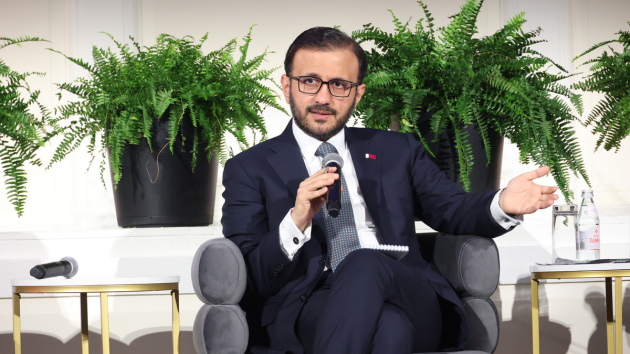
Dr. Majed al-Ansari, Advisor to the Prime Minister of Quatar and Official Spokesperson for the Ministry of Foreign Affairs, speaks onstage during Global Citizen NOW: Impact Sessions on September 24, 2025, in New York City. (Photo by Rob Kim/Getty Images for Global Citizen)

(LONDON) — Renewed fighting between the U.S. and Iran in the Middle East puts into question key elements of the memorandum of understanding (MOU) agreed by regional nations last month, a senior Qatari government official told ABC News on Thursday.

Majed al-Ansari, an adviser to Qatar’s prime minister and the spokesperson for the country’s Ministry of Foreign Affairs, said on the sidelines of the Chatham House think tank’s 2026 conference in London that Doha is hoping that intense rounds of reciprocal strikes between the U.S. and Iran do “not kill off the memorandum of understanding altogether.”

“But it does put into question a lot of other things that we have already agreed upon,” he said.

The past 48 hours, Ansari said, have been “quite tense.” He added that since the resumption of strikes, “We’ve seen again navigation through the Strait of Hormuz basically grind to a halt.”

“We are urging all sides to exercise restraint and give some more time for the talks,” Ansari said.

U.S. Central Command said it launched more than 170 strikes on Iranian targets over the past two days in response to alleged Iranian attacks on commercial shipping transiting the Strait of Hormuz earlier this week — allegations that Tehran denied. One of the ships attacked was a Qatari liquid natural gas tanker, the Al-Rekayyat, Qatar said.

In response to the U.S. strikes, the Iranian military claimed to have launched attacks on U.S. military facilities in Kuwait, Bahrain and Qatar.

The U.S. and Iran have traded several volleys of attacks since the MOU was signed on June 17.

Ansari denied the Iranian claim that it launched fresh attacks on Qatar on Thursday. “There haven’t been any attacks in Qatar. The Iranian claims, they’re claims. But our military was very much ready, immediately as the attacks began on the region,” he said. “We had some pass overs, but nothing targeting us.”

President Donald Trump on Wednesday suggested that the MOU was “over” following the reported Iranian attacks, dismissing leaders in Tehran as “scum” and threatening intensified military action.

Asked about those comments, Ansari said Doha and “all parties remain engaged in the talks.”

“Yes, we’re not at the place that we were hoping to be at this time in the chronology of where we wanted the talks to go. But talks have not broken down,” he said. “But, of course, any escalation on the ground derails the diplomatic work.”

Qatar — alongside Pakistan — played a key role in forging the 14-point MOU agreed in June, under which the U.S. and Iran agreed to the reopening Strait of Hormuz and the end of the U.S. naval blockade of Iranian ports. 

The agreement also stipulated that fighting would stop for 60 days while the U.S. and Iran negotiated the terms of a final deal, which would cover issues including Iran’s nuclear material.

Ansari said talks on that final deal are ongoing despite the escalating strikes and heated rhetoric from both Washington and Tehran.

“The easy answer is everybody’s talking to everybody,” he said when asked what was happening behind the scenes, noting that work is ongoing on all three separate tracks — one regarding the Strait of Hormuz, one regarding Iran’s nuclear program and the third regarding the sanctions on Iran and frozen Iranian assets.

“Our focus is on that diplomatic resolution right now,” Ansari added. “The focus has to be on the diplomatic track working, the talks succeeding and on the end of war to pave the way for sustainable peace in our region, and not for it just to be lulls between attacks.”

“No country, however strong that country is when it comes to its military, is able to withstand an unending military conflict in a small region like ours,” Ansari said.

Nonetheless, he said Qatar’s armed forces are prepared for renewed conflict. “We have taken all the contingencies in respect of what might happen in the region,” Ansari said. 

Qatar, he added, has “not taken part in any attacks against Iran or any other of our neighboring countries.” When asked if Doha would be willing to do so, Ansari replied, “We reserve the right to retaliate.”

Copyright © 2026, ABC Audio. All rights reserved.
Record share of kindergartners missed required vaccines last year as Trump executive order takes aim at state mandates

(CNN) — A record share of kindergartners in the United States had an exemption for a required vaccination last school year, as the Trump administration continues to make moves to reduce the number of vaccinations recommended for children.An executive order signed by President Donald Trump last week aims to reshape the federal government’s approach to vaccines. The order offers recommendations to “give parents more information and options” — but the authority to set and enforce vaccine requirements still lies with states, and a growing share are utilizing existing policies that allow exemptions.The administration signaled that it will push states to rework their vaccine requirements to incorporate the new federal guidelines, effectively upending longstanding practices aimed at improving childhood immunization rates. It’s unclear exactly how officials plan to reinforce this, but the Department of Justice, the Department of Education and the Department of Health and Human Services have been directed to tie compliance with federal funding.The new executive order emphasizes the administration’s aim to “maximize parental choices over vaccinations for their children,” specifically noting that states should “provide religious and medical exemptions” to vaccine requirements.All 50 states have their own laws requiring certain vaccines for students to attend school, and all allow students to be exempted from school vaccine requirements for medical reasons. The vast majority of states also allow vaccine exemptions for non-medical reasons, which may be categorized as religious or personal.Utilization of these exemptions is more common than it’s ever been. Data published Monday by the US Centers for Disease Control and Prevention shows that 4.2% of kindergartners had an exemption for at least one required vaccine during the 2025-26 school year.This left about 157,000 new schoolchildren without full coverage for at least one state-mandated vaccine last school year, CDC data shows – nearly 20,000 more than the year before.The share of students with a vaccine exemption is the highest on record and twice as high as it was a decade ago. Last school year, only 0.2% of exemptions were for medical reasons, a share that has held steady for years.Exemptions increased in all but nine states, and nearly half of states report exemptions exceeding 5%, according to the CDC.According to the National Conference of State Legislatures, only four states do not allow exemptions that are not for medical reasons: California, Connecticut, Maine and New York.New York removed the option for religious exemptions for school vaccines in 2019 after measles outbreaks in the state grew to some of the largest the US had seen in decades.The new CDC data shows that the measles-mumps-rubella (MMR) vaccination rate among kindergartners fell only slightly last school year, from 92.5% to 92.4%, but that’s still well below the 95% coverage needed to provide herd immunity and prevent outbreaks.State authority to set vaccine policy has been challenged before but broadly upheld by the US Supreme Court.States are still reviewing the new executive order, but many – including those that follow federal guidance for vaccine policy and those that have broken from federal recommendations – say that it does not require any changes at the state level.“Federal recommendations do not change the requirements in Texas,” the state health department said in an email to CNN.Others responded to the president’s action with a commitment to science-based vaccine policy.“Vaccines are our most effective defense against vaccine-preventable illnesses,” Dr. Puthiery Va, director of the Maine Center for Disease Control and Prevention, said in a statement. “In Maine, vaccines remain available at no cost to eligible children through the Maine CDC’s Immunization Program. Maine’s school and child care immunization requirements remain unchanged by federal actions to date.”Changes to any state vaccine exemption laws would need to be passed by state legislatures, many of which will not meet again until January.But courts can get involved, too. Mississippi started allowing religious exemptions in 2023 after a federal court order, and a move to allow religious exemptions in West Virginia is facing legal challenges. Before these changes, both states were known to have exceptionally high childhood vaccination coverage under some of the strictest laws.Public health experts say that building trust in the safety and effectiveness of vaccines is key to reversing the decline in childhood immunization rates.“If more and more parents choose not to vaccinate their children for non-medical reasons, we will no doubt see a rise in disease outbreaks,” Dr. William Moss, an associate professor with Johns Hopkins Bloomberg School of Public Health, has said.Measles cases in the US have reached a 35-year-high this year, the vast majority of which are in people who have not been vaccinated with the MMR.But the new executive order advises that the MMR be separated into three individual shots — a dramatic change that goes against broad scientific consensus and a suggestion that could raise doubts.States have typically aligned their policies for vaccine requirements with recommendations from the CDC and its Advisory Committee on Immunization Practices (ACIP). But ACIP has undergone sweeping changes under US Department of Health and Human Services Secretary Robert F. Kennedy Jr., and actions by the federal agency and the advisory board to overhaul the childhood vaccine schedule — including a reduction in the number of diseases covered by routine vaccinations — have led many states to break from this longstanding practice.According to KFF, 28 states have announced that they will no longer follow federal vaccine recommendations. Most have indicated that they will instead follow recommendations from the American Academy of Pediatrics, an independent medical association. “For decades, the U.S. childhood immunization schedule was developed through a rigorous scientific process required by law that evaluates the safety and effectiveness of vaccines and how they should be given to patients. This transparent, expert-led process has helped prevent serious diseases, reduce hospitalizations, and save millions of lives,” the Governors Public Health Alliance said in a statement. The coalition includes more than a dozen governors who represent about a third of the US population.“President Trump’s Executive Order directing changes to longstanding federal vaccine recommendations circumvents that process and defies scientific consensus. It also risks causing confusion and endangering our children,” the alliance said.“Parents should know that vaccines currently available in the United States remain available and that the Executive Order does not change that. Governors and state public health leaders hold the power to continue working with healthcare providers, schools, and local health agencies to ensure that parents have access to trusted information and can make informed decisions regarding the health of their children.”The-CNN-Wire™ & © 2026 Cable News Network, Inc., a Warner Bros. Discovery Company. All rights reserved.
Read Next Story