(LONDON) — Renewed fighting between the U.S. and Iran in the Middle East puts into question key elements of the memorandum of understanding (MOU) agreed by regional nations last month, a senior Qatari government official told ABC News on Thursday.
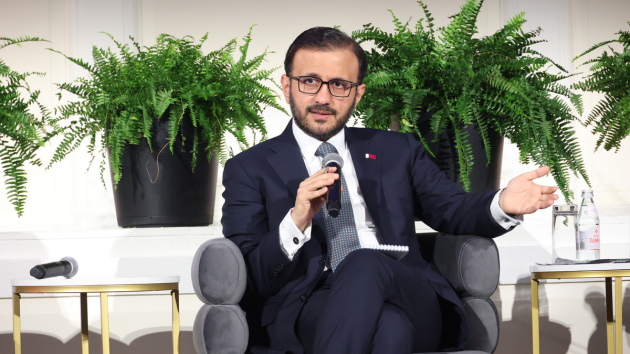
Majed al-Ansari, an adviser to Qatar’s prime minister and the spokesperson for the country’s Ministry of Foreign Affairs, said on the sidelines of the Chatham House think tank’s 2026 conference in London that Doha is hoping that intense rounds of reciprocal strikes between the U.S. and Iran do “not kill off the memorandum of understanding altogether.”
“But it does put into question a lot of other things that we have already agreed upon,” he said.
The past 48 hours, Ansari said, have been “quite tense.” He added that since the resumption of strikes, “We’ve seen again navigation through the Strait of Hormuz basically grind to a halt.”
“We are urging all sides to exercise restraint and give some more time for the talks,” Ansari said.
U.S. Central Command said it launched more than 170 strikes on Iranian targets over the past two days in response to alleged Iranian attacks on commercial shipping transiting the Strait of Hormuz earlier this week — allegations that Tehran denied. One of the ships attacked was a Qatari liquid natural gas tanker, the Al-Rekayyat, Qatar said.
In response to the U.S. strikes, the Iranian military claimed to have launched attacks on U.S. military facilities in Kuwait, Bahrain and Qatar.
The U.S. and Iran have traded several volleys of attacks since the MOU was signed on June 17.
Ansari denied the Iranian claim that it launched fresh attacks on Qatar on Thursday. “There haven’t been any attacks in Qatar. The Iranian claims, they’re claims. But our military was very much ready, immediately as the attacks began on the region,” he said. “We had some pass overs, but nothing targeting us.”
President Donald Trump on Wednesday suggested that the MOU was “over” following the reported Iranian attacks, dismissing leaders in Tehran as “scum” and threatening intensified military action.
Asked about those comments, Ansari said Doha and “all parties remain engaged in the talks.”
“Yes, we’re not at the place that we were hoping to be at this time in the chronology of where we wanted the talks to go. But talks have not broken down,” he said. “But, of course, any escalation on the ground derails the diplomatic work.”
Qatar — alongside Pakistan — played a key role in forging the 14-point MOU agreed in June, under which the U.S. and Iran agreed to the reopening Strait of Hormuz and the end of the U.S. naval blockade of Iranian ports.
The agreement also stipulated that fighting would stop for 60 days while the U.S. and Iran negotiated the terms of a final deal, which would cover issues including Iran’s nuclear material.
Ansari said talks on that final deal are ongoing despite the escalating strikes and heated rhetoric from both Washington and Tehran.
“The easy answer is everybody’s talking to everybody,” he said when asked what was happening behind the scenes, noting that work is ongoing on all three separate tracks — one regarding the Strait of Hormuz, one regarding Iran’s nuclear program and the third regarding the sanctions on Iran and frozen Iranian assets.
“Our focus is on that diplomatic resolution right now,” Ansari added. “The focus has to be on the diplomatic track working, the talks succeeding and on the end of war to pave the way for sustainable peace in our region, and not for it just to be lulls between attacks.”
“No country, however strong that country is when it comes to its military, is able to withstand an unending military conflict in a small region like ours,” Ansari said.
Nonetheless, he said Qatar’s armed forces are prepared for renewed conflict. “We have taken all the contingencies in respect of what might happen in the region,” Ansari said.
Qatar, he added, has “not taken part in any attacks against Iran or any other of our neighboring countries.” When asked if Doha would be willing to do so, Ansari replied, “We reserve the right to retaliate.”
Copyright © 2026, ABC Audio. All rights reserved.