
U.K. far-right leader Nigel Farage resigns as lawmaker in risky gamble

▶ Watch Video: What led to Starmer’s resignation as U.K. prime minister and who will likely replace him

London — British politician Nigel Farage, a one-time ally of President Trump who has led a surging far-right, populist movement in the U.K., resigned on Tuesday as a lawmaker to trigger a special election. It’s a high-risk political gamble to renew his mandate from voters as he faces mounting pressure over a financial scandal.

Farage has been accused of violating British parliamentary law for failing to disclose financial gifts — including from a 32-year-old convicted criminal who calls him “Daddy,” according to The Sunday Times newspaper.

The Reform U.K. Party leader said he would stand in the by-election for his vacated seat, which is likely to take place in the early fall. 

gettyimages-2285056608-2-1.jpg
Reform UK party leader Nigel Farage announces his resignation as a member of parliament, July 7, 2026, in London, England.

Getty

“I’ve decided that the people of Clacton should be the judges of my actions,” Farage said in a televised address Tuesday, referring to the southeast England constituency he’s represented in parliament for two years.

“This will be a people versus the establishment by-election,” he declared, calling it “a chance to stick two fingers up to the entire establishment to frankly tell them where to go.” 

His resignation means that two parliamentary investigations into donations from two wealthy individuals will be suspended. 

Farage reiterated his stance on Tuesday that he had “done nothing wrong.”
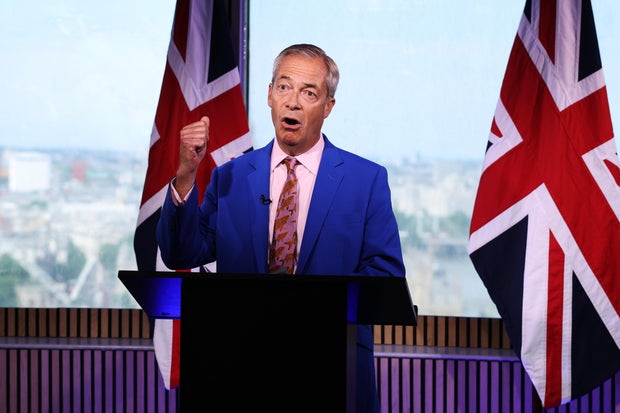
Nigel Farage Makes Statement On 'Future In Public Life'
Reform U.K. leader Nigel Farage announces his resignation as a member of parliament, July 7, 2026, in London, England.

Dan Kitwood/Getty

BBC New’s chief political correspondent Henry Zeffman called the move an attempt “to appeal to a higher political authority than the parliamentary standards committee,” the body that has been investigating Farage’s financial declarations as a lawmaker.

Britain’s outgoing Prime Minister Keir Starmer, however, called it a “desperate stunt,” saying Farage had made the decision because he is “up to his neck in sleaze.”

Farage’s party, Reform U.K., which supports the mass deportation of people in the country without legal documentation and the scrapping of national climate goals, has been topping public opinion polls for at least a year.

The party’s ascent — and its success in recent local elections in particular — was part of the reason the ruling Labour Party forced Starmer to tender his own resignation last month.

Starmer is almost certain to be replaced by his Labour colleague Andy Burnham within a few weeks, taking the reigns of both the party and the prime minister’s office. 

Farage, if he wins his seat back, could become Burnham’s most serious challenger in the next national elections. If he isn’t reelected to the parliament, however, he cannot become prime minister.

Farage is a divisive figure in U.K. politics. He’s seen as the architect of Britain’s “Brexit” from the European Union, which recent polling shows a majority of voters now believe was a mistake, and he has faced multiple allegations of historic racism.

He has, in the past, appeared keen to show himself as a close ally of President Trump, particularly ahead of the 2016 U.S. election when Mr. Trump won his first term in office. In 2024, he offered to act as a “bridge” between Mr. Trump and Britain’s newly-elected Labour Party. 

“I might be useful as an interlocutor, unofficially, behind the scenes, to try and help mend some of those fences,” he said at the time.

In March, however, after Farage visited Mr. Trump’s Mar-a-Lago resort in Florida but didn’t end up meeting with the president, sources close to the British politician told the Financial Times the relationship between the two men had cooled.

Farage had stated before the trip that he would be “dining at Mar-a-Lago.” 

A representative said after the trip that he had never planned to meet Mr. Trump in Florida. 

Darline Graham ganará la segunda vuelta por el escaño en el Senado de su difunto hermano en Carolina del Sur, proyecta CNN

La senadora Darline Graham ganará la segunda vuelta republicana de la elección especial al Senado en Carolina del Sur, proyecta CNN. Graham reemplazará a su difunto hermano, el senador Lindsey Graham, en la papeleta de las elecciones generales.Darline Graham, recién llegada a la política, fue designada por el gobernador Henry McMaster para completar el mandato de su hermano después de que este muriera repentinamente en julio.Graham contó con el apoyo del presidente Donald Trump, quien la respaldó para cumplir un mandato completo en el Senado antes de que ella siquiera anunciara su intención de postularse. Trump también hizo campaña junto a ella antes de la segunda vuelta. Graham quedó en primer lugar en unas primarias especiales celebradas a principios de este mes, pero obtuvo apenas cerca de un tercio de los votos, por lo que tuvo que disputar una segunda vuelta contra el representante Ralph Norman.Algunos republicanos han expresado malestar ante la impresión de que se estaba allanando el camino para que Graham heredara el escaño por encima de candidatos con más experiencia. En noviembre, será la favorita frente a Annie Andrews, médica y candidata demócrata al Senado, en un estado sólidamente republicano.Tras una “segunda vuelta de primarias muy reñida”, el Partido Republicano de Carolina del Sur felicitó a la senadora Darline Graham.“Como hemos dicho a lo largo de este proceso, este fue un momento histórico para Carolina del Sur, y los votantes de nuestras primarias republicanas se lo tomaron en serio y estuvieron a la altura del desafío”, dijo en un comunicado el presidente estatal del partido, Drew McKissick.McKissick pidió al partido cerrar filas en torno a Graham y centrar su atención en noviembre.La victoria de la senadora Graham supone otro triunfo para Invest in Tomorrow Coalition —Coalición para Invertir en el Futuro—, un comité independiente de campaña centrado en las energías limpias.El grupo destinó US$ 1 millón a hacer campaña contra su rival, el representante Ralph Norman, por considerar que se opone a la industria de las energías renovables. El comité independiente de campaña ayudó anteriormente a derrotar al representante Andy Ogles, republicano de Tennessee, en sus primarias y también gastó dinero contra el representante Chip Roy, republicano de Texas, durante su fallida campaña para fiscal general de Texas.“Nos gustaría dar una cálida bienvenida a Ralph Norman, quien se une a sus colegas Chip Roy y Andy Ogles en el club de congresistas que sacrificaron sus carreras por lanzar unos cuantos golpes bajos contra la industria energética nacional de Estados Unidos”, afirmó en un comunicado Tom Mattzie, presidente del comité independiente de campaña.Annie Andrews, la candidata demócrata al Senado de Estados Unidos por Carolina del Sur, desafió a la senadora Darline Graham a participar en al menos tres debates televisados después de que Graham ganara este martes por la noche la candidatura republicana.Andrews, pediatra, enfrenta un panorama difícil en un estado que no elige a un demócrata para un cargo de elección estatal desde 2006. Sin embargo, dijo que los votantes merecen conocer mejor las posiciones de Graham, una recién llegada a la política que tuvo tropiezos durante el debate de la segunda vuelta de las primarias frente al representante Ralph Norman.“Ningún nombramiento, respaldo o vínculo familiar le da a nadie el derecho de ocupar durante seis años un escaño en el Senado de Estados Unidos”, dijo Andrews en un comunicado. “Este escaño pertenece al pueblo de Carolina del Sur”.The-CNN-Wire™ & © 2026 Cable News Network, Inc., a Warner Bros. Discovery Company. All rights reserved.
Read Next Story