
U.K. far-right leader Nigel Farage resigns as lawmaker in risky gamble

▶ Watch Video: What led to Starmer’s resignation as U.K. prime minister and who will likely replace him

London — British politician Nigel Farage, a one-time ally of President Trump who has led a surging far-right, populist movement in the U.K., resigned on Tuesday as a lawmaker to trigger a special election. It’s a high-risk political gamble to renew his mandate from voters as he faces mounting pressure over a financial scandal.

Farage has been accused of violating British parliamentary law for failing to disclose financial gifts — including from a 32-year-old convicted criminal who calls him “Daddy,” according to The Sunday Times newspaper.

The Reform U.K. Party leader said he would stand in the by-election for his vacated seat, which is likely to take place in the early fall. 

gettyimages-2285056608-2-1.jpg
Reform UK party leader Nigel Farage announces his resignation as a member of parliament, July 7, 2026, in London, England.

Getty

“I’ve decided that the people of Clacton should be the judges of my actions,” Farage said in a televised address Tuesday, referring to the southeast England constituency he’s represented in parliament for two years.

“This will be a people versus the establishment by-election,” he declared, calling it “a chance to stick two fingers up to the entire establishment to frankly tell them where to go.” 

His resignation means that two parliamentary investigations into donations from two wealthy individuals will be suspended. 

Farage reiterated his stance on Tuesday that he had “done nothing wrong.”
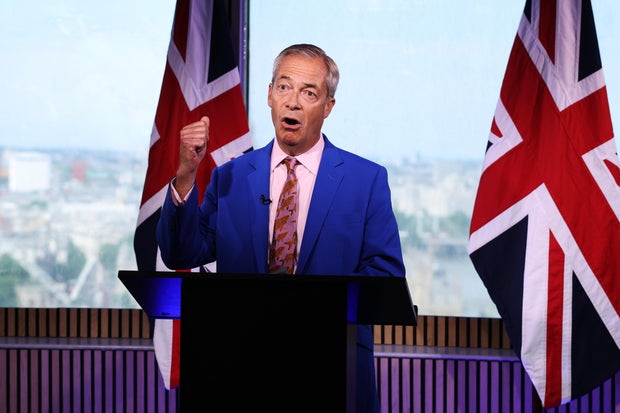
Nigel Farage Makes Statement On 'Future In Public Life'
Reform U.K. leader Nigel Farage announces his resignation as a member of parliament, July 7, 2026, in London, England.

Dan Kitwood/Getty

BBC New’s chief political correspondent Henry Zeffman called the move an attempt “to appeal to a higher political authority than the parliamentary standards committee,” the body that has been investigating Farage’s financial declarations as a lawmaker.

Britain’s outgoing Prime Minister Keir Starmer, however, called it a “desperate stunt,” saying Farage had made the decision because he is “up to his neck in sleaze.”

Farage’s party, Reform U.K., which supports the mass deportation of people in the country without legal documentation and the scrapping of national climate goals, has been topping public opinion polls for at least a year.

The party’s ascent — and its success in recent local elections in particular — was part of the reason the ruling Labour Party forced Starmer to tender his own resignation last month.

Starmer is almost certain to be replaced by his Labour colleague Andy Burnham within a few weeks, taking the reigns of both the party and the prime minister’s office. 

Farage, if he wins his seat back, could become Burnham’s most serious challenger in the next national elections. If he isn’t reelected to the parliament, however, he cannot become prime minister.

Farage is a divisive figure in U.K. politics. He’s seen as the architect of Britain’s “Brexit” from the European Union, which recent polling shows a majority of voters now believe was a mistake, and he has faced multiple allegations of historic racism.

He has, in the past, appeared keen to show himself as a close ally of President Trump, particularly ahead of the 2016 U.S. election when Mr. Trump won his first term in office. In 2024, he offered to act as a “bridge” between Mr. Trump and Britain’s newly-elected Labour Party. 

“I might be useful as an interlocutor, unofficially, behind the scenes, to try and help mend some of those fences,” he said at the time.

In March, however, after Farage visited Mr. Trump’s Mar-a-Lago resort in Florida but didn’t end up meeting with the president, sources close to the British politician told the Financial Times the relationship between the two men had cooled.

Farage had stated before the trip that he would be “dining at Mar-a-Lago.” 

A representative said after the trip that he had never planned to meet Mr. Trump in Florida. 

Trump gets a much-needed South Carolina win and other takeaways from Tuesday’s elections

(CNN) — President Donald Trump demonstrated his might with Republican primary voters Tuesday in South Carolina, as CNN’s Decision Desk projected that Darline Graham — the sister of the late Sen. Lindsey Graham and the president’s pick in the state’s special Senate primary runoff — will claim the GOP nomination.Now favored to win a full term in November, Darline Graham is, in many ways, a senator of Trump’s own making. The president lobbied South Carolina’s governor to appoint her to fill the remaining months in her brother’s term after he died in July. Then, he privately and publicly pressed her to run for a full six-year term.And when it looked like her rival in the runoff, Rep. Ralph Norman, might win, Trump visited Myrtle Beach to rally Republican loyalists to Graham’s cause, as his super PAC, MAGA Inc., disclosed spending more than $827,000 to support Graham.Graham’s win is narrow — she led by just a few percentage points Tuesday evening — but symbolically significant for the president in a month full of political setbacks, with six of his endorsed picks losing Republican primaries.Trump’s preferred candidate in the Oklahoma governor’s race, former state Sen. Mike Mazzei, meanwhile, was locked in a close Republican primary runoff against state Attorney General Gentner Drummond as ballots were being counted Tuesday night.And in a low-turnout special election runoff in Georgia, Democrats filled a vacancy in the narrowly divided House.Here are takeaways from Tuesday’s elections in South Carolina, Oklahoma and Georgia:A badly needed win for TrumpDarline Graham took to the stage at her victory party Tuesday night and declared: “South Carolina is truly Trump country.”Unlike her brother, who was close to the late Sen. John McCain and built a reputation as a foreign policy hawk independent from Trump, Darline Graham’s political profile was tied entirely to the president.“Our victory would not have been possible without you, and we are truly grateful,” she said in a message directed at Trump.For Trump, the win was badly needed — a victory in one of his highest-risk interventions in Republican primaries this year, after a string of several losses this month and with midterm elections just over two months away. It could serve to remind Republican lawmakers who might be looking to distance themselves from an unpopular president of the potential political costs of being at odds with Trump.Norman acknowledged Trump’s role in the race’s outcome, telling his supporters Tuesday night that “the president got involved. He has that right.”“I never understood why he got in this race,” Norman said as some members of the crowd booed the president. “But it is what it is, and I’ll accept it.”Graham is now set to face Democratic nominee Annie Andrews, a pediatrician, in November. Andrews on Tuesday challenged Graham to at least three televised debates, saying in a statement that “no appointment, endorsement, or family connection entitles anyone to six years” in the Senate. Still, Graham is heavily favored to win the deep-red state in the general election.A senator of Trump’s makingTrump has endorsed a slew of candidates this year, but rarely has he put his own political capital on the line like he did in South Carolina.When Trump initially talked up Darline Graham to fill the seat of her late brother, and Gov. Henry McMaster complied, it seemed like a short-term gig. The seat was already on the ballot for a full six-year term in November, so she’d have been a placeholder for a few months, until South Carolina voters nominated and elected one of the state’s myriad experienced Republicans who had been waiting decades for a Senate vacancy.But Trump doubled down three days after she was sworn in, urging her on social media to seek a full term. And, days later, she announced she would do so.The president’s “complete and total endorsement” wasn’t enough to clear the field. After all, Darline Graham had no political experience, and her brother wasn’t exactly beloved among conservative voters in South Carolina: He’d earned just 57% of the vote in his primary two months earlier against a handful of relative unknowns.The results of the August 11 primary suggested she could be defeated in the runoff. She finished first, but with just shy of 33% of the vote.There were reasons to believe Trump’s influence might be limited. After all, his choice in South Carolina’s GOP primary for governor, Lt. Gov. Pam Evette, lost to state Attorney General Alan Wilson — who Trump also endorsed at the last minute when it was clear his preference was on course for defeat.The president did not have the luxury of the same face-saving tack here: Norman had endorsed and campaigned with former Gov. Nikki Haley as she ran against Trump for the 2024 GOP presidential nomination.Graham’s inexperience was on display during a debate with Norman earlier this month, when she declined to answer a question about Taiwan and the South China Sea, saying that national security was “not my thing.”But Trump carried Graham over the finish line. He visited South Carolina on Friday, telling Republicans that he’d personally lobbied her to run for a full term. “Pretend, please, that I’m on the ballot,” he urged GOP voters.Another endorsement test in OklahomaAnother Trump-endorsed candidate, Mazzei, was locked in a tight race Tuesday night against Drummond in the hard-fought runoff for the Republican nomination for governor.The two are vying to take on Oklahoma House Minority Leader Cyndi Munson, the Democratic nominee, in the race to replace term-limited Republican Gov. Kevin Stitt in November.The race was another test of Trump’s influence — and there were significant questions over whether his endorsement would be enough for Mazzei, after Trump’s picks in Republican gubernatorial primaries in Georgia, Iowa and Minnesota all lost earlier this year.A key divide in the primary was a proposed $4 billion aluminum smelter at the Tulsa Port of Inola, estimated to bring about 1,000 jobs to the area. Trump touted the plant, claiming on Truth Social that it “will be one of the best projects ever conceived or built, not only in the Great State of Oklahoma, but in the United States, itself.” But, amid local concerns about pollution and damage to the livestock economy, Drummond has sued, asking a federal court to block the plant’s construction.Georgia Dems fill a House seatCNN projects that Democrat Everton Blair, a former Gwinnett County School Board chair, will win the special election for Georgia’s 13th District House seat vacated by the late Rep. David Scott’s death in April.But he won’t hold that seat for long.Blair, who will be the first out gay member of Congress from Georgia, defeated the longtime lawmaker’s daughter Marcye Scott in the special election runoff on Tuesday. He campaigned on a pledge to be a stronger opponent to Trump and advocate for a more progressive affordability agenda than both the late congressman and his daughter.However, Blair finished a distant third in the regular House primary earlier this year, so he won’t be on the ballot in November.State lawmaker Jasmine Clark is the Democratic nominee for a full two-year term in the deep-blue district in November. She did not run in the special election because under state law, she would have had to resign her seat in the Georgia House — costing Democrats a seat just as Republican Gov. Brian Kemp was launching an unsuccessful push for mid-decade redistricting.In the meantime, Blair’s win, and the special election of state Sen. Aisha Wahab in California last week, will help Democrats further narrow the already razor-thin GOP majority in the House.CNN’s Katie Doran and Adam Cancryn contributed to this report.The-CNN-Wire™ & © 2026 Cable News Network, Inc., a Warner Bros. Discovery Company. All rights reserved.
Read Next Story