
Trump’s proposed arch needs structural revisions to earn final approval

▶ Watch Video: New drawings show proposed “Arc de Trump”

President Trump’s 250-foot proposed Triumphal Arch would require structural revisions to earn final approval, the National Planning Commission said Thursday, before voting to preliminarily approve the plans. 

The proposed Memorial Circle monument features a 166-foot mezzanine and a 24-foot observation level, topped by a 60-foot statue of Lady Liberty. This would violate the 1910 Heights of Buildings Act, which seeks to preserve the Washington, D.C., skyline by limiting buildings to 130 feet, according to the National Planning Commission. The Department of the Interior argued the act “does not apply to federal buildings” in a June memo.

The NPC, however, said it “has historically held that the Height of Buildings Act is binding on federal buildings, and NCPC has consistently applied that position.”

The commission offered a compromise, suggesting the mezzanine and observation level be decreased to 130 feet and 20 feet, respectively. The remaining 40 feet could be added back to the statue. Under this proposal, Lady Liberty would be 100 feet tall, and the overall arch would still measure 250 feet. 

If construction goes forward as proposed, the arch would dwarf the 99-foot Lincoln Memorial, which is across the bridge. It would also be roughly 30 feet taller than the Plaza de la República in Mexico City, currently the largest arch in the world. 

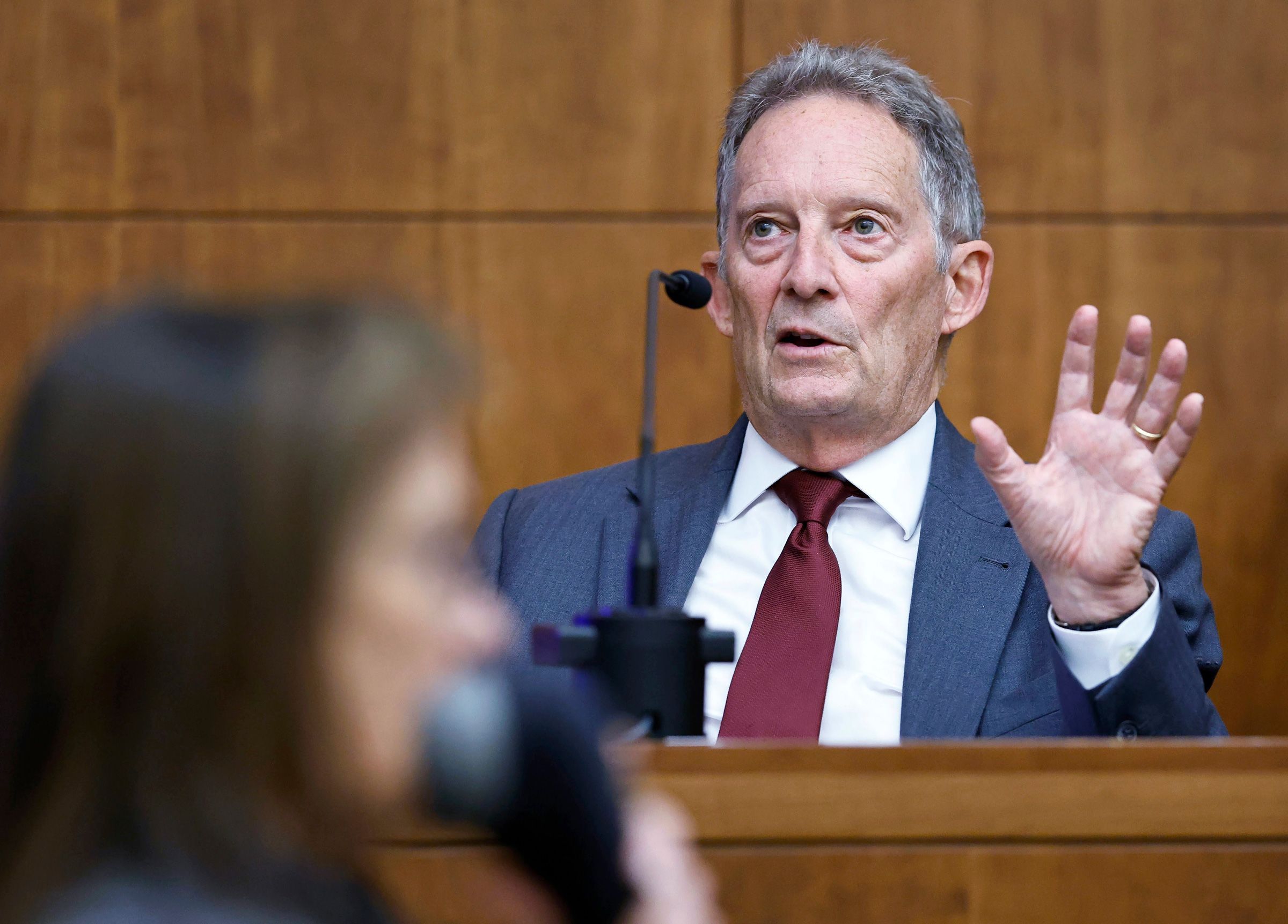
The arch has faced significant public criticism, which was on display as witnesses spoke for well over an hour at the meeting. A variety of reasons from public process to cultural presentation were cited, including passionate appeals about how the visual obstruction of Arlington Cemetery is offensive. 

“My concern is not with commemoration itself, but with this specific proposal, its location, its scale, and its impact on a historic memorial landscape,” said Cynthia Morrison, a Gold Star mother. “The open space between the Lincoln Memorial and Arlington National Cemetery is not just empty land. It is deliberately designed and historically significant memorial vista.”

Michael Lemmon, a Vietnam veteran and plaintiff in the lawsuit against the arch, advocated for “a careful review by concerned stakeholders” such as residents, veterans, historians and legislators and raised concerns about how the arch may impede ceremonies, burials and visits to Arlington. 

“As a combat veteran, I feel a duty to protect the memory and honor the sacrifice of my comrades and all those buried there,” Lemmon said, “This vainglorious monumental arch does neither.”

A majority of the commission voted in favor of approving preliminary site plans for the arch.

While the commission, chaired by Trump White House aide Will Scharf, did not pose any substantive challenges to the arch, it did leave a few stipulations. 

Critics of the arch have also expressed concerns about the flight path to nearby Ronald Reagan National Airport. 

Any recommendations from the Federal Aviation Administration must be incorporated, and the FAA must still conduct a full aeronautical study before construction. 

The NPC is asking for revisions to plans for pedestrian accessibility and lighting, as well. The commission is concerned the 32 proposed traffic poles will create clutter and about the brightness from eight 14-to-20-foot tall stanchions. 

There is no date set for final review of the site and building plans. According to National Park Service documents filed to the federal registrar last month, federal officials are seeking an aggressive work schedule that would require 20 hours a day of construction over two years. 

While many of D.C.’s monuments are constructed in natural stone such as marble and limestone, the arch is set to be built from concrete and finished with granite. 
Two visions of America are emerging as midterms draw near. Voters must decide which one is real

(CNN) — Two rallies, nearly 1,000 miles and two days apart, laid out the increasingly stark choice confronting midterm election voters and a looming moment of reckoning over the nation’s future course.In Atlanta on Sunday, Georgia Sen. Jon Ossoff delivered an acidic takedown of President Donald Trump; an economy that many voters think is failing them; and a war Trump started and has failed to resolve. Ossoff boiled the election down to a referendum on corruption, costs and failed global leadership.“Under Donald Trump, it costs more than ever to stock your fridge, to power your home, to make a cup of coffee, to buy school supplies for your kid or a tractor for your farm,” the Democrat said. He accused the president of sleeping through meetings and lying about the war, and said that while sailors on the USS Abraham Lincoln aircraft carrier are doing their nation proud during a deployment of over 250 days, Trump spends his time playing golf and buying stocks.On Friday, in Long Island, Trump gave the most explicit version yet of an argument Republicans hope will stave off the midterm curse that haunts incumbent presidents — even as their leader faces headwinds over his personal unpopularity, the Iran war and voter frustration over high prices.He accused Democrats of wanting to turn America into a “communist country” and of declaring war on the police and the rule of law. “The communists want to turn America into a third-world country, into a hellhole of crime and filth,” the president said, seeking to exploit the successes of progressive Democrats.The contrast encapsulates a bitter moment in American history as a deeply unpopular president attempts to dodge lame-duck status by branding Democrats as un-American extremists. But he’s facing opponents keyed into a classic change campaign as they attempt to saddle Republicans with Trump’s failures and to tap into voters’ fury over the state of the nation.Democrats have struggled for years to land disqualifying arguments against Trump. Their past warnings that US democracy was in peril often seemed rather esoteric to people struggling to afford gas and groceries. Ossoff is providing something that the party has lacked: abrasive, robust language and framing that can be borrowed by other candidates to weave Trump’s vulnerabilities into a positive case for their own campaigns.This is one reason a senator with a strong record of winning in the conservative South and among Black voters — a critical Democratic constituency — is drawing talk of a possible 2028 run for president. First, however, he must try to win reelection.Ossoff is also showing how Democrats can pin down their individual opponents by linking them to Trump’s record. He slammed his opponent, Rep. Mike Collins, whom Trump jammed onto the ballot despite the objections of state leaders. “Georgia deserves better — better than pro-war, pro-tariff, pro-cutting your healthcare Trump puppet Mike Collins, and America deserves better than Donald Trump,” Ossoff told his crowd.Amid polls showing the Democratic senator in the lead, Collins told CNN’s Manu Raju in July that his foe was “lying, and the reason is he’s losing and he knows he’s losing.”Trump is already going scorched-earthTrump is laying out a two-pronged campaign: claiming that his presidency is a historic success while branding Democrats as an unacceptable choice. In Long Island, he refused to apologize for a war in which US credibility has been tested by a weaker power as Iran holds the world economy hostage by effectively closing the Strait of Hormuz.Yet Trump’s vulnerable position on Iran was laid bare when he appeared to belittle the pain caused by the conflict at home. He said that it was worth it for people to “pay a tiny little bit more” for gasoline to prevent Iran getting a nuclear weapon. His apparent indifference to affordability issues — which he again mocked as made-up Democratic talking points — also risks undercutting the more positive aspects of his economic message such as larger-than-expected tax refunds under the GOP’s 2025 domestic policy bill and efforts to cut prescription drug prices.Trump’s searing assault on progressive Democrats is apparently designed to shift the narrative from his economic challenges. In addition to his claims about communism, Trump warned last week that “we have jihadists being elected all over the place.” His comment followed the triumph of Abdul El-Sayed, a public health professional and Muslim, over a more centrist candidate in Michigan’s Democratic Senate primary. It should also be placed in the context of his repeated attacks on Rep. Ilhan Omar, a Somali American from Minnesota.But Trump faces a risk that such divisive rhetoric will complicate one of the most important requirements of his reelection campaign: lining up independent and moderate voters in key states that swelled his coalition two years ago.Still, given the difficult terrain of the election, a strategy designed to fire up Trump’s base may make sense. Republicans have tended not to drive out the broader MAGA coalition when Trump is not on the ballot. And incumbent parties in midterm elections often struggle to match the enthusiasm of partisans favoring the party desperate to win back power. In tight races, a high turnout of MAGA voters might be one way to stem GOP losses.The ideological clash that could dampen Democratic hopesWhile the political environment seems challenging for Republicans, there’s a wild card that Trump hopes to exploit and that was also on display over the weekend as the midterm campaign heated up.A blue wave in November may depend on the party agreeing to postpone arguments about ideological splits that have emerged in congressional primary campaigns.On Sunday, Maryland Gov. Wes Moore told CNN’s Jake Tapper that his party must concentrate directly on the plight of voters struggling with the prices of housing, food and healthcare. “Any Democratic policy that’s not focusing on what people are feeling right now and the status quo protection has got to go,” Moore said on “State of the Union.”But Trump’s very unpopularity seems often to fuel Democratic disputes over ideology since it makes the prospect of congressional majorities seem closer.One progressive Democrat, Rep. Ro Khanna, on Sunday backed the Medicare-for-All healthcare system also favored by El-Sayed and other progressive candidates. “(It) is arguably the most important priority. It would save money, and it would save lives,” the California lawmaker said on NBC’s “Meet the Press.”But Rep. Hakeem Jeffries, the Democratic leader in line to be speaker if Democrats win the House, declined to commit to a state-run system, foreshadowing likely splits between emboldened progressives and more moderate Democrats in any majority next year.“It’s not legislation that I currently am co-sponsoring or that I support,” Jeffries said on NBC, adding he doesn’t back many policies attributed by Trump to democratic socialists. “I do not support defunding the police. I do not support open borders. I do not support abolishing the Senate,” he said.Republicans hope such differences inside the Democratic coalition and the presence of some more radical candidates on the party’s more broadly moderate lists will offer Trump a narrow opening.In Long Island, Trump renewed his boast that the United States is the “hottest” country in the world and that Americans are lucky to be living in a “golden age.”Democrats are arguing that high prices, a foreign war with no end in sight and an apparently uninterested president mean he’s selling a fantasy.The midterm elections may hinge on which vision is closer to voters’ lived experience.The-CNN-Wire™ & © 2026 Cable News Network, Inc., a Warner Bros. Discovery Company. All rights reserved.
Read Next Story