
Trump wants Lindsey Graham’s sister to finish his Senate term

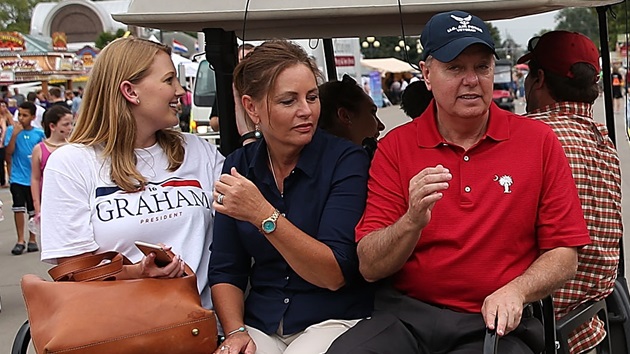
Lindsey Graham rides on the back of a golf cart with his sister Darline Graham Nordone (C) during the Iowa State Fair on August 17, 2015 in Des Moines, Iowa. (Justin Sullivan/Getty Images)

(WASHINGTON) — President Donald Trump said on Monday he wants Lindsey Graham’s sister, Darline Graham Nordone, to be his temporary replacement in the Senate.

South Carolina Gov. Henry McMaster announced around the same time as Trump’s post that he will be making an announcement about who is appointing to the Senate seat at 4 p.m. on Monday

ABC News has reached out to McMaster’s office about Trump’s push for Nordone to be Graham’s replacement. ABC News has already reached out to Nordone for comment.

Trump wrote in a social media post that he made his recommendation to McMaster, and said it would a “fabulous tribute” to Graham.

Separate from the temporary replacement to complete Graham’s term, South Carolina will hold a special election on Aug. 11 to replace Graham as the Republican nominee on the general election ballot this November.

Graham and his sister shared an incredibly close relationship. After their parents died when Graham was only 22 years old, he took on a caretaker role for his younger sister, becoming her legal guardian.

Nordone, in a recent video for Graham’s reelection campaign, said of her brother, “He’s always been there for me, no matter what.”

It is not immediately clear if Nordone has any political experience or aspirations. According to The New York Times, Nordone is a mother of two and has worked to help people with disabilities find jobs. 

Graham’s office announced over the weekend that the longtime Republican lawmaker had died suddenly at the age of 71. Preliminary findings from the Medical Examiner of the District of Columbia said the senator died from an “aortic dissection due to arteriosclerotic cardiovascular disease.”

Trump, in an interview with “Fox and Friends” on Monday morning, called Graham a “friend” and praised his work on shepherding through the nomination of Supreme Court Justice Brett Kavanaugh during his first term.

“He had fun with politics, but he was really good at it,” Trump said of Graham. “And then when he got angry, like he did in the case of Brett Kavanaugh, it was so impactful.”

Copyright © 2026, ABC Audio. All rights reserved.

IRS proposal would force nonprofits to disclose leaders’ terrorism convictions

Washington — The Trump administration is weighing a proposal to require nonprofits to disclose in their annual tax filings whether their top officials have been convicted of certain financial or terrorism-related crimes, sources with direct knowledge of the matter told CBS News.The IRS disclosure requirement would be added to the Form 990, the annual return that nonprofit groups file with the agency, said the sources, who spoke on the condition of anonymity because they were not authorized to talk publicly. Federal officials have viewed it as an effort to pressure tax-exempt groups to cut ties with people who have such criminal records and ensure that donors can make informed decisions about how to best direct their money, the sources said.Convictions that would have to be reported include providing material support to terrorists, fraud, money laundering, securities fraud, tax evasion, theft and civil judgments from Securities and Exchange Commission or state securities regulators' enforcement actions.The IRS proposal would not force groups to identify which officer, director or trustee was convicted, according to the sources. It is not a violation of federal law for people with felony convictions to serve on a nonprofit board.The proposal is expected to relate to convictions that occurred within the last 10 years. Nothing has been finalized, and it is one of at least two proposed revisions to the Form 990 moving through the Treasury Department and the IRS. Another proposal announced in April would impose new disclosure requirements for nonprofits that receive government funding. "No one has a right to privacy of their criminal record," said Tom Jones, an ally of President Trump who leads the conservative American Accountability Foundation nonprofit. "If your board members are convicted criminals, I am hard pressed to understand why you have a problem with that being publicized. You should have to explain why those people are on your board."A spokesperson for the Treasury Department said that it is considering "a range of measures to strengthen accountability for nonprofit organizations" and that the agency "will continue to follow the money to ensure tax-exempt status is not exploited to facilitate illicit activity."Inside the IRS, some officials have privately raised concerns about the conviction-related proposal and what the agency could lawfully do with the information — as well as questioned how it relates to enforcement of tax laws, multiple sources familiar with the conversations told CBS News. These IRS officials have said they view the effort as a form of potential political targeting that could draw legal challenges, including on free speech grounds, sources said."This disclosure rule goes directly to guilt by association," said Roger Colinvaux, a law professor at the Catholic University of America and former counsel to the nonpartisan Joint Committee on Taxation in Congress. "There's no federal law that says a nonprofit cannot have a convicted felon on their board. It could just create a stigma and chill association. This would reach deeply into American civil society."One of the sources with direct knowledge of the proposal, who spoke on the condition of anonymity because they were not authorized to talk publicly, suggested that such a move is not much different from material disclosures that publicly traded companies are required to make to help the investing public make informed decisions. The source also suggested that the proposal could help the IRS move faster to suspend or revoke the tax-exempt status of nonprofits if they fail to disclose convictions of any of their leaders. That's because the nonprofit officials who submit the Form 990 must attest to its accuracy under the penalty of perjury, and fact-checking whether board members have undisclosed criminal convictions would be a relatively simple task for the IRS to do, the source added.The disclosure efforts come amid a broader effort by the Trump administration to target left-leaning nonprofits. Mr. Trump signed a national security memorandum last year that directed the IRS to refer groups believed to be financing "domestic terrorism" to the Justice Department. In March, CBS News was first to report that the FBI and IRS Criminal Investigation teamed up to launch a "command post" tasked with investigating possible links between nonprofits and terrorism.That followed a directive from then-Attorney General Pam Bondi late last year for law enforcement agencies and federal prosecutors to probe the anti-fascist antifa movement and other "extremist groups." The memo asked law enforcement agents to consider investigating extremist groups for potential fraud and tax crimes. Antifa, a decentralized coalition of far-left activists, is not a formal organization and has no board members or officers.A number of federal criminal investigations and prosecutions targeting nonprofits are now underway. The highest-profile prosecution focuses on the Southern Poverty Law Center, which is accused of misleading donors and banks by funneling money to informants for white supremacist groups. The SPLC has pleaded not guilty.In another matter, Neville Roy Singham, the wealthy husband of the founder of the progressive nonprofit Code Pink and benefactor of far-left political causes, is under criminal investigation in Manhattan, CBS News previously reported. That investigation began by looking into possible violations of the Foreign Agents Registration Act and has since expanded into a criminal tax probe over whether money was unlawfully funneled through nonprofits he controls and whether he lied on tax forms for those nonprofits.Earlier this year, eight people affiliated with a North Texas antifa group were sent to prison for sentences ranging from 30 to 100 years, after they were convicted for providing material support to terrorists and other offenses, including the attempted murder of an Alvarado police officer at the Prairieland Detention Center.The proposal comes as the Trump administration has also focused its attention on fraud in recent months and spotlighted the pandemic-era Feeding Our Future scandal in Minnesota as an example of abuses in the nonprofit sector. So far, the estimated $250 million scheme has resulted in 68 convictions or guilty pleas. Some states already ask tax-exempt groups a version of the question the IRS is now weighing. California requires charities soliciting donations in the state to disclose whether their officers or directors have been convicted of certain offenses, as part of an effort to prevent charitable fraud. Under state law, a court can remove a director for fraud, dishonest acts or breach of duty in a case the attorney general can bring. But federal law has no equivalent remedy, said Ellen Aprill, a senior scholar in residence at UCLA Law School's center for philanthropy and nonprofits — meaning the IRS would be collecting information it has no stated authority to act on. "I think there is the potential for a fishing expedition," Aprill said.Alexander Reid, a partner at the law firm BakerHostetler who specializes in tax-exempt organizations, said the proposal about board members would collide with the Supreme Court's 2021 decision in the case Americans for Prosperity Foundation v. Bonta. The ruling struck down a California requirement that charities turn over lists of their major donors."The bulk collection and disclosure of sensitive information from tens of thousands of charities, much of which would never be relevant to tax administration or charitable-law enforcement, would fail exacting scrutiny by chilling freedom of association without furthering a narrowly defined governmental interest," Reid said.The IRS has come under the spotlight more recently over questions about political interference. Ken Kies, who was the top tax official at the Treasury Department, was ousted in July after warning that the White House was at risk of illegally involving itself in IRS audits, The Wall Street Journal reported.Steven Toscher, a tax attorney in California, said that from a good governance perspective, he does not see a problem with requiring nonprofits to disclose terrorism-related convictions of their board members. At the same time, he said, it's fair to raise questions about why the Trump administration wants this information, what it might use it for and how it defines terrorism."It's hard to view this in isolation of just good corporate nonprofit governance because of the executive who is proposing it," he said. "They have an agenda, so it's hard to filter this." Diane Yentel, president and CEO of the National Council of Nonprofits, which represents roughly 25,000 organizations, sees the administration's proposal for officers as part of a pattern of Republicans seeking to target groups in the sector that are not aligned with Mr. Trump."Nonprofits welcome reasonable regulation as a way to maintain public trust," said Yentel, but the proposal is "a step too far when viewed in the context of all of the administration's actions and rhetoric of the last 18 months, including equating some nonprofits to 'domestic terrorists' or 'enemies' of the American people."She said complying with the disclosure "would take precious time and resources away from nonprofits' core work of serving communities."
Read Next Story