
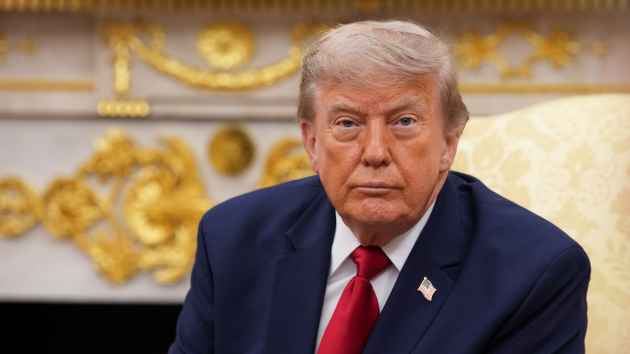
(WASHINGTON) — President Donald Trump, in a primetime address on Thursday, announced he has declassified a slew of documents he claims reveal vulnerabilities in America’s elections systems, election fraud and interference in elections by China, and ordered the Department of Justice to prosecute those believed to be involved.
“America is back and doing really well, but we still have a major challenge that must be urgently addressed because no country can be great without fair and honest elections, you have to trust your country,” Trump said. “Because if there can be no trust, there can be no greatness, and that’s very simple: no trust, no greatness.”
But throughout the more than 20-minute speech, the president did not provide specific evidence that the election outcome, or any votes, were altered in the 2020 election, despite his repeated claims that the election was “stolen” or “rigged.”
Trump has long pushed debunked conspiracy theories to claim that his 2020 election loss was fraudulent.
The president’s speech led to his main argument: he wants Congress to pass the SAVE America Act, his sweeping elections reform bill that Senate Majority Leader John Thune has repeatedly said does not have enough Republican votes to pass.
In his remarks, the president said that he would immediately declassify the release of “critical intelligence, revealing shocking vulnerabilities in our election infrastructure.”
According to the president, the documents focus on what he said were a number of areas of concern, including claims that China “compromised” election data during the 2020 election, and attempts to downplay the extent of China’s efforts.
Trump argued that the intelligence community suppressed information about China accessing 220 million voter files and trying to turn American opinion against him in the run-up to the 2020 election.
The president also accused the “deep-state” of keeping information about election meddling from him.
Trump claimed that U.S. intelligence agencies learned that tens of millions of voters’ data in 18 states had been “bought, stolen, or hacked” by China, and that the intelligence community deliberately kept this information from him while he was president.
Trump’s remarks asserting that the Chinese undertook a far more ambitious role in attempting to dictate the outcome of the 2020 election goes beyond what U.S. intelligence community has previously assessed.
In March 2021, two months into the Biden administration, a declassified “Intelligence Community Assessment” (ICA) that was produced at the end of Trump’s first term publicly acknowledged the belief among some intelligence officials that “China took at least some steps to undermine former President Trump’s reelection chances.” But the ICA said any such actions were “primarily through social media and official public statements and media,” not through interference with “election processes.”
Further, the ICA said that while China was “probably” trying “to gather information on U.S. voters and public opinion; political parties, candidates and their staffs; and senior government officials,” the more reliable intelligence indicated that such efforts were not actually intended to undermine Trump but instead to “predict electoral outcomes and to inform its efforts to influence US policy toward China under either election outcome.”
The heavily redacted documents released by the White House on Thursday do not appear to back up Trump’s assertions, instead containing scattershot intelligence that descries efforts to obtain — but not alter — voter records and to conduct social media activity to sow social discord.
One heavily-redacted document titled “200M Voter Records Compromised. repeatedly references personally identifiable information being compromised. This information includes names, phone numbers and addresses — which can also be found from many other sources.
In another series of near-completely redacted memos, words such as “state voter registration data” and “personal identifiable information” appear between large blocks of black redaction markings. It is impossible to surmise the meaning of these records without context, but they appear to point to some Chinese efforts to gather American voter data, much of which is publicly available.
Notably, these memos document Chinese activities ahead of both the 2020 and 2024 presidential elections.
Elsewhere in his remarks, Trump alleged that former Justice Department officials slow-walked an investigation in Michigan that involved the submission of voter registration applications that had forged signatures and other indications of fraudulent applications. Trump called on FBI Director Kash Patel to look into whether any charges can still be brought.
Local media at the time said that a state-level investigation was halted so the FBI could continue with a related investigation. It’s unclear why no federal charges were ever brought or if federal charges were warranted.
At the time, state officials said that the fact that the fraudulent applications were detected shows that the system worked.
The president also said the documents released Thursday include a Department of Homeland Security report he called “stunning,” alleging approximately 278,000 non-citizens were included on voter rolls.
In the documents released by the White House, the DHS report that alleged 250,000 noncitizen voters on the rolls came from a review of “public voter files” that appear to have come from four states: California, New Jersey, Pennsylvania and Nevada. DHS did not provide any methodology about how it reached that number, nor does it specify what “public voter files” it reviewed.
DHS acknowledged it did not have access to those states’ voter rolls, and alleges that in the 10 states that provided the federal government access to their rolls, the agency found 28,000 noncitizen voters.
Findings from the conservative-leaning Heritage Foundation have found only around 100 verified instances of non-citizen voting going back two decades.
-ABC News’ Lucien Bruggeman and Mike Levine contributed to this report.
Copyright © 2026, ABC Audio. All rights reserved.