
▶ Watch Video: Iran and U.S. both claim control over Strait of Hormuz, trade more strikes
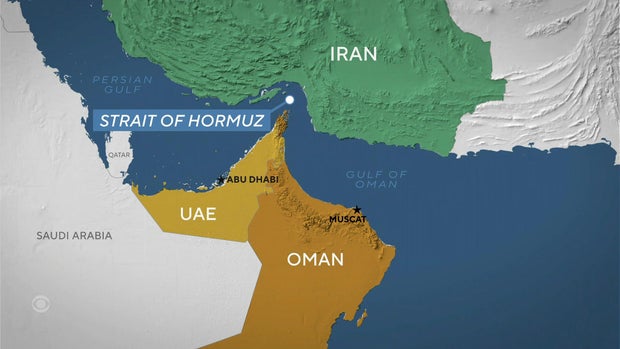
President Trump said Monday that the U.S. will be “the guardian” of the Strait of Hormuz and suggested that other countries will pay the U.S. for securing it.
“The U.S.A. will be, from this point forward, known as ‘THE GUARDIAN OF THE HORMUZ STRAIT,’ but as such, and as a matter of FAIRNESS, will be reimbursed, at the rate of 20% on all cargo shipped, for any and all costs necessary to do the job of providing safety and security to this very volatile section of the World,” he said on Truth Social. “The process and formation will begin immediately.”
He also said the U.S. is reinstating its blockade on Iranian ports and vessels, adding the blockade is “so named because it is only stopping Iran’s ships or customers from entering or leaving.”
“All other countries will have fair and open use of the Strait,” he said, adding that it will stay open “with or without Iran.”
The president told Fox News earlier Monday that the U.S. was “going to keep the strait, and we’ll probably run it. We’ll become the guardian of the strait. Maybe we’ll call it the ‘Guardian Angel of the Strait.’ And we should be reimbursed for that.”
CBS News
He did not name any countries he expected would pay under such an arrangement, but implied that Persian Gulf energy producers should.
“When we do that, we’re going to be reimbursed, because the other nations are very wealthy; they’re on our side, and we can’t be expected to do that for nothing,” he said.
He also said the U.S. had “guarded the strait for 50 years, more, and we never got paid for it,” saying other nations “made all the money.”
“We guarded it for nothing, and now we’re going to guard it,” he said. “We’re going to get paid for guarding it, a lot of money.”
The strait was open to all vessels before the U.S. and Israel launched their joint war on Iran on Feb. 28. Maritime traffic through the strait has been significantly reduced since then, and the U.S.-Iran dispute over control of the crucial waterway has derailed attempts to reach a lasting peace deal in the conflict.
Iran has argued that the vaguely worded memorandum of understanding signed by the U.S. and Iran in mid-June gave it the right to control shipping through the strait, and it balked at the U.S. government and military’s calls for ships to use the southern route close to Oman, which President Trump has insisted is open.
Iran’s embassy in the U.K., in a statement Monday, accused the U.S. of having “done nothing but violate” the agreement “since day one,” specifically by “pushing vessels toward a dangerous southern parallel route” through the strait, close to Oman’s coast. It called that “not only legally questionable but also unsafe, unreliable, and prone to accidents.”
Iran attacked several ships attempting to use that southern route last week, and on Saturday it also struck a container vessel near the western entrance to the strait, prompting the U.S. to launch multiple rounds of airstrikes on Iranian targets.
Later Monday, Iran’s Persian Gulf Strait Authority declared in a social media post that, “due to recent hostile actions by the US forces, passage through the Strait of Hormuz is currently unfeasible.”
“As soon as stability and calm are restored, all applications will be reviewed in accordance with the scheduled timeline, and the permitting process will resume,” the PGSA added, reminding vessels that in Iran’s view, “the sole means of obtaining a passage permit” to transit the strait is through its website.
Mr. Trump’s suggestion on Monday that the U.S. should “get paid for guarding” the strait came after weeks of condemnation from Washington over suggestions by Tehran that it would in the future charge commercial ships “fees” for passage.