
Trump says he’ll remove Syria as state sponsor of terrorism for the first time since 1979

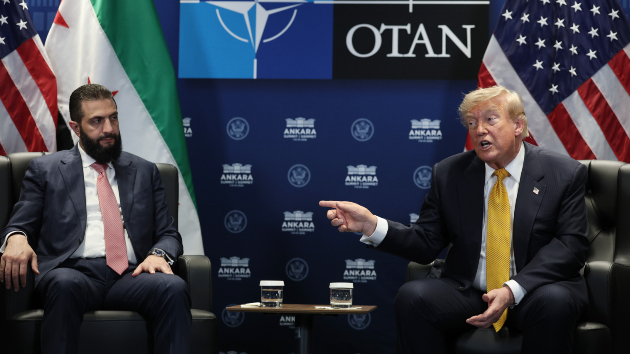
U.S. President Donald Trump (R) meets with Ahmed al-Sharaa, President of Syria (L) for bilateral talks at Beştepe Presidential Compound during the NATO Summit on July 08, 2026 in Ankara, Turkey. (Win McNamee/Getty Images)

(WASHINGTON) — President Donald Trump, sitting next to Syrian President Ahmed al-Sharaa at the NATO summit in Turkey, said Wednesday that he will remove Syria from the State Department’s State Sponsors of Terrorism list. 

“He’s done a great job. Maybe he would have brought that up. That’s a good question. Yeah, any problems with that? I think we should. Yeah, I will,” Trump said of al-Sharaa when asked about removing Syria from the list.

Trump offered high praise for al-Sharaa during their meeting on the sidelines of the NATO summit, a remarkable turnaround for the man who once led an al-Qaeda affiliate in Syria.

Al-Sharaa at one point had a $10 million bounty on his head and served time in the infamous Abu Ghraib prison in Iraq.

He then then led a coalition of Islamist rebel factions in late 2024 to topple former Syrian President Bashar al-Assad.

“He’s done a really fantastic job as president. He’s unified the country in a very short period of time,” Trump said Wednesday, describing the Syrian leader as a “strong person” who is “respected by everybody.”

“We’re proud of the job he’s doing,” Trump said. 

Secretary of State Marco Rubio said Trump had alerted Congress Wednesday of the administration’s intent to rescind Syria’s designation following a 45-day period — the amount of time required for congressional review. 

In his statement, Rubio referenced an executive order issued by the president last year ordering a review of Syria’s designation and remarks on the “positive changes and counterterrorism actions taken by the Syrian government under President Ahmed al-Sharaa, and formal assurances provided by President al-Sharaa that Syria will not support acts of international terrorism in the future,” two requirements for delisting. 

Congress could attempt to block the delisting but the move is not expected to face significant opposition. 

What it means for Syria

Trump’s commitment to potentially remove Syria from the State Sponsors of Terrorism list would mark one of the final obstacles blocking the country from fully rejoining the international financial system.

The U.S. designated Syria a state sponsor of terrorism in 1979 — the longest such designation for any country on the list. The other countries on the list are Cuba, Iran and North Korea. Syria was designated as such because of the former al-Assad regime’s historical support for designated terrorist groups.

But U.S. officials have said there are a number of steps needed ahead before the designation can be removed.

U.S. lawmakers are cautiously optimistic.

A bipartisan trio of lawmakers wrote to Trump earlier this month lobbying for Syria’s removal from the list. But they argued al-Sharaa’s government has more work to do to follow through on equal representation for women and minority constituents in Syria and ensuring security in the region. 

The new US-Syria relationship 

In May 2025, Trump announced he would lift sanctions on Syria to create a new relationship between the two countries.

Last November, the United Nations Security Council formally adopted a U.S.-led resolution that lifted sanctions on al-Sharaa so he could travel to the U.S. to meet with Trump in the Oval office, the first offical visit by a Syrian president. 

Congress also approved repealing comprehensive sanctions under the Caesar Syrian Civilian Protection Act. Trump signed it into law in December.

The repeal provided a way for Syria to begin transacting with regional and U.S. businesses, but the state sponsor of terrorism designation blocks it from accessing significant U.S. foreign assistance.

Lifting this designation on Syria could facilitate a whole range of investments in the country, including in oil, banking, technology, and real estate — which could lead to an economic sea change for the country and more overall stability. 

ABC News’ Shannon K. Kingston contributed to this report.

Copyright © 2026, ABC Audio. All rights reserved.
JD Vance and the Trump team keep moving the goalposts on Iran

(CNN) — One of the Trump administration’s biggest problems in extracting itself from the Iran war is the list of very absolutist goals that President Donald Trump and his team laid out.The goals have included complete Iranian surrender, regime change, Iran never getting a nuclear weapon and ending Tehran’s support for its Middle East proxy groups like Hezbollah.As the war — now in its sixth month — has dragged on, this list of goals has conspicuously shifted and been pared back. And Vice President JD Vance appears to have pared it back recently in a remarkable way, offering the latest indication that the administration might be preparing to settle for less — maybe even a lot less.Appearing on Fox News on Thursday, Vance was asked how the war might end. And he laid out two goals.“It’s ensuring that the Gulf countries continue to send oil and gas to the world economy so that we have energy price stability,” he said, adding: “That’s goal number one: Keep oil and gas cheap for Americans all over our country.“And then, obviously, goal number two is ensure that Iran never gets a nuclear weapon.”This is not the administration’s old list of goals — and the order Vance placed them in is striking.When asked about Vance’s comments on Friday, White House press secretary Karoline Leavitt maintained that “both goals are equally as important to the president.”The administration has almost always characterized Iran never getting a nuclear weapon as the overriding concern.And even if the goals are truly equal in the administration’s mind, including oil and gas prices at all — and not other items — is a notable shift.In fact, Trump explicitly rejected this as a goal back in May. When asked if he considered Americans’ financial situation when trying to resolve the war, Trump responded, “Not even a little bit.” He signaled that denuclearization was so important that he didn’t factor in anything else.(Trump echoed that line on Friday, saying he would “never apologize” for Americans paying a little more for gas, given the stakes in Iran.)I wrote in March about how the administration frequently listed four goals for the war — but how the four goals frequently differed depending upon who was speaking.Some lists included ending funding for proxy groups, for example, while others did not. Some mentioned destroying Iran’s missile infrastructure, while others omitted that. Some mentioned getting rid of Iran’s air force and navy, but others only mentioned the navy.It was like the administration was workshopping the list in real time.But the key point here is that none of those lists included keeping oil and gas prices low in the United States.And given the Strait of Hormuz was open before the war started, that particular goal could just be read as a return to the pre-war status quo — with denuclearization being the only goal that would represent a new achievement.Indeed, the new emphasis on low gas prices from some in the administration seems like the latest sign of relaxing the goals to prepare for a conclusion to the war that comes up well shy of Trump’s initial aims.By May, it became clear the administration was no longer going to emphasize certain goals.By June, the Trump administration entered into a memorandum of understanding with Iran that barely mentioned previously central US goals.And for the last two-plus months, Trump has been saying things that sounded a lot like he might scale back his nuclear demands.While the administration previously emphasized Iran turning over its enriched uranium, Trump’s spoken about how perhaps enough damage was done to its nuclear program and its nuclear materials are buried too far underground to be accessed. The president has also talked about how the US government could simply monitor from space to make sure Iran didn’t try to retrieve them.He’s even claimed that Iran was already denuclearized.In other words, Trump sounded a lot like a guy who knew he might not be able to cow Iran into accepting a really restrictive nuclear deal.His administration talking about energy prices as “goal number one” — even if Trump isn’t — would fit neatly with this progression away from the hard-and-fast goals that the administration set out to achieve.If a return to the pre-war status quo really is “goal number one” right now, that says a lot about how little this war has accomplished.The-CNN-Wire™ & © 2026 Cable News Network, Inc., a Warner Bros. Discovery Company. All rights reserved.
Read Next Story