▶ Watch Video: Latest news on Trump’s Gaza peace plan announcement involving Hamas’ future
President Trump said Thursday evening Hamas and his international “Board of Peace” have agreed on the next steps in a peace deal that includes Hamas’ disarmament in the Gaza Strip.
In a Truth Social post, the president called it a “HISTORIC agreement for the COMPLETE DISARMAMENT of Hamas and all other armed groups in Gaza,” and a “monumental step toward lasting PEACE and SECURITY.”
The exact timetable for disarmament isn’t clear.
Hamas communicated through mediators that it agreed to the final text of the plan, including decommissioning their weapons, U.S. and Board of Peace officials told reporters Thursday.
Hamas has agreed to the plan for Gaza’s disarmament, a senior Hamas official told CBS News’ partner network BBC News. Israel has not yet publicly commented on Mr. Trump’s announcement.
Under the plan, Israeli forces would withdraw from parts of Gaza as “disarmament is completed,” Mr. Trump said Thursday, with an International Stabilization Force and a new Palestinian police force responsible for security.
“This agreement is a critical step towards Gaza finally being governed by a new Palestinian government that will work closely with the Board of Peace to help the Palestinian people,” the president wrote. “At the same time, Israel will have the security it deserves, with Gaza no longer used as a base for terror attacks.”
If the agreement sticks, it would be the first time Hamas or any other militant group in Gaza has agreed to disarm.
The negotiations stem from a 20-point peace proposal that Mr. Trump offered last fall to end the war between Israel and Hamas. The conflict broke out with Hamas’ terrorist attack on southern Israel on Oct. 7, 2023, which killed about 1,200 people and took roughly 250 hostages. Israel responded with an intense aerial and ground campaign in the Gaza Strip, where more than 73,000 people have been killed, the Hamas-run Gaza Health Ministry says.
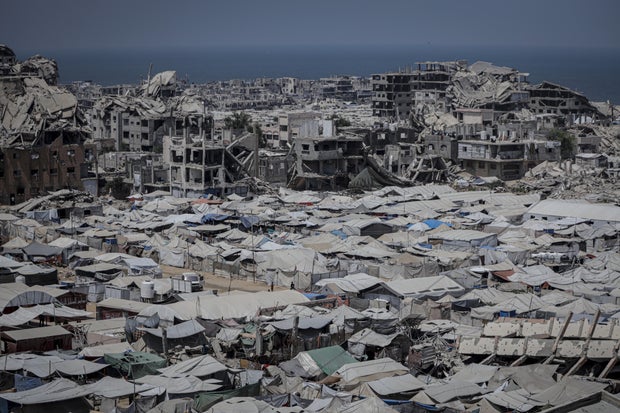
Ahmed Jihad Ibrahim Al-arini/Anadolu via Getty Images
Mr. Trump’s initial framework called for the release of hostages, a pause in fighting, a ramp-up of aid distribution in Gaza and, eventually, an Israeli withdrawal from the territory as Hamas disarms. It envisioned an International Stabilization Force that would temporarily oversee security, and a “technocratic” committee made up of Palestinians to govern the territory.
During talks last fall, negotiators broke that framework into two phases. The initial phase — covering the release of hostages and a ceasefire — was implemented in October. But issues like the decommissioning of Hamas’ arms and the redeployment of Israel’s military were left for later. Some Israeli strikes and militant attacks have continued since then.
The newly agreed-upon roadmap essentially turns the 20-point plan into a framework that will be refined over the next few weeks, U.S. and Board of Peace officials told reporters in a call Thursday. They acknowledged that the agreement took longer than they had hoped, but they said they wanted to be deliberate given the issue’s complexity.
Officials said there could be progress on implementation in the next month or two. They said the proposal is built on an assumption of no trust between Israel and Hamas. Neither side expects the other to stick to its commitments, so every aspect of the roadmap is conditional.
Under the plan, a transitional authority called the National Committee for the Administration of Gaza would have a monopoly on weapons in the Gaza Strip, and Hamas would need to relinquish any involvement in governance, the officials said.
The National Committee for the Administration of Gaza was established under the auspices of the Board of Peace, a Trump-backed group that was formally chartered earlier this year with the backing of Israel and several other Middle Eastern states.
Police weapons are expected to be the first arms to be relinquished. A new police authority would take control of those weapons, recruit new officers and vet current ones.
Then, there would be a decommissioning process for heavy weapons, depots and tunnels once it is confirmed that the parties are upholding their commitments. Personal weapons would be dealt with under Palestinian legislation.
The plan also calls for Israel to withdraw from the territory in phases, under a timetable that needs to be finalized, the officials said.
An Israeli politician source tells CBS News that Gaza was not discussed in the recent meeting between President Trump and Israeli Prime Minister Benjamin Netanyahu, who visited earlier this week. That same source says there will be no withdrawal of Israeli troops from Gaza until Hamas is disarmed.
Earlier this month, a Hamas official publicly announced that the group was dissolving its government so the National Committee for the Administration of Gaza could take over.
Israeli Defense Minister Gideon Sa’ar called the move a “trick,” writing on social media that Hamas must disarm.
“As long as Hamas retains its weapons, any civilian government will of course operate as Hamas dictates,” he wrote. “This would allow Hamas to continue oppressing the Palestinian people in Gaza, while pursuing its jihadist war against Israel.”