
Trump says documents show voting vulnerabilities, China meddling and fraud

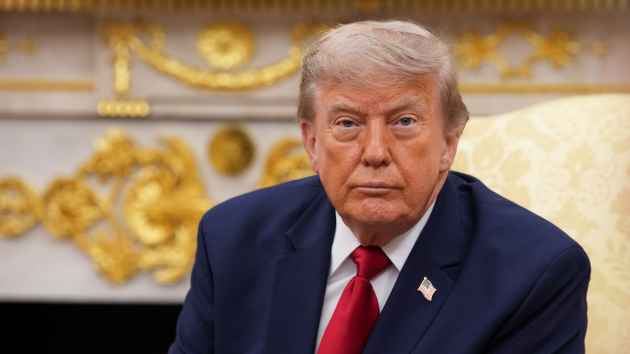
U.S. President Donald Trump looks on during a bilateral meeting with the Prime Minister of Iraq Ali al-Zaidi, in the Oval Office of the White House on July 14, 2026 in Washington, DC. (Photo by Andrew Harnik/Getty Images)

(WASHINGTON) — President Donald Trump, in a primetime address on Thursday, announced he has declassified a slew of documents he claims reveal vulnerabilities in America’s elections systems, election fraud and interference in elections by China, and ordered the Department of Justice to prosecute those believed to be involved.

“America is back and doing really well, but we still have a major challenge that must be urgently addressed because no country can be great without fair and honest elections, you have to trust your country,” Trump said. “Because if there can be no trust, there can be no greatness, and that’s very simple: no trust, no greatness.”

But throughout the more than 20-minute speech, the president did not provide specific evidence that the election outcome, or any votes, were altered in the 2020 election, despite his repeated claims that the election was “stolen” or “rigged.”

Trump has long pushed debunked conspiracy theories to claim that his 2020 election loss was fraudulent.

The president’s speech led to his main argument: he wants Congress to pass the SAVE America Act, his sweeping elections reform bill that Senate Majority Leader John Thune has repeatedly said does not have enough Republican votes to pass.  

In his remarks, the president said that he would immediately declassify the release of “critical intelligence, revealing shocking vulnerabilities in our election infrastructure.”

According to the president, the documents focus on what he said were a number of areas of concern, including claims that China “compromised” election data during the 2020 election, and attempts to downplay the extent of China’s efforts.

Trump argued that the intelligence community suppressed information about China accessing 220 million voter files and trying to turn American opinion against him in the run-up to the 2020 election.

The president also accused the “deep-state” of keeping information about election meddling from him.

Trump claimed that U.S. intelligence agencies learned that tens of millions of voters’ data in 18 states had been “bought, stolen, or hacked” by China, and that the intelligence community deliberately kept this information from him while he was president.

Trump’s remarks asserting that the Chinese undertook a far more ambitious role in attempting to dictate the outcome of the 2020 election goes beyond what U.S. intelligence community has previously assessed.

In March 2021, two months into the Biden administration, a declassified “Intelligence Community Assessment” (ICA)  that was produced at the end of Trump’s first term publicly acknowledged the belief among some intelligence officials that “China took at least some steps to undermine former President Trump’s reelection chances.” But the ICA said any such actions were “primarily through social media and official public statements and media,” not through interference with “election processes.”

Further, the ICA said that while China was “probably” trying “to gather information on U.S. voters and public opinion; political parties, candidates and their staffs; and senior government officials,” the more reliable intelligence indicated that such efforts were not actually intended to undermine Trump but instead to “predict electoral outcomes and to inform its efforts to influence US policy toward China under either election outcome.”

The heavily redacted documents released by the White House on Thursday do not appear to back up Trump’s assertions, instead containing scattershot intelligence that descries efforts to obtain — but not alter — voter records and to conduct social media activity to sow social discord.

One heavily-redacted document titled “200M Voter Records Compromised. repeatedly references personally identifiable information being compromised. This information includes names, phone numbers and addresses — which can also be found from many other sources.

In another series of near-completely redacted memos, words such as “state voter registration data” and “personal identifiable information” appear between large blocks of black redaction markings. It is impossible to surmise the meaning of these records without context, but they appear to point to some Chinese efforts to gather American voter data, much of which is publicly available.

Notably, these memos document Chinese activities ahead of both the 2020 and 2024 presidential elections.

Elsewhere in his remarks, Trump alleged that former Justice Department officials slow-walked an investigation in Michigan that involved the submission of voter registration applications that had forged signatures and other indications of fraudulent applications. Trump called on FBI Director Kash Patel to look into whether any charges can still be brought.

Local media at the time said that a state-level investigation was halted so the FBI could continue with a related investigation. It’s unclear why no federal charges were ever brought or if federal charges were warranted.

At the time, state officials said that the fact that the fraudulent applications were detected shows that the system worked.

The president also said the documents released Thursday include a Department of Homeland Security report he called “stunning,” alleging approximately 278,000 non-citizens were included on voter rolls.

In the documents released by the White House, the DHS report that alleged 250,000 noncitizen voters on the rolls came from a review of “public voter files” that appear to have come from four states: California, New Jersey, Pennsylvania and Nevada. DHS did not provide any methodology about how it reached that number, nor does it specify what “public voter files” it reviewed.

DHS acknowledged it did not have access to those states’ voter rolls, and alleges that in the 10 states that provided the federal government access to their rolls, the agency found 28,000 noncitizen voters.  

Findings from the conservative-leaning Heritage Foundation have found only around 100 verified instances of non-citizen voting going back two decades.

-ABC News’ Lucien Bruggeman and Mike Levine contributed to this report.

Copyright © 2026, ABC Audio. All rights reserved.

Trump gets a much-needed South Carolina win and other takeaways from Tuesday’s elections

(CNN) — President Donald Trump demonstrated his might with Republican primary voters Tuesday in South Carolina, as CNN’s Decision Desk projected that Darline Graham — the sister of the late Sen. Lindsey Graham and the president’s pick in the state’s special Senate primary runoff — will claim the GOP nomination.Now favored to win a full term in November, Darline Graham is, in many ways, a senator of Trump’s own making. The president lobbied South Carolina’s governor to appoint her to fill the remaining months in her brother’s term after he died in July. Then, he privately and publicly pressed her to run for a full six-year term.And when it looked like her rival in the runoff, Rep. Ralph Norman, might win, Trump visited Myrtle Beach to rally Republican loyalists to Graham’s cause, as his super PAC, MAGA Inc., disclosed spending more than $827,000 to support Graham.Graham’s win is narrow — she led by just a few percentage points Tuesday evening — but symbolically significant for the president in a month full of political setbacks, with six of his endorsed picks losing Republican primaries.Trump’s preferred candidate in the Oklahoma governor’s race, former state Sen. Mike Mazzei, meanwhile, was locked in a close Republican primary runoff against state Attorney General Gentner Drummond as ballots were being counted Tuesday night.And in a low-turnout special election runoff in Georgia, Democrats filled a vacancy in the narrowly divided House.Here are takeaways from Tuesday’s elections in South Carolina, Oklahoma and Georgia:A badly needed win for TrumpDarline Graham took to the stage at her victory party Tuesday night and declared: “South Carolina is truly Trump country.”Unlike her brother, who was close to the late Sen. John McCain and built a reputation as a foreign policy hawk independent from Trump, Darline Graham’s political profile was tied entirely to the president.“Our victory would not have been possible without you, and we are truly grateful,” she said in a message directed at Trump.For Trump, the win was badly needed — a victory in one of his highest-risk interventions in Republican primaries this year, after a string of several losses this month and with midterm elections just over two months away. It could serve to remind Republican lawmakers who might be looking to distance themselves from an unpopular president of the potential political costs of being at odds with Trump.Norman acknowledged Trump’s role in the race’s outcome, telling his supporters Tuesday night that “the president got involved. He has that right.”“I never understood why he got in this race,” Norman said as some members of the crowd booed the president. “But it is what it is, and I’ll accept it.”Graham is now set to face Democratic nominee Annie Andrews, a pediatrician, in November. Andrews on Tuesday challenged Graham to at least three televised debates, saying in a statement that “no appointment, endorsement, or family connection entitles anyone to six years” in the Senate. Still, Graham is heavily favored to win the deep-red state in the general election.A senator of Trump’s makingTrump has endorsed a slew of candidates this year, but rarely has he put his own political capital on the line like he did in South Carolina.When Trump initially talked up Darline Graham to fill the seat of her late brother, and Gov. Henry McMaster complied, it seemed like a short-term gig. The seat was already on the ballot for a full six-year term in November, so she’d have been a placeholder for a few months, until South Carolina voters nominated and elected one of the state’s myriad experienced Republicans who had been waiting decades for a Senate vacancy.But Trump doubled down three days after she was sworn in, urging her on social media to seek a full term. And, days later, she announced she would do so.The president’s “complete and total endorsement” wasn’t enough to clear the field. After all, Darline Graham had no political experience, and her brother wasn’t exactly beloved among conservative voters in South Carolina: He’d earned just 57% of the vote in his primary two months earlier against a handful of relative unknowns.The results of the August 11 primary suggested she could be defeated in the runoff. She finished first, but with just shy of 33% of the vote.There were reasons to believe Trump’s influence might be limited. After all, his choice in South Carolina’s GOP primary for governor, Lt. Gov. Pam Evette, lost to state Attorney General Alan Wilson — who Trump also endorsed at the last minute when it was clear his preference was on course for defeat.The president did not have the luxury of the same face-saving tack here: Norman had endorsed and campaigned with former Gov. Nikki Haley as she ran against Trump for the 2024 GOP presidential nomination.Graham’s inexperience was on display during a debate with Norman earlier this month, when she declined to answer a question about Taiwan and the South China Sea, saying that national security was “not my thing.”But Trump carried Graham over the finish line. He visited South Carolina on Friday, telling Republicans that he’d personally lobbied her to run for a full term. “Pretend, please, that I’m on the ballot,” he urged GOP voters.Another endorsement test in OklahomaAnother Trump-endorsed candidate, Mazzei, was locked in a tight race Tuesday night against Drummond in the hard-fought runoff for the Republican nomination for governor.The two are vying to take on Oklahoma House Minority Leader Cyndi Munson, the Democratic nominee, in the race to replace term-limited Republican Gov. Kevin Stitt in November.The race was another test of Trump’s influence — and there were significant questions over whether his endorsement would be enough for Mazzei, after Trump’s picks in Republican gubernatorial primaries in Georgia, Iowa and Minnesota all lost earlier this year.A key divide in the primary was a proposed $4 billion aluminum smelter at the Tulsa Port of Inola, estimated to bring about 1,000 jobs to the area. Trump touted the plant, claiming on Truth Social that it “will be one of the best projects ever conceived or built, not only in the Great State of Oklahoma, but in the United States, itself.” But, amid local concerns about pollution and damage to the livestock economy, Drummond has sued, asking a federal court to block the plant’s construction.Georgia Dems fill a House seatCNN projects that Democrat Everton Blair, a former Gwinnett County School Board chair, will win the special election for Georgia’s 13th District House seat vacated by the late Rep. David Scott’s death in April.But he won’t hold that seat for long.Blair, who will be the first out gay member of Congress from Georgia, defeated the longtime lawmaker’s daughter Marcye Scott in the special election runoff on Tuesday. He campaigned on a pledge to be a stronger opponent to Trump and advocate for a more progressive affordability agenda than both the late congressman and his daughter.However, Blair finished a distant third in the regular House primary earlier this year, so he won’t be on the ballot in November.State lawmaker Jasmine Clark is the Democratic nominee for a full two-year term in the deep-blue district in November. She did not run in the special election because under state law, she would have had to resign her seat in the Georgia House — costing Democrats a seat just as Republican Gov. Brian Kemp was launching an unsuccessful push for mid-decade redistricting.In the meantime, Blair’s win, and the special election of state Sen. Aisha Wahab in California last week, will help Democrats further narrow the already razor-thin GOP majority in the House.CNN’s Katie Doran and Adam Cancryn contributed to this report.The-CNN-Wire™ & © 2026 Cable News Network, Inc., a Warner Bros. Discovery Company. All rights reserved.
Read Next Story