Trump overturns pause of ICE vehicle stops implemented after deadly shootings

▶ Watch Video: Federal officials suspend most vehicle stops during ICE operations after deadly shootings

President Trump overturned a suspension of U.S. Immigration and Customs Enforcement traffic stops that multiple law enforcement sources said had been implemented after fatal shootings in Texas and Maine over the last week.

ICE agents had been instructed to immediately suspend most vehicle stops during immigration enforcement operations nationwide, except in cases involving serious criminal targets.

In a Truth Social post Wednesday morning, however, Mr. Trump wrote that “we CANNOT give up one of I.C.E.’s most important and effective Crime Fighting tools, THE TRAFFIC STOP! Once we do, we are playing right into the criminal’s hands.” But he told ICE to “be judicious, fair and smart.” 

The White House confirmed to CBS News that the president’s Truth Social post was intended to overturn Tuesday’s memo from DHS temporarily suspending vehicle stops by ICE Enforcement and Removal Operations, or ERO.

Later Wednesday, ICE sources confirmed to CBS News the agency’s deportation officers can again make vehicle stops.

A law enforcement official and a DHS official said that ICE field offices issued verbal clarifications to personnel, and agents were told that traffic stops are “not off the table” and remain “a tool in the toolkit.”

DHS Secretary Markwayne Mullin wrote on X that he and the president are “on the same page.”

“We want our [ICE] officers to have all options available to keep them safe while executing our mission of deporting as many illegal alien criminals from our country as possible,” Mullin said.

While the DHS directive pausing vehicle stops applied to ICE ERO, the division responsible for civil immigration arrests and removals, it did not include Homeland Security Investigations, which primarily handles criminal investigations, according to sources with visibility on the memo. The directive was intended to be a temporary pause while Enforcement and Removal Operations officers received additional training on vehicle-stop tactics, the sources said.

“It’s not a policy change. It’s a temporary pause,” Trump administration border czar Tom Homan said later Tuesday on Fox News.

Homan said ICE leadership and DHS “want to look at these last couple of incidents. And look, is there something that could have been done better?” He added, “I’m confident that ICE is well trained in vehicle stops and you’re going to see us keep moving forward.”

Under the now-overturned directive, ERO officers were still permitted to conduct vehicle stops when working with partner law enforcement agencies to target criminal suspects with judicial warrants, sources said.

Vehicle stops have been a common tactic in ICE enforcement operations under the Trump administration, allowing officers to identify, follow and arrest targeted individuals away from homes or workplaces.

In the most recent incident, Johan Sebastián Durán Guerrero, 25, a Colombian national who was in the country illegally, was shot when he “attempted to flee the scene” Monday when ICE tried to stop him at around 7 a.m. ET in Biddeford, Maine, according to the Department of Homeland Security. “Fearing for public safety, an officer discharged his weapon,” DHS said in a statement.

While Durán Guerrero was not the target of the operation, ICE agents attempted to pull over the man’s car while “conducting targeted surveillance on the last known address of an illegal alien with a final order of removal,” DHS said.

Durán Guerrero’s father, Omar Duran, told CBS News partner Noticias Caracol that his son leaves behind a wife and 3-year-old daughter, adding that he had “left the country to build a future for his family.”

“I only ask God … that this be resolved in the best way, and that there be justice,” Duran said, translated from Spanish. 

Durán Guerrero had previously been given an order to leave the country, independent Maine Sen. Angus King said Monday. 

Speaking to CBS News on Tuesday, King called for an independent investigation.

“I want a full, fair, open, transparent investigation of this, not strictly run by the feds,” said King, an independent who caucuses with Democrats. “Unfortunately, the feds don’t have the credibility today. The people of Maine are not going to accept an investigation that’s run by ICE or at the FBI.”
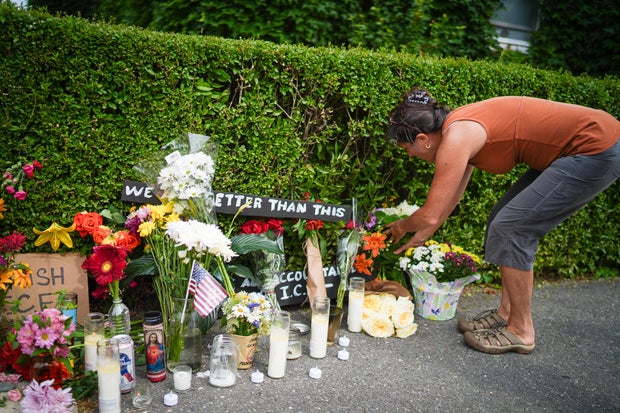
ICE Officers Fatally Shoot Undocumented Immigrant In Maine
A woman places flowers at a makeshift memorial for a man who was fatally shot by U.S. Immigration and Customs Enforcement agents, on July 14, 2026 in Biddeford, Maine.

Ryan Murphy/Getty Images

Maine Republican Sen. Susan Collins said she had urged Mullin to halt the vehicle stops.

“While the investigation of the Biddeford shooting is not yet complete, it raises sufficient critical questions that I spoke with DHS Secretary Mullin last night and urged him to cease all non-urgent vehicle stops,” Collins said in a statement.

Just six days earlier, a similar situation unfolded in Houston.

Mexican national Lorenzo Salgado Araujo was fatally shot by ICE officers who had pulled over his vehicle while looking for a different person, DHS confirmed last week.

“After receiving a credible tip from our law enforcement partners, our officers conducted surveillance on a target’s address. Weeks prior to the incident, they noted two white vans at the property,” DHS said. “On July 7, officers were almost at the target’s address when they observed a white van with an individual who resembled the target. Officers then initiated the vehicle stop.”

DHS initially said ICE officers were targeting Salgado Araujo because he was living in the country illegally. The department alleged he was shot after he ignored “multiple verbal commands” and attempted to ram an officer who fired his weapon in self-defense.

Salgado Araujo had no criminal record and was close to obtaining a work permit after living in the U.S. for more than three decades without legal status, his family has said.

In his remarks to CBS News, King criticized the Trump administration’s immigration enforcement tactics.

“It’s a tragedy for our country that we’re going through this process that’s based on a phony premise,” he said. “The whole premise of this has been [arresting] ‘the worst of the worst.’ How frequently have we heard that term? ‘We’re going after the worst of the worst. We’re going to take criminals off our streets.’ Well, in Maine last winter, they arrested over 200 people. Nineteen of them had criminal records. That means 90% of the people arrested had no criminal records.”
Los consumidores redujeron el gasto en julio mientras persistían las presiones inflacionarias

Los consumidores estadounidenses redujeron el gasto en julio mientras la inflación seguía elevada, según nuevos datos publicados este miércoles por el Departamento de Comercio.El gasto de los consumidores, ajustado por inflación, no varió respecto al mes anterior, una marcada desaceleración frente al aumento del 0,4 % registrado en junio, de acuerdo con el informe.El índice de precios de los gastos de consumo personal (PCE, por sus siglas en inglés), el indicador que utiliza la Reserva Federal para su meta de inflación del 2 %, subió un 0,2 % respecto a junio. Con ello, la tasa anual se mantuvo en el 3,7 %, según el informe.Los economistas esperaban que el índice PCE aumentara un 0,1 % respecto al mes anterior y que la tasa anual bajara al 3,6 %, de acuerdo con estimaciones de FactSet.Al excluir los volátiles precios de los alimentos y la energía, el índice PCE subyacente aumentó un 0,2 % mensual y un 3,3 % interanual.El índice PCE forma parte del informe mensual sobre ingresos y gastos personales del Departamento de Comercio, que incluye datos amplios sobre los ingresos, el gasto y el ahorro de los estadounidenses.La reducción del gasto en julio coincidió con una mejora de las finanzas de los hogares. La tasa de ahorro, que en junio cayó a un mínimo de cuatro años del 2,6 %, repuntó en julio al 3 %.El sólido crecimiento de los ingresos también contribuyó a aumentar el ahorro. Los ingresos después de impuestos crecieron un 0,4 %, el mayor avance desde enero, un mes en el que suelen verse impulsados por los aumentos del Seguro Social y los ajustes salariales de comienzos de año.Sin ajustar por inflación, el gasto aumentó un 0,2 % respecto a junio. El incremento se debió por completo a los servicios, en particular los financieros y de seguros, la atención médica, la vivienda y los servicios públicos, según los datos del Departamento de Comercio.La mayoría de las compras discrecionales disminuyó respecto a junio. La excepción fue el gasto en restaurantes, que aumentó un 4,6 %. Las mayores caídas en el gasto en bienes se registraron en categorías como gasolina, vehículos, mobiliario para el hogar y bienes no duraderos.Parte de la disminución del gasto en bienes puede atribuirse a que Amazon adelantó a junio su popular venta de Prime Day. El cambio de fecha de Prime Day y las promociones de otros minoristas influyeron considerablemente en la caída del 0,6 % de las ventas minoristas de Estados Unidos informada a comienzos de este mes.En conjunto, el gasto de los consumidores se ha mantenido relativamente sólido este año pese a factores adversos como el aumento de los precios de la energía provocado por la guerra, la debilidad del mercado laboral y los efectos acumulados de más de cinco años de inflación superior a lo normal.No obstante, con los reembolsos de impuestos agotándose y la inflación superando el crecimiento de los salarios desde hace un par de meses, el gasto podría debilitarse durante la segunda mitad del año.Dan North, economista senior de Allianz Trade, dijo que la caída del 0,6 % de las ventas minoristas en julio podría indicar que los consumidores están haciendo una pausa.“Me hace preguntarme si finalmente los consumidores están diciendo: ‘Demos un paso atrás por un momento. Hay incertidumbre por esta guerra; la inflación sigue siendo persistente; para empezar, detesto la economía; mis ingresos no están creciendo mucho. Tomémonos un pequeño descanso’”, dijo North en una entrevista con CNN.Aun así, pese a que el gasto se estancó en julio, podría seguir impulsando el crecimiento económico general durante los próximos meses, dijo a CNN Kathy Bostjancic, economista jefa de Nationwide Financial.Otro informe publicado este miércoles mostró que los envíos de bienes duraderos aumentaron rápidamente en julio, lo que indica que la inversión empresarial también debería mantenerse sólida, afirmó.“La combinación de estos datos sobre el consumo y la inversión sugiere que el crecimiento del producto interno bruto (PIB) podría ser de al menos un 3 % en el tercer trimestre, o incluso más”, dijo. “Francamente, eso indica que la economía real sigue funcionando con bastante solidez”.La inflación sigue siendo un problema.Los precios subieron en julio un poco más de lo previsto. Con ello, la tasa anual de inflación se mantuvo en el 3,7 %, la tercera más alta de los últimos tres años.Los precios de los alimentos bajaron ligeramente en julio y los de la energía también descendieron. No obstante, las presiones inflacionarias en la mayoría de las demás categorías siguieron siendo “bastante persistentes”, dijo Bostjancic.“Las fuentes de la inflación son los aranceles, que están elevando los precios de los bienes; el gasto en inteligencia artificial, que impulsa el precio de los chips y otros equipos relacionados con esa tecnología; y la energía, cuyos precios bajaron en el mes más reciente, pero que sigue siendo motivo de preocupación por los elevados precios de la gasolina”, afirmó.Los datos más recientes podrían aportar argumentos a los miembros de la Reserva Federal que consideran una posible subida de la tasa de interés, señaló. El banco central de Estados Unidos ha mantenido sin cambios su tasa de referencia en lo que va del año, pero ha dejado abierta la posibilidad de aumentarla mientras la inflación siga elevada.La próxima reunión de la Fed sobre las tasas de interés no se celebrará hasta mediados de septiembre. Por ello, se seguirá muy de cerca el discurso que el presidente de la Reserva Federal, Kevin Warsh, pronunciará el viernes en el simposio económico anual de Jackson Hole, Wyoming.Además del discurso del viernes, los datos del mercado laboral que se publicarán la próxima semana serán cruciales para evaluar la solidez de la economía, dijo Bostjancic.“Nuestra previsión de que la economía seguirá avanzando se basa en la idea de que el crecimiento del empleo privado se mantendrá sólido porque, en última instancia, eso es lo que determina el poder adquisitivo”, afirmó.The-CNN-Wire™ & © 2026 Cable News Network, Inc., a Warner Bros. Discovery Company. All rights reserved.
Read Next Story