
Trump gives Ukraine OK to produce Patriot missiles as war with Russia drags on

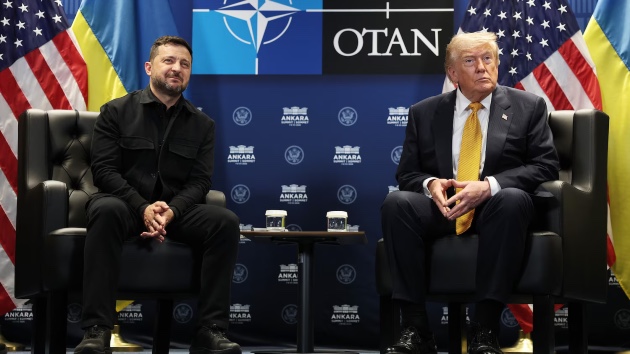
President Donald Trump holds a bilateral meeting with Ukrainian President Volodymyr Zelenskiy alongside the NATO leaders summit at the Bestepe Presidential Compound in Ankara, Turkey, July 8, 2026. (Win McNamee/Getty Images)

(ANKARA, Turkey) — President Donald Trump told Ukrainian President Volodymyr Zelenskyy on Wednesday the U.S. will give Ukraine a license to produce Patriot air defense systems.

“One of the things we’re going to be talking about is, you’ll — we’re going to give a license to you to make Patriots. That’s pretty cool, right?” Trump told Zelenskyy during a bilateral meeting at the NATO summit in Ankara, Turkey.

“This way he can’t complain that we’re not giving him enough. I said, ‘Make them yourself,'” Trump added.

Trump said the company that manufactures Patriot systems hasn’t been informed yet, but “that’ll work out all right.”

But when asked whether Trump would be willing to provide Patriot interceptors to Ukraine up front while production gets into place, the president said the U.S. didn’t have that many missiles.

“We have Patriots, but we don’t have that many. We need them for ourselves, too,” he said.

The meeting between Trump and Zelenskyy in Ankara came as expenditures of U.S. Patriot PAC-3 interceptor missiles in Ukraine and the Middle East have dramatically outpaced current production capabilities, resulting in a critical global shortage as the Russia-Ukraine war drags on.

“We need to find a way to get as quick as possible, as much as possible, missiles for Patriot systems. This is the most important thing,” Zelenskyy said at a defense industry forum at the alliance’s annual summit on Tuesday.

Russia has sought to exploit this shortfall by launching concentrated bombardments of ballistic missiles and drone swarms at Ukrainian targets, overwhelming the country’s defenses and resulting in scores of civilian deaths. 

On Wednesday, Zelenskyy praised the U.S. for its support throughout the war. 

“Mr. President, thank you very much for this meeting. And we’re thankful, as always, to your support, American support, bipartisan support,” he said.

Russia’s ‘last major advantage’

In an address to members of the NATO alliance on Tuesday, Zelenskyy stressed the critical nature of the shortage and argued it was time for Europe to produce its own systems to counter Russian ballistic missiles, calling the rocket-powered missiles Moscow’s “last major advantage.”

“We all value the Patriot system. It’s an excellent system,” he said. “But today’s wars have shown current Patriot production is not enough to meet the growing demand for protection against ballistic missiles. That is a fact.”

For his part, Trump presented a rosier outlook — asserting that an end to the conflict in Ukraine, which is now in its fifth year, could be on the horizon. 

“I think we’re getting much closer than people realize, and President Putin wants it to end,” Trump said on Monday. “And President Zelenskyy actually wants it to end now.”

Trump also downplayed the impact of the war in Ukraine on Tuesday, saying “it doesn’t affect us” and depicting the conflict as a European issue. Trump had promised to end the war on Day 1 in office — a pledge he later said was hyperbolic.

Trump’s comments come amid Russian escalation in recent days. On Monday, Russian strikes targeted Ukraine’s military-industrial complex and energy infrastructure in and around Kyiv, according to Russia’s defense ministry.

Zelenskyy has been warning the Trump administration about the crucial depletion of interceptor missiles for several weeks. He is also pressing the U.S. to expedite a license that would allow Ukraine to manufacture Patriot batteries and interceptors domestically.

A strained relationship

The bilateral meeting tested the strength of Trump and Zelenskyy’s sometimes-rocky relationship at a time when Ukraine is facing new vulnerabilities on the battlefield and diplomacy with Russia has largely stalled. 

Trump, on Wednesday, described Zelenskyy as a “difficult character,” but said they have a good relationship.

The leader’s first meeting of Trump’s second term — a February 2025 conversation in the Oval Office — devolved into a shouting match after Trump expressed skepticism about Ukraine’s position in the conflict and called for more gratitude from Zelenskyy for U.S. support.

But Trump appeared to grow more sympathetic to the Ukrainian cause over the past year as repeated efforts to bring Russian President Vladimir Putin to the negotiating table fell flat.

A watershed moment came last July when, after repeatedly pausing military aid to Ukraine, Trump agreed to supply weapons to Ukraine if they were purchased from the U.S. by NATO allies.

And there have been signs over the past month that Trump is reengaging in efforts to bring peace to Ukraine and once again eager to coordinate a deal between Zelenskyy and Putin. 

During their bilateral meeting, Trump said he spoke with Putin about the Russian president’s desire to set up a meeting in Moscow, though Zelenskyy wouldn’t commit to such a meeting.

Trump held calls with Zelenskyy and Putin over the weekend as both leaders congratulated the president on the 250th anniversary of the United States’ independence. 

It’s unclear how substantive the conversations were, though a Kremlin aide said that Trump spoke to Putin for 90 minutes and again offered to help end the war. Zelenskyy said he had “a very good call” with Trump and conveyed there was a “real prospect” for peace.

Trump last met with Zelenskyy at the G7 summit in June, where he, at times, appeared friendly to Ukraine’s cause — describing Russia as the “offensive” party in the conflict and saying he was “going to do whatever” he could to strike a deal.

French President Emmanuel Macron — the host of the G7 summit — said after the meeting that he was optimistic about Trump’s support for Ukraine, claiming he observed “a real change in comparison to recent months” in his attitude. 

Copyright © 2026, ABC Audio. All rights reserved.
Liberia once offered Black Americans a new home. Decades on, it is receiving migrants the US wants out

(CNN) — Is Liberia an American dumping ground — or a place where a new generation of arrivals can build a new life?That’s the question Liberians are asking themselves after the first people to be deported to the West African country from the United States arrived in the capital, Monrovia.The 20 people on the flight from Louisiana were the first to be sent under an agreement that could see up to 1,200 people transferred to Liberia, a country of less than 6 million people, many of them descendants of formerly enslaved Black Americans.Liberian officials said the new arrivals were from “African and western hemisphere countries.”Liberia is one of several countries that have agreed to take migrants being deported from the US under the Trump administration’s anti-immigration crackdown. The arrivals are coming to a nation whose history is deeply tied to migration from the US.Nearly two centuries ago, free and formerly enslaved Black Americans crossed the Atlantic to settle in what would become Liberia – a name that translates as “land of the free.”Now, a country shaped in part by that migration is accepting people the US wants to remove.For Liberians, that has thrown up a mix of feelings in a country still recovering from a long and bloody civil war.“This country is going through a lot, and having more people come in — can we handle all of this?” said Pheta Morris, 48, a descendant of the Black Americans who settled in Liberia.But she said she sees the new arrivals through the lens of Liberia’s history and is struck by the contrast.“I think about the Americo-Liberians — people who were rejected where they were and needed somewhere to go, and Liberia opened its arms to them,” she said.“Back then, people needed somewhere they could be free, accepted and welcomed. Now, people are being rejected from the US, and Liberia is opening its doors to them.”The first transfer has already faced complications.Reuters reported that five migrants who refused to disembark after arriving in Monrovia were flown instead to Equatorial Guinea in Central Africa, where they are held with more than 30 other migrants previously sent there by the US.A US State Department spokesperson said implementing the Trump administration’s immigration policies was a “top priority,” adding that the department generally does not comment on private diplomatic communications with other governments.CNN has contacted Liberia’s information ministry for more details about the agreement and its terms.A country shaped by AmericaThe first group of free Black Americans arrived in Liberia in the early 1820s.Over the following decades, thousands more made the journey, with the American Colonization Society helping to establish settlements along the West African coast. The US State Department says about 16,000 Black Americans migrated to Liberia during the 19th century.The migration was complicated. Some Black Americans saw Liberia as a chance to escape racism and build a new life, while others opposed the colonization movement and rejected the idea that free Black people should leave the US.Africans rescued from slave ships by the US Navy were also brought to Liberia. The settlements eventually formed the Republic of Liberia, which declared independence in 1847.The American influence remains visible today. Liberia’s flag resembles that of the US; its capital was named Monrovia after America’s fifth President James Monroe, and its early institutions were heavily influenced by Washington.Conmany Wesseh, a former Liberian lawmaker and member of the ruling Unity Party who was nominated as Liberia’s ambassador to the United Nations and later the European Union under former president Ellen Johnson Sirleaf, said that history continues to shape how Liberians view the US.For Wesseh though, the arrival of the deportees raises a more immediate question: Can Liberia, a country still struggling with basic infrastructure and services, accommodate more people?The cost of taking them inLiberia began rebuilding after a 14-year civil war ended in 2003, but Wesseh said the country still needs major investment. Poverty levels remain high and youth unemployment stands at 40%, according to African Development Bank data.“Our country needs a great deal of support,” he said. “We are short on medical facilities, and we have problems with education.”He questioned how the country would manage an influx of people from abroad.“They will have to go to the same hospitals. You won’t create a new hospital for them,” he said. “There’s no spare housing. We don’t have existing housing to put new people in.”Wesseh said Liberia’s development needs may have influenced the government’s decision, with officials hoping the agreement would bring support from Washington.Liberian authorities described the arrangement as humanitarian and said the deportees will be treated as guests who can seek asylum or leave the country.Asked whether he viewed the deal as humanitarian assistance, a diplomatic arrangement or the US outsourcing its immigration enforcement, Wesseh chose the latter.“I think (the administration of US President Donald Trump) just sees this as a place to dump people,” he said. “They want to take them off their hands and dump them in this country.”A chance for a new startFrancis Dennis had long known that his family had roots in the migration of Black Americans to Liberia in the 19th century. But just a few weeks ago, he became curious about his family’s past and began using AI genealogy tools to dig deeper into that history.The 71-year-old former president of the Liberia Chamber of Commerce told CNN he traced his great-great-great-grandfather to Snow Hill, a town on Maryland’s Eastern Shore in the US, using the technology and notes left by his father.He said the research also pointed him to the name of the vessel that carried his ancestor across the Atlantic to Liberia, along with a list of its passengers.Generations later, Dennis is watching another group arrive in Liberia from the US. But he does not believe their circumstances have to define what comes next.“People may have their apprehension about a new life, but it’s also an opportunity,” he said. “Some may be happy, some may resent it, but it opens a new window, a new opportunity.”His own ancestor crossed the Atlantic generations ago and became part of the community that helped shape modern Liberia.Now, he hopes those arriving under very different circumstances will also see the country as a chance for a fresh start.“The ball will be in their court,” Dennis said. “Are they going to seize it as an opportunity for a new start, a fresh start, a new life? Or will they be thinking about the past?”The-CNN-Wire™ & © 2026 Cable News Network, Inc., a Warner Bros. Discovery Company. All rights reserved.
Read Next Story