
Trump floats temporarily withdrawing Blanche’s AG nomination over GOP holdouts

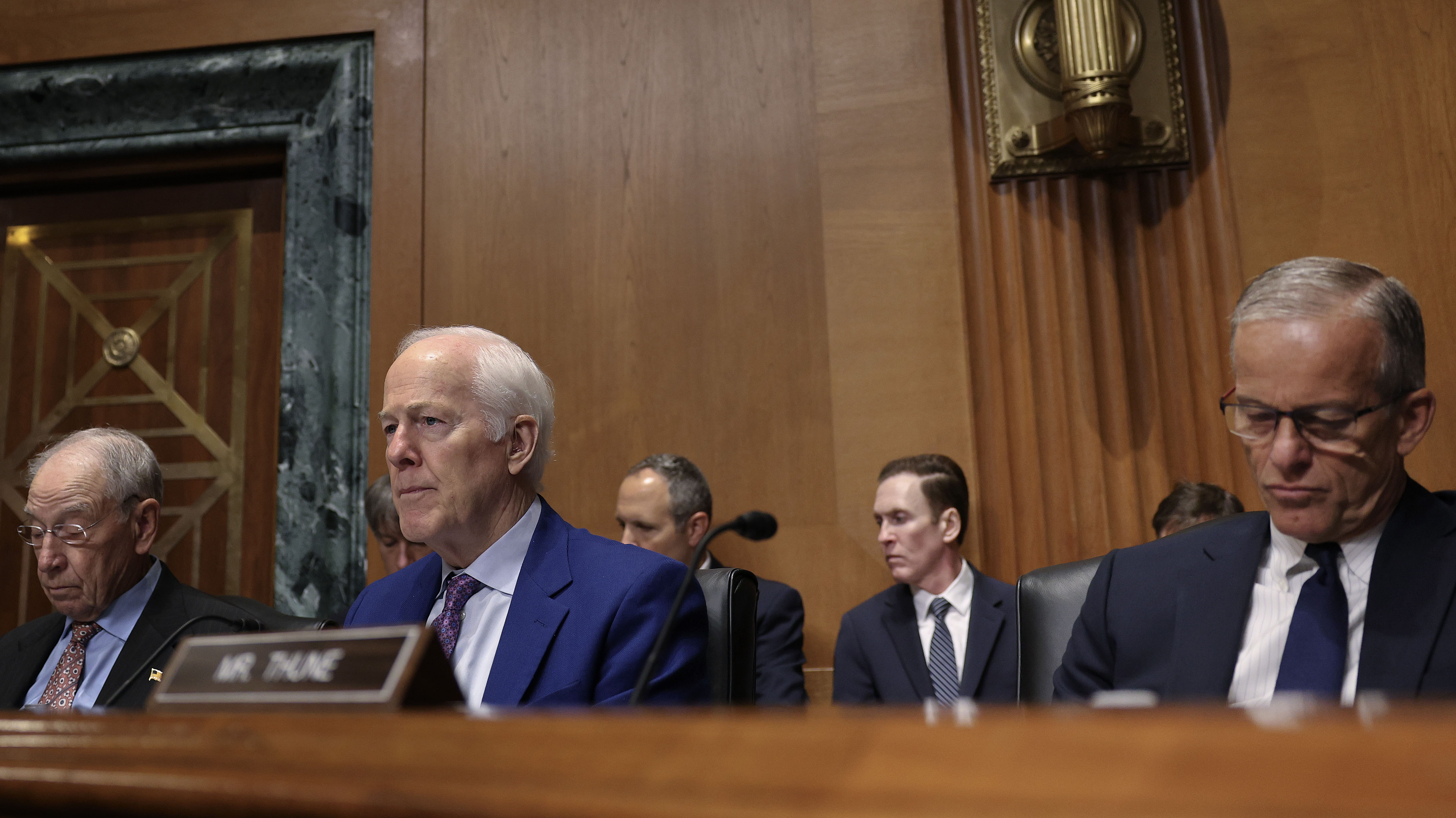
Senate Finance Committee Chairman Charles Grassley (R-IA), Sen. John Cornyn (R-TX) and Senate Majority Leader John Thune (R-SD) attend a Finance Committee hearing on July 30, 2026, in Washington, DC. Cornyn is withholding support for President Donald Trump’s nominee for U.S. attorney general, Todd Blanche, until he gets reassurances on Trump’s IRS lawsuit settlement and the elimination of the “anti-weaponization fund.” (Photo by Win McNamee/Getty Images)

(WASHINGTON) — President Donald Trump on Thursday floated the possibility of temporarily withdrawing Todd Blanche’s nomination for attorney general as his confirmation is being held up by two outgoing Republican senators.

“Todd Blanche is a STAR, and everyone knows it! He has the potential to go down as one of the Greatest Attorney Generals of All Time. However, John Cornyn, of Texas, and Thom Tillis, of North Carolina, both of whom I refused to Endorse, and whose political careers have been ended by my action, are refusing to vote for this Great Nominee, who will remain, in any event, as Acting,” Trump wrote in a social media post.

“I have no objection to temporarily withdrawing Todd’s name, if they do not do the right thing, and putting him back after Cornyn and Tillis are out of office,” Trump wrote.

Both senators’ terms will end in January. Cornyn lost a primary battle in Texas earlier this year after Trump endorsed his opponent, Ken Paxton. Tillis announced last year he would not seek reelection after Trump threatened to field primary challengers.

Cornyn, in response to Trump’s social media post, suggested that, in addition to him and Tillis, there are more lawmakers with “concerns” regarding Blanche.

“POTUS is mistaken if he believes concerns about the provisions in his tax lawsuit settlement are limited to me and Senator Tillis,” Cornyn wrote on X. 

Cornyn is demanding the Department of Justice put in writing that the nearly $1.8 billion so-called “Anti-Weaponization Fund” is officially dead, and that the scope of Trump’s immunity deal with the IRS be narrowed.

As part of Trump’s settlement with the IRS in his $10 billion lawsuit against the agency, the DOJ issued an addendum, signed by Blanche in his role as acting attorney general, that would bar the government from continuing any existing audits of tax returns filed by Trump, his family and their companies.

“I know that Todd Blanche understands it, but I think he’s probably getting some pushback from the White House, and that’s making things more complicated than there needs to be,” Cornyn told ABC News on Thursday morning.

Cornyn said he wanted the DOJ to rewrite the IRS settlement agreement itself and said they were “reluctant” to do so. Cornyn then said he offered them an alternative.

“So we provided some additional paper…which, if he would put that in writing, would satisfy my concerns because he said the weaponization fund is dead. He said the audit protections don’t extend beyond the parties in the lawsuit, and it doesn’t cover any federal entities,” the senator said.

When asked by a reporter if the DOJ committed to doing that, Cornyn said “no.”

“I don’t know whether they think they can wait us out or we’ll cave, but I assure you, we won’t,” Cornyn said.

Tillis said the administration could “roll the dice” and wait out his and Cornyn’s Senate terms, but said Trump is getting bad advice on how to proceed with Blanche’s nomination.

“Hey, 158 days they can try it again, roll the dice on what the Senate confirmation process looks like next year. It’s all on him. It’s certainly within his authority to do that,” Tillis said.

The Senate Judiciary Committee postponed its scheduled Thursday vote on Blanche’s nomination for attorney general amid the resistance from Cornyn and Tillis.

Sources told ABC News that DOJ sent an updated proposal to the two senators last night to try and quell their concerns. 

But when we asked on Thursday morning whether Wednesday night’s proposal moved him any closer to voting for Blanche, Cornyn responded, “We are no closer than we were before.”

Withdrawing Blanche’s nomination is a decision that would have no consequence in terms of Blanche leading the DOJ. Blanche can continue to serve as acting attorney general.

Acting department officials can serve in the role for 210 days, according to the Federal Vacancies Reform Act — however, that resets if a nomination is withdrawn.

Copyright © 2026, ABC Audio. All rights reserved.
Liberia once offered Black Americans a new home. Decades on, it is receiving migrants the US wants out

(CNN) — Is Liberia an American dumping ground — or a place where a new generation of arrivals can build a new life?That’s the question Liberians are asking themselves after the first people to be deported to the West African country from the United States arrived in the capital, Monrovia.The 20 people on the flight from Louisiana were the first to be sent under an agreement that could see up to 1,200 people transferred to Liberia, a country of less than 6 million people, many of them descendants of formerly enslaved Black Americans.Liberian officials said the new arrivals were from “African and western hemisphere countries.”Liberia is one of several countries that have agreed to take migrants being deported from the US under the Trump administration’s anti-immigration crackdown. The arrivals are coming to a nation whose history is deeply tied to migration from the US.Nearly two centuries ago, free and formerly enslaved Black Americans crossed the Atlantic to settle in what would become Liberia – a name that translates as “land of the free.”Now, a country shaped in part by that migration is accepting people the US wants to remove.For Liberians, that has thrown up a mix of feelings in a country still recovering from a long and bloody civil war.“This country is going through a lot, and having more people come in — can we handle all of this?” said Pheta Morris, 48, a descendant of the Black Americans who settled in Liberia.But she said she sees the new arrivals through the lens of Liberia’s history and is struck by the contrast.“I think about the Americo-Liberians — people who were rejected where they were and needed somewhere to go, and Liberia opened its arms to them,” she said.“Back then, people needed somewhere they could be free, accepted and welcomed. Now, people are being rejected from the US, and Liberia is opening its doors to them.”The first transfer has already faced complications.Reuters reported that five migrants who refused to disembark after arriving in Monrovia were flown instead to Equatorial Guinea in Central Africa, where they are held with more than 30 other migrants previously sent there by the US.A US State Department spokesperson said implementing the Trump administration’s immigration policies was a “top priority,” adding that the department generally does not comment on private diplomatic communications with other governments.CNN has contacted Liberia’s information ministry for more details about the agreement and its terms.A country shaped by AmericaThe first group of free Black Americans arrived in Liberia in the early 1820s.Over the following decades, thousands more made the journey, with the American Colonization Society helping to establish settlements along the West African coast. The US State Department says about 16,000 Black Americans migrated to Liberia during the 19th century.The migration was complicated. Some Black Americans saw Liberia as a chance to escape racism and build a new life, while others opposed the colonization movement and rejected the idea that free Black people should leave the US.Africans rescued from slave ships by the US Navy were also brought to Liberia. The settlements eventually formed the Republic of Liberia, which declared independence in 1847.The American influence remains visible today. Liberia’s flag resembles that of the US; its capital was named Monrovia after America’s fifth President James Monroe, and its early institutions were heavily influenced by Washington.Conmany Wesseh, a former Liberian lawmaker and member of the ruling Unity Party who was nominated as Liberia’s ambassador to the United Nations and later the European Union under former president Ellen Johnson Sirleaf, said that history continues to shape how Liberians view the US.For Wesseh though, the arrival of the deportees raises a more immediate question: Can Liberia, a country still struggling with basic infrastructure and services, accommodate more people?The cost of taking them inLiberia began rebuilding after a 14-year civil war ended in 2003, but Wesseh said the country still needs major investment. Poverty levels remain high and youth unemployment stands at 40%, according to African Development Bank data.“Our country needs a great deal of support,” he said. “We are short on medical facilities, and we have problems with education.”He questioned how the country would manage an influx of people from abroad.“They will have to go to the same hospitals. You won’t create a new hospital for them,” he said. “There’s no spare housing. We don’t have existing housing to put new people in.”Wesseh said Liberia’s development needs may have influenced the government’s decision, with officials hoping the agreement would bring support from Washington.Liberian authorities described the arrangement as humanitarian and said the deportees will be treated as guests who can seek asylum or leave the country.Asked whether he viewed the deal as humanitarian assistance, a diplomatic arrangement or the US outsourcing its immigration enforcement, Wesseh chose the latter.“I think (the administration of US President Donald Trump) just sees this as a place to dump people,” he said. “They want to take them off their hands and dump them in this country.”A chance for a new startFrancis Dennis had long known that his family had roots in the migration of Black Americans to Liberia in the 19th century. But just a few weeks ago, he became curious about his family’s past and began using AI genealogy tools to dig deeper into that history.The 71-year-old former president of the Liberia Chamber of Commerce told CNN he traced his great-great-great-grandfather to Snow Hill, a town on Maryland’s Eastern Shore in the US, using the technology and notes left by his father.He said the research also pointed him to the name of the vessel that carried his ancestor across the Atlantic to Liberia, along with a list of its passengers.Generations later, Dennis is watching another group arrive in Liberia from the US. But he does not believe their circumstances have to define what comes next.“People may have their apprehension about a new life, but it’s also an opportunity,” he said. “Some may be happy, some may resent it, but it opens a new window, a new opportunity.”His own ancestor crossed the Atlantic generations ago and became part of the community that helped shape modern Liberia.Now, he hopes those arriving under very different circumstances will also see the country as a chance for a fresh start.“The ball will be in their court,” Dennis said. “Are they going to seize it as an opportunity for a new start, a fresh start, a new life? Or will they be thinking about the past?”The-CNN-Wire™ & © 2026 Cable News Network, Inc., a Warner Bros. Discovery Company. All rights reserved.
Read Next Story