
‘Trump does like a winner’: Ukraine victories could mean more US backing, Zelenskyy adviser says

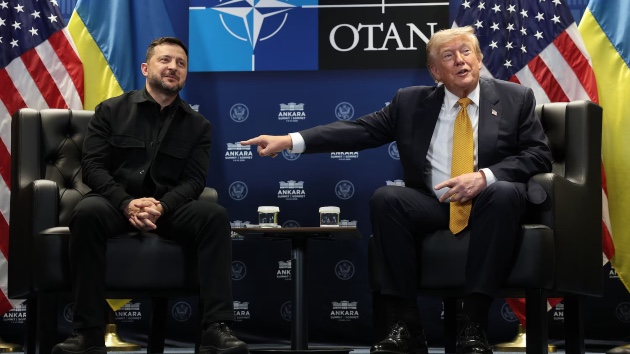
President Donald Trump meets with Ukrainian President Volodymyr Zelenskyy for bilateral talks at Bestepe Presidential Compound during the NATO Summit on July 8, 2026 in Ankara, Turkey. (Win Mcnamee/Getty Images)

(LONDON) — Ukrainian President Volodymyr Zelenskyy left last week’s NATO summit armed with a valuable commitment from President Donald Trump — that Kyiv would get approval to produce vital interceptor missiles for the Patriot air defense system, which since 2023 has helped defend Ukraine’s skies against Russian aircraft, drones and ballistic missiles.

Zelenskyy and his top officials have long warned that Ukraine needs more air defense systems and far more ammunition to blunt Russia’s daily long-range strikes. In recent weeks and with interceptor missile stocks reportedly running low, those warnings have become more dire.

Trump’s approval for Kyiv to get a production license to produce Patriot interceptors on home soil is “really good news for Ukraine,” Chrystia Freeland, previously Canada’s deputy prime minister and now an economic adviser to Zelenskyy, told ABC News on the sidelines of the Chatham House think tank’s conference in London last week.

“It would be even better if they were getting Patriots right now, because they’re being hammered,” Freeland added. “It’s great to get the licenses. But between getting the licenses and actually being able to make the Patriot [missiles] to defend themselves, it’s going to take time. And during that time, lots of people are going to die.”

As civilian casualties in Ukraine rise, securing more air defense systems and ammunition are a priority for Kyiv, Zelenskyy has said repeatedly. Russian strikes killed at least 265 civilians in Ukraine and injured 1,816 in June, senior United Nations official Rosemary DiCarlo told the body’s Security Council earlier this month.

The combined casualty total for June is the highest recorded since the first months of Russia’s full-scale invasion, DiCarlo said. Moscow’s full-scale invasion ‌in February 2022, a top U.N. official told the Security Council on Thursday.

In a post to X on Monday, Zelenskyy said that he and Trump “have reached an important deal on licenses to produce Patriot systems. Our teams are now working to implement this truly historic political agreement. We worked toward this for a very long time.”

Trump said during his warm meeting with Zelenskyy in the Turkish capital Ankara that the two leaders had developed a “good relationship.” The friendly exchange was a far cry from the infamous bilateral meeting at the White House last year which devolved into a heated public argument, with Trump and Vice President JD Vance openly admonishing Zelenskyy.

Freeland said that while Trump’s backing was welcome in Kyiv, Ukrainian leaders were focused on the bigger strategic picture. “They’re playing 100% to necessity. Ukrainians aren’t fighting to put on a show for Trump. They’re fighting because otherwise they will die,” she said.

“Trump does like a winner. He is not averse to flip flops. And I do think the stronger Ukrainians are the more likely they are to get his support,” Freeland added.

The Ankara declaration — NATO allies traditionally issue a joint communique to mark the end of each summit — said that Ukraine “contributes to transatlantic security” and is in line to receive some $80 billion in allied funding across 2026, with 2027 funding to be “at least equivalent.”

“Allies stand united in our unwavering support for Ukraine in defending its freedom, sovereignty, and territorial integrity,” the statement read.

The outcome was a positive one for Ukraine, Freeland said. “I would emphasize that the Ukrainians are making their own luck. I think the better they do, the more enthusiasm there is for supporting them. I think the Ukrainians recognize,” she said.

European allies, in particular, Freeland said, had shown they “are prepared to hang in there.” She added, “I think neither the Russians nor the Americans thought that Europe could do it.”

Russia’s full-scale invasion of its neighbor is now in its fifth year, the latest round of conflict having followed a lower-intensity conflict which began in 2014 with Russia’s annexation of Crimea and its fomentation of separatist rebellion in Ukraine’s eastern Donbas region.

A campaign that was designed to deliver a rapid Russian victory has now lasted longer than World War One, with Kyiv claiming to have inflicted nearly 1.5 million casualties on the invading forces while Russia’s ongoing offensives in the east of the country remain at a glacial pace.

Ukrainian long-range strikes into Russia, meanwhile, have increased exponentially in scale and intensity, putting particular pressure on the country’s lucrative oil production, refining and export sectors. Ukrainian drones are also increasingly targeting the supply routes into Crimea, seeking to effectively blockade the occupied peninsula from afar.

Ukraine’s foreign partners have been lauding the country’s reported successes. Even Trump, who famously suggested last year that Ukraine did not “have the cards” to play, said last month that Zelenskyy was “doing pretty well” in the showdown with Russian President Vladimir Putin.

Both the Trump administration and former President Joe Biden’s administration had put pressure on Kyiv to refrain from attacking certain targets, with Ukraine’s strikes on Russian oil facilities reportedly a particularly sensitive subject under both administrations.

But Ukraine’s ongoing success on that front, Freeland said, showed it had been “a mistake to ask the Ukrainians to tie one hand behind their back.”

“One of the things that has changed is Ukrainians are now using their own weapons and they’re making their own weapons, and that means they don’t need to ask anyone’s permission for where they strike. And I do think that’s made a big difference,” she added.

Though the wartime narrative appears to be swinging somewhat in Ukraine’s favor, the country’s cities remain under near-constant fire and Kyiv’s forces do not appear able to liberate significant territory still occupied by Russian troops. In his latest casualty update in February, Zelenskyy said Ukraine had lost at least 55,000 soldiers killed since 2022.

Ukraine also still appears to be frozen out of NATO membership in the short term, despite Zelenskyy’s repeated and recent appeals for the alliance to set out a clear roadmap for Ukraine’s accession, which allies have repeatedly said they support in principle.

“I have actually heard, behind closed doors and also in public, more and more European leaders saying Russia shouldn’t have a veto on who is in NATO, and Ukraine now has the strongest army in Europe, we should have them on our team,” Freeland said.

Moscow and Kyiv still appear far apart on the key issues in any future settlement. Though Putin has claimed a willingness to negotiate, he is still refusing to engage directly with Zelenskyy and is still demanding a raft of major Ukrainian concessions in exchange for peace.

“I think it’s impossible to foresee what will happen next,” Freeland said when asked about the war’s outlook. “Where are we right now? We know that the Ukrainians are doing well … We know that Russia is suffering more than it has since the beginning of the war.”

“I think that the view that Ukraine was about to collapse was always overdone. And I think that was a line that Russia pushed in order to get Western allies, particularly the United States, to push Ukraine to surrender. And they were effective, for a while,” she added.

“What I think is important for us to recognize and what is absolutely true, is Ukraine’s success right now is showing us that if we give them the tools, they will finish the job,” Freeland said.

ABC News’ Yulia Drozd contributed to this report.

Copyright © 2026, ABC Audio. All rights reserved.

Trump gets a much-needed South Carolina win and other takeaways from Tuesday’s elections

(CNN) — President Donald Trump demonstrated his might with Republican primary voters Tuesday in South Carolina, as CNN’s Decision Desk projected that Darline Graham — the sister of the late Sen. Lindsey Graham and the president’s pick in the state’s special Senate primary runoff — will claim the GOP nomination.Now favored to win a full term in November, Darline Graham is, in many ways, a senator of Trump’s own making. The president lobbied South Carolina’s governor to appoint her to fill the remaining months in her brother’s term after he died in July. Then, he privately and publicly pressed her to run for a full six-year term.And when it looked like her rival in the runoff, Rep. Ralph Norman, might win, Trump visited Myrtle Beach to rally Republican loyalists to Graham’s cause, as his super PAC, MAGA Inc., disclosed spending more than $827,000 to support Graham.Graham’s win is narrow — she led by just a few percentage points Tuesday evening — but symbolically significant for the president in a month full of political setbacks, with six of his endorsed picks losing Republican primaries.Trump’s preferred candidate in the Oklahoma governor’s race, former state Sen. Mike Mazzei, meanwhile, was locked in a close Republican primary runoff against state Attorney General Gentner Drummond as ballots were being counted Tuesday night.And in a low-turnout special election runoff in Georgia, Democrats filled a vacancy in the narrowly divided House.Here are takeaways from Tuesday’s elections in South Carolina, Oklahoma and Georgia:A badly needed win for TrumpDarline Graham took to the stage at her victory party Tuesday night and declared: “South Carolina is truly Trump country.”Unlike her brother, who was close to the late Sen. John McCain and built a reputation as a foreign policy hawk independent from Trump, Darline Graham’s political profile was tied entirely to the president.“Our victory would not have been possible without you, and we are truly grateful,” she said in a message directed at Trump.For Trump, the win was badly needed — a victory in one of his highest-risk interventions in Republican primaries this year, after a string of several losses this month and with midterm elections just over two months away. It could serve to remind Republican lawmakers who might be looking to distance themselves from an unpopular president of the potential political costs of being at odds with Trump.Norman acknowledged Trump’s role in the race’s outcome, telling his supporters Tuesday night that “the president got involved. He has that right.”“I never understood why he got in this race,” Norman said as some members of the crowd booed the president. “But it is what it is, and I’ll accept it.”Graham is now set to face Democratic nominee Annie Andrews, a pediatrician, in November. Andrews on Tuesday challenged Graham to at least three televised debates, saying in a statement that “no appointment, endorsement, or family connection entitles anyone to six years” in the Senate. Still, Graham is heavily favored to win the deep-red state in the general election.A senator of Trump’s makingTrump has endorsed a slew of candidates this year, but rarely has he put his own political capital on the line like he did in South Carolina.When Trump initially talked up Darline Graham to fill the seat of her late brother, and Gov. Henry McMaster complied, it seemed like a short-term gig. The seat was already on the ballot for a full six-year term in November, so she’d have been a placeholder for a few months, until South Carolina voters nominated and elected one of the state’s myriad experienced Republicans who had been waiting decades for a Senate vacancy.But Trump doubled down three days after she was sworn in, urging her on social media to seek a full term. And, days later, she announced she would do so.The president’s “complete and total endorsement” wasn’t enough to clear the field. After all, Darline Graham had no political experience, and her brother wasn’t exactly beloved among conservative voters in South Carolina: He’d earned just 57% of the vote in his primary two months earlier against a handful of relative unknowns.The results of the August 11 primary suggested she could be defeated in the runoff. She finished first, but with just shy of 33% of the vote.There were reasons to believe Trump’s influence might be limited. After all, his choice in South Carolina’s GOP primary for governor, Lt. Gov. Pam Evette, lost to state Attorney General Alan Wilson — who Trump also endorsed at the last minute when it was clear his preference was on course for defeat.The president did not have the luxury of the same face-saving tack here: Norman had endorsed and campaigned with former Gov. Nikki Haley as she ran against Trump for the 2024 GOP presidential nomination.Graham’s inexperience was on display during a debate with Norman earlier this month, when she declined to answer a question about Taiwan and the South China Sea, saying that national security was “not my thing.”But Trump carried Graham over the finish line. He visited South Carolina on Friday, telling Republicans that he’d personally lobbied her to run for a full term. “Pretend, please, that I’m on the ballot,” he urged GOP voters.Another endorsement test in OklahomaAnother Trump-endorsed candidate, Mazzei, was locked in a tight race Tuesday night against Drummond in the hard-fought runoff for the Republican nomination for governor.The two are vying to take on Oklahoma House Minority Leader Cyndi Munson, the Democratic nominee, in the race to replace term-limited Republican Gov. Kevin Stitt in November.The race was another test of Trump’s influence — and there were significant questions over whether his endorsement would be enough for Mazzei, after Trump’s picks in Republican gubernatorial primaries in Georgia, Iowa and Minnesota all lost earlier this year.A key divide in the primary was a proposed $4 billion aluminum smelter at the Tulsa Port of Inola, estimated to bring about 1,000 jobs to the area. Trump touted the plant, claiming on Truth Social that it “will be one of the best projects ever conceived or built, not only in the Great State of Oklahoma, but in the United States, itself.” But, amid local concerns about pollution and damage to the livestock economy, Drummond has sued, asking a federal court to block the plant’s construction.Georgia Dems fill a House seatCNN projects that Democrat Everton Blair, a former Gwinnett County School Board chair, will win the special election for Georgia’s 13th District House seat vacated by the late Rep. David Scott’s death in April.But he won’t hold that seat for long.Blair, who will be the first out gay member of Congress from Georgia, defeated the longtime lawmaker’s daughter Marcye Scott in the special election runoff on Tuesday. He campaigned on a pledge to be a stronger opponent to Trump and advocate for a more progressive affordability agenda than both the late congressman and his daughter.However, Blair finished a distant third in the regular House primary earlier this year, so he won’t be on the ballot in November.State lawmaker Jasmine Clark is the Democratic nominee for a full two-year term in the deep-blue district in November. She did not run in the special election because under state law, she would have had to resign her seat in the Georgia House — costing Democrats a seat just as Republican Gov. Brian Kemp was launching an unsuccessful push for mid-decade redistricting.In the meantime, Blair’s win, and the special election of state Sen. Aisha Wahab in California last week, will help Democrats further narrow the already razor-thin GOP majority in the House.CNN’s Katie Doran and Adam Cancryn contributed to this report.The-CNN-Wire™ & © 2026 Cable News Network, Inc., a Warner Bros. Discovery Company. All rights reserved.
Read Next Story