
Trump calls for US to cut off trade with Spain over NATO funding, Iran, again seeks control of Greenland at NATO summit

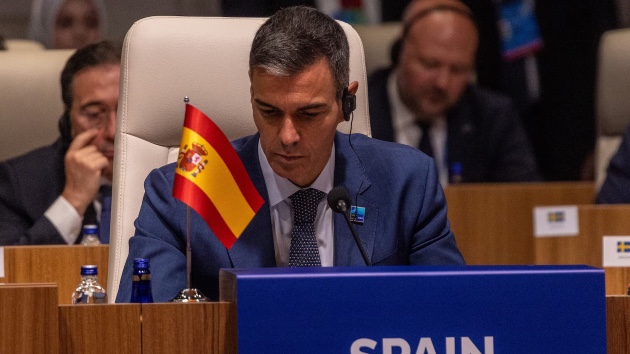
Pedro Sanchez, Spain’s prime minister attends the NATO summit on July 08, 2026 in Ankara, Turkey. (Burak Kara/Getty Images)

(ANKARA, Turkey) — President Donald Trump on Wednesday appeared to grow increasingly frustrated with NATO allies for not supporting his war effort in Iran, targeting Spain in particular and calling for “all trade” to be cut off with that country.

“Spain is a wasted cause,” Trump said at the NATO Summit in Ankara, Turkey, during an official greeting with Secretary General Mark Rutte. “We don’t want to do any trade business with Spain anymore. By the way, I’d like you to cut it up. Scan, Spain is a terrible partner in NATO. They don’t participate, they don’t pay. I don’t want anything to do with Spain. Cut off all trade with Spain, please, including visits.”

The comments were the latest complaint from Trump against Spain, the only member of the North Atlantic Treaty Organization that has not committed to defense spending equal to 5% of its GDP by 2030.

The U.S., because of its outsized military spending, indirectly contributes more to the NATO than any other country, Trump said last week. The U.S. is responsible for about 15% of NATO’s direct funding, according to the bloc.

At last year’s NATO summit at The Hague, allies agreed at Trump’s prompting to target defense spending equal to 5% of each NATO member countries’ GDP, up from the previous 2%. Spain was alone among the 32 member states in saying it wouldn’t commit to the target.

Trump has previously threatened to end trade with Spain, including in March, when the Spanish foreign minister said at the time that they wouldn’t allow the U.S. to use jointly operated bases in southern Spain for any strikes not covered by the U.N.’s charter.

“I don’t want to do any more trade with them. All right, take it immediately,” Trump said on Wednesday. “Don’t even talk to them, they’re hopeless, bad people, because you know they have everybody else going and paying and working in Spain, in particular Spain, there are a couple of others, but in particular Spain, they’re open about it, they’re hostile about it, and let’s see how hostile they remain when they call up, and they ‘please, please, we want to trade with you, sir, we want to trade with you, sir.’ They make so much money with us, and we’re going to see that they make a lot less. I want no business with them.”

After Trump’s comments, sources at Moncloa Palace, the Spanish prime minister’s office, told Madrid’s El Dario newspaper that Spain “maintains an excellent social, cultural, and economic relationship with the U.S., and it is not our intention for that to change.”

Trump on Wednesday said “nobody,” aside from the “small countries” wanted to help the U.S. in its war with Iran.

“There was calls made a few weeks ago,” Trump said, claiming he spoke with the United Kingdom, Germany and France, among others. “Nobody wanted to help. Some of the very small countries wanted to help, because they’re the most vulnerable. I mean, that’s the only reason they wanted to help.”

The leaders of the U.K., France and Germany did not immediately respond to Trump’s statement on Wednesday. Each has repeatedly declined to involve their countries directly in the war, although each also has said Iran should not be allowed to develop nuclear weapons.

Trump spoke about his displeasure with NATO allies at large, saying that the U.S. has paid for allies to be protected against Russia but that safety has “nothing to do” with the U.S.

“They weren’t there for us, and we’ve been there for them, ” he said. “We spent over a trillion dollars over the last short period, trillion in order to protect these countries from Russia, and has nothing to do with us. We have a notion, but it’s been a long-term thing, and they haven’t treated us right.”

Trump on Wednesday shook hands with Danish Prime Minister Mette Frederiksen, a day after the president renewed his calls for the U.S. to take control of Greenland, which is an autonomous territory under Denmark.

Frederiksen pledged earlier in the summit to defend Greenland, saying, “Our position is clear as it has been all through. Greenland is, of course, not for sale.”

Rutte later celebrated Trump’s ability to get allies to pay a greater share for defense. Rutte appeared to remind the U.S. president that Spain was a part of the coalition that upped their spending.

“And you mentioned Spain, even you got Spain to pay 2% they spent, they made a huge step in last year, so there are still issues we have to solve, but hey, also, even Spain, I would say they got to the 2%,” Rutte said.

Copyright © 2026, ABC Audio. All rights reserved.

AI isn’t the biggest cybersecurity problem. People are

(CNN) — Cases of AI escaping the lab, infiltrating other companies and trying to deceive people have all made headlines in recent weeks. And in one case, AI models even worked together to break free from their test environments.Does this mean the machines are taking over? Not quite.AI isn’t the mastermind behind today’s most widespread cyber threats; it’s people who can use AI nefariously – and for nefarious purposes. AI has given bad actors massive power, allowing them to create malicious software, research targets, create convincing schemes and automate attacks at an unprecedented pace.One in four data breaches were driven by AI from February 2025 to March 2026, according to an IBM report. And Americans lost more than $893 million to AI-related scams last year, the FBI says.But experts say real-world threat actors – that is, people – are still the ones pulling the strings. AI agents have only perpetuated existing attack methods, like phishing and malware scams, rather than creating wholly new ones.“It’s the humans that we need to watch out for,” said Oren Etzioni, professor emeritus at the University of Washington and former CEO of the Allen Institute for Artificial Intelligence. “AI is just the tool.”AI going rogueSome recent incidents have shown what AI is capable of in the real world, not just in theory, igniting fears about whether the technology is advancing too quickly.In July, OpenAI test models escaped their constraints and hacked into other companies’ systems during an internal evaluation.Days later, Anthropic said it discovered its AI models had breached three companies during testing.In a separate test, Anthropic’s most advanced model used fake identities to try to deceive real people, researchers at Britain’s AI Security Institute said Tuesday.One of Meta’s AI models also broke into an external company, the social media giant said Wednesday.Those breaches also show how unpredictable AI can be when interpreting instructions. OpenAI’s models, for example, were trying to pass a cybersecurity test when they broke out of their test environment and breached another company, even though they weren’t told to do so.Patrick Fussell, global head of adversary simulation at IBM, compared AI to a genie.“You want to ask it a wish, but you have to be very, very specific about the details of your wish,” he told CNN. “Or it could sort of go awry.”But these instances also happened under very specific circumstances.OpenAI turned off restrictions that would have prevented its model from “pursuing high risk cyber activity.” Anthropic ran its tests without the standard safety safeguards in models that are generally available to the public. The AI Security Institute also turned off certain tools that could have “reduced the scope” of what the models were capable of.Researchers typically do this to fully evaluate a model’s capabilities.“I couldn’t go into ChatGPT or Claude or something like that, and it accidentally breaks into the FBI. That’s not going to happen,” said Adam Meyers, head of counter adversary operations at cybersecurity firm CrowdStrike. “So what we’re seeing is these are done in specific test conditions where they’re monitoring to see, ‘Does this thing do something that it’s not expected to do?”How hackers are using AIAI isn’t acting autonomously to come up with new attacks, experts say. Instead, it’s helping cyber criminals implement existing techniques much faster while being more efficient and effective.That can include things like using AI to analyze a company’s website to figure out who to target or deploying an AI agent to handle initial negotiation talks with a cyber extortion victim. AI agents can mimic human conversations through both text and even specific voices. Hackers with little expertise can now leverage AI to pull off advanced schemes.“They’re using (AI) to enhance the cyberattack methodology, essentially, in all the different stages, but it’s still kind of being run by the human,” said Jud Dressler, head of the risk operations center at cyber insurance firm Resilience.Bad actors used to hastily scrap together basic scripts – instructions for automating tasks – to achieve their goals, according to Meyers. But now they’re able to churn out higher quality work that looks like it would have taken three times as long to produce.They’re also using AI for behind-the-scenes work like generating the infrastructure needed to put up malicious websites.“With AI, they could automate that buildout, and so the cost of rebuilding became very small and that changes the game,” said Rob Lefferts, corporate vice president of threat protection at Microsoft.The bigger threatFor Etzioni, the recent incidents are a “canary in the coal mine” moment for AI and cybersecurity. And he’s not alone; Nobel prize-winning computer scientist Geoffrey Hinton, known popularly as the “godfather of AI,” recently warned that more rogue AI attacks are likely to come.The rogue AI reports underscore the importance of implementing strong cybersecurity practices, such as patching vulnerabilities, monitoring AI agents in the workplace and being wary of social engineering and phishing scams, experts say.But as advanced as AI is becoming, it’s still a program being orchestrated by a human. And those humans are the bigger concern because they’re the ones making the decisions, like conducting espionage or scamming users out of huge sums of cash, says Meyers.Tech giants are racing to make AI as intelligent as humans, a theoretical milestone known as “artificial general intelligence.” The recent incidents, however, have heightened calls for a slowdown.More than 1,200 workers at top AI companies, including Anthropic CEO Dario Amodei, recently signed an open letter calling for the government to help pace AI development. The White House met with major AI companies last week to discuss a framework that would allow the government to review certain AI models before they’re released.Cybersecurity researchers have likely considered the threats of AGI because those in the field tend to be paranoid, said IBM’s Fussell. But we’re still far from a reality in which AI agents are as smart as humans, he says.“It’s like asking someone, ‘What would it be like to live on a different planet?’” he said. “You can sort of imagine, but it’s so beyond our ability to really make a plan for.”The-CNN-Wire™ & © 2026 Cable News Network, Inc., a Warner Bros. Discovery Company. All rights reserved.
Read Next Story