
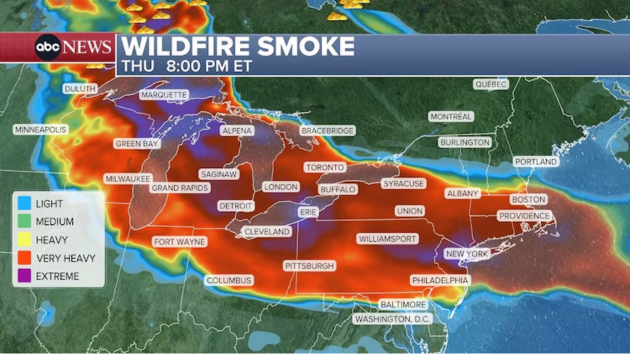
(NEW YORK) — Air quality alerts are in place on Thursday across at least 18 states, from Minnesota to New Hampshire to Virginia, as dangerous smoke continues to waft into the U.S. from Canadian wildfires, including more than 100 blazes burning out of control.
Smoke from at least 850 active wildfires in Canada is traveling more than a thousand miles to reach U.S. locations including New York City. At least another nine large fires are burning in northern Minnesota.
On Thursday afternoon, Minneapolis surpassed Detroit for having the worst measured air quality in the world among major cities, according to the air quality monitoring website IQAir.
Earlier Thursday, Detroit, which dropped to second on the list, reached an air quality index, or AQI, of nearly 570. IQAir rates the most dangerous air quality index, described as “hazardous,” as 301 or above.
Chicago was third on the IQAir’s AQI scale for the worst air quality on the planet while Toronto, Ontario, was sixth on Thursday afternoon. Toronto is more than 1,100 miles from where some 180 wildfires are burning in sparsely populated areas of Ontario province.
Meanwhile, all of New York State, including New York City, and parts of New Jersey are under an Air Quality Advisory on Thursday due to the wildfire smoke.
The extreme smoke will continue through Thursday evening in the Upper Midwest, including northern Wisconsin, northern Michigan, the New York City area and across the Northeast. Heavy smoke will also stretch from Chicago to Detroit and from Philadelphia to Boston.
New York City could see orange skies on Thursday afternoon as dense plumes of hazardous smoke continues pour into the area.
According to the Canadian Wildland Fire Information System, 859 active wildfires are burning as of late Thursday afternoon, including 37 new fires that ignited Thursday. At least 109 of the wildfires were burning out of control Thursday afternoon, according to the agency.
So far this year, according to the agency, Canada has had 3,549 wildfires that have burned a total of 2.3 million hectares, or more than 93,000 square miles, which is roughly the size of the United Kingdom.
The smoke and ash from the Canadian wildfires was even affecting commercial air traffic. On Thursday, the Federal Aviation Administration (FAA) said it was slowing arriving flights into the Philadelphia International Airport due to low visibility from wildfires smoke.
An American Airlines pilot told Philadelphia air traffic controllers on Thursday that ash was sticking the windshield of his aircraft, according to a recording of the communications provided by ATC.com.
“I’ve never seen it stick to the windshield like this,” the pilot was heard telling air traffic controllers.
American Steve Ventling of Montana told ABC News that he witnessed the Canadian wildfires up close this week when a blaze began while he was on a fishing trip in Northern Ontario. Ventling shared photos with ABC News of billowing smoke and flames quickly spreading through a lakeside forest.
“I’ve seen plenty of fires in my lifetime. Nothing prepared me for this. The flames exploded through the treetops. Entire trees vanished in seconds,” said Ventling, adding that he and others he was fishing with evacuated the area in a boat.
On Wednesday, the wildfire smoke cast a yellowish haze over New York City, leaving a strong stench of smoke in the air.
New York City Mayor Zohran Mamdani warned that “a combination of dangerous heat and unhealthy air” will continue to be a serious threat to the health of New Yorkers on Thursday.
“This is very serious,” Mamdani said at a news conference on Thursday morning. “We are reaching into a level of air quality that is dangerous for every single New Yorker.”
In a social media post on Wednesday night, Mamdani advised New Yorkers to “stay somewhere cool with air conditioning, limit your time outdoors, drink plenty of water, and check on your neighbors – especially older New Yorkers and anyone with a health condition.”
The mayor said the city is providing free masks to help people cope with the smoke.
By Thursday noon, air quality was rated as “unhealthy” in New York City, with air quality in the Long Island and Lower Hudson Valley regions forecast to also become unhealthy before the end of the day, according to the air monitoring site AirNow.
Air quality in the Central and Western New York regions and the Eastern Lake Ontario region of New York state were rated as “very unhealthy,” according to AirNow.
New York Gov. Kathy Hochul said smoke will be thick on Thursday and spread across the rest of the state throughout the day.
“Distant wildfires have impacted New York State in recent years, and this week unfortunately will be no different with expected hazy skies and poor air quality,” Hochul said in a statement on Wednesday. “We are now closely tracking these conditions and I strongly encourage New Yorkers to stay informed and take appropriate precautions to stay safe. Sensitive groups should take particular caution.”
By Friday morning, the smoke is expected to push farther south, affecting areas through Ohio and Virginia, including Washington, D.C., and Baltimore, throughout the day.
Copyright © 2026, ABC Audio. All rights reserved.