
Torrential rain prompts Texas Hill Country flash flood emergency warnings

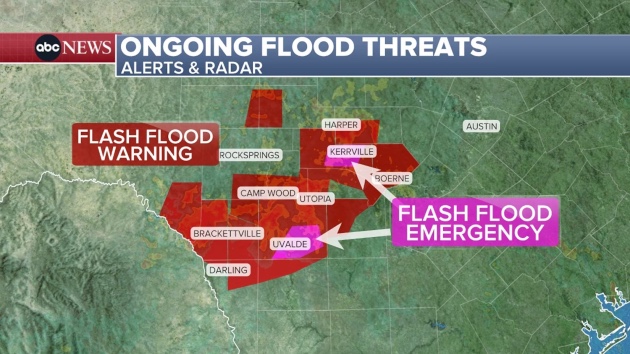
This ABC News graphic shows flood warnings in Texas as of July 16, 2026. (ABC News)

(NEW YORK) — Torrential rain through Wednesday into Thursday prompted flash flood emergency warnings for Texas Hill Country as water levels in creeks and rivers rose rapidly.

As of Thursday morning, there were two flash flood emergencies ongoing in Texas Hill Country, impacting Kerrville — the city where the deadly Camp Mystic flooding occurred in July 2025 — Hunt, Uvalde and Knippa.

Evacuations and water rescues were reported in all four areas, with warnings of life-threatening flash flooding and reports of water entering buildings.

The Guadalupe River at Hunt rose from 9 to 19 feet between 3 a.m. and 4 a.m. CT, cutting off access to some roads and bridges.

Engineers assessed the bridge over the Guadalupe River on Highway 87 into Comfort, Texas, due to fears that the force of the water may have made it unstable, Kendall County Judge Shane Stolarcyz told ABC News. The engineers concluded that the bridge is structurally sound for now, ABC News has learned.

There are 63 residents inside the town’s evacuation center with their pets, waiting out the storm.

The fast-moving water below the bridge could be seen carrying debris within the current. The water is starting to recede, but authorities anticipate there could be a second wave later Thursday. They do not believe it will be anywhere near the level seen in the morning. 

The National Weather Service elevated the flash flood emergency on Thursday to say a “large and deadly flood wave” had begun along the Guadalupe River around Kerrville and was moving through Center Point, which is downstream of Kerrville, and on to Comfort and Waring, Sisterdale, Crown and Bergheim.

The river gauge at Center Point rose 32 feet in four hours and was expected to reach a crest similar to the catastrophic July 4, 2025, river flood.

A rainfall rate of 2 to 4 inches per hour was forecast for the region. Up to 20 inches of rain had fallen in the Uvalde area over the previous 48 hours — more than six months’ worth of rain for this area — with 8 inches falling in 2 hours.

Gov. Greg Abbott said in a press conference on Wednesday that disaster declarations had been made for 59 counties, with the possibility of more being added.

He said that more than 75 people had been rescued so far and that the expected rainfall from this storm could exceed 30 inches, 10 inches more than the level recorded during last year’s deadly floods.

“We are dealing with and responding to a flood that is likely going to break records,” Abbott said. “There are over 1,300 state personnel from more than 30 agencies that are already activated. More than 800 vehicles, more than 75 boats, and 20 aircraft have been deployed. Our primary focus right now and throughout the remainder of this torrential rain is saving lives.”

The NWS issued a flash flood emergency warning for Boerne, located in Texas Hill Country about 55 miles southeast of Camp Mystic, on Wednesday afternoon, urging residents to relocate to higher elevations immediately.

“This is a PARTICULARLY DANGEROUS SITUATION,” the NWS warning stated. “SEEK HIGHER GROUND NOW!”

A rain gauge near Boerne measured 3.5 inches of rain within one hour Wednesday morning, according to the NWS. The Cibolo Creek rose 10 feet in just 90 minutes — between 9:45 and 11:15 a.m. local time, and measured at a record-high level of more than 22 feet.

A flash flood emergency was also issued for D’Hanis, Texas, about 60 miles southwest of Boerne, where between 4 and 10 inches of rain have fallen, according to the NWS. The Seco Creek is rapidly rising, prompting local officials to advise those in flood-prone areas to move to higher ground without delay.

Intense rainfall began in parts of Texas Hill Country on Tuesday, where some areas received between 6 inches and 16 inches of rainfall in 24 hours.

The NWS had previously issued a high risk for flash flooding — a level 4 out of 4 — for the same region on Wednesday due to a forecast of an additional 6 to 12 inches of rain.

A “high risk” is a rare occurrence. It’s only issued about 4% of days, but accounts for around one-third of all flood-related fatalities and 80% of all flood-related damages, according to the National Weather Service.

Between 4 and 12 inches of rain had fallen by noon Wednesday, and an additional 1 to 2 inches of rain were possible in the area. Flash flood warnings were also issued for Kerrville, Uvalde and just north of San Antonio.

Life-threatening flash flooding occurred at low water crossings, small creeks and streams, urban areas, highways, streets and underpasses, according to the NWS.

In Uvalde County, about 100 miles southwest of Boerne, at least 25 rescues had occurred by 9 a.m. on Wednesday. Additional rescues were underway Wednesday afternoon in North County, where the Leona River gauge reached nearly 20 feet, according to the Uvalde Police Department.

When will the heavy rain, flooding risk end

The flood watch across Texas Hill Country remains in effect through Thursday.

The same area faces a level 4 of 4 risk for flash flooding on Thursday, with the heaviest rain expected between 2 a.m. and 2 p.m. Another round of heavy rain could occur Thursday night.

Isolated additional rain totals of more than a foot are possible through Thursday, forecasts show.

Why Texas Hill Country is prone to flash flooding

Texas Hill Country is often referred to as “Flash Flood Alley,” one of the most flood-prone regions in the U.S., because the weather and landscape in the south-central Texas allow for rapid flood events, according to the Texas Water Resources Institute (TWRI).

The “alley,” which stretches from Dallas to San Antonio and encompasses the Colorado and Guadalupe River basins, is highly susceptible to dangerous flood events due to its steep terrain, shallow soil and repeated high rainfall events.

Much of the region is situated on a floodplain between tall hills, funneling any rainfall into rivers and creeks, causing them to rapidly rise. In addition, the clay soil does not easily absorb water and triggers high water runoff once wet, the TWRI said.

Major floods have occurred over nearly all sections of the Guadalupe River Basin, according to U.S. Geological river streamflow records dating back to the 1800s.

High rainfall intensities are a common occurrence because the Gulf provides an infinite source of moist air, as does the Pacific, which produces monsoonal moisture as well as cool air masses from the north that converge to produce extreme rainfall events.

Last year, more than 100 people died, including 25 girls at Camp Mystic, as a result of catastrophic flooding along the Guadalupe River during the Fourth of July weekend.

The torrential rain that turned the river into a raging wall of water was fueled by unique atmospheric conditions, meteorologists and climate scientists told ABC News last year.

Heavy rain combined with slow-moving thunderstorms caused the Guadalupe River to rise 26 feet in less than an hour, officials said.

ABC News’ Melissa Griffin and Faith Abubey contributed to this report.

Copyright © 2026, ABC Audio. All rights reserved.
Trump will need China for his new economic war against Iran. Good luck getting Xi on side

Beijing (CNN) — When US Treasury Secretary Scott Bessent unveiled “Operation Economic Outcast,” threatening damaging new sanctions on countries that refuse to stop doing business with Iran, he didn’t name the one country that could decide its success or failure: China.The world’s second largest economy has long been a critical economic lifeline for Tehran, buying up the vast majority of its oil exports – worth an estimated tens of billions in US dollars last year – in addition to other trade.Bringing it on board with the White House’s latest effort to subdue an Iranian leadership stubbornly defiant after almost six months of war, however, is an extremely tall order.Beijing flatly rejects what it calls “unilateral” US sanctions and has long defended its right to regular trade with partners like Iran and Russia. It also surmises that Washington would be wary of triggering a broader economic confrontation that would hurt both countries, right ahead of the US midterms.On Tuesday, following Bessent’s presser, China’s Foreign Ministry vowed to “take all necessary measures” to safeguard its “own legitimate rights and interests” in the face of US sanctions threats.“Economic warfare and maximum pressure will not help resolve the issue; they will only further intensify tensions and conflicts, create spillover risks, disrupt the global economic and financial order,” ministry spokesperson Lin Jian said.Bessent’s threat also comes ahead of a highly anticipated visit by Chinese leader Xi Jinping to the US next month, where the two sides could make progress on extending a critical trade truce set to expire later this fall.Trump earlier said that he did not ask Xi “for any favors” on Iran during a May meeting between the two – a statement, which, if correct, will likely smell to Beijing of American desperation to end the conflict.What’s left now is a careful calculus for both countries in how they navigate what Bessent has said will be a period of “quiet diplomacy” – or privately issuing ultimatums to Iran’s economic partners, which the Treasury chief did not specifically name during his press conference.Chinese analysts suggest limited space for Washington’s demands: “China is unlikely to accept a situation in which Washington determines what Chinese companies can legally trade with third countries,” said Zhao Long, director of the Institute for International Strategic and Security Studies at the Shanghai Institutes for International Studies.“That would establish a precedent that US secondary sanctions can effectively determine China’s commercial relations with third countries,” he said.What Washington could doChina imports Iranian oil using a shadowy system that’s by design insulated from the US dollar system – and sanctions.Private, so-called teapot refineries, purchase and process US-sanctioned Iranian crude, relying on a network of ports, financial institutions and tankers that are often similarly firewalled from international exposure. China hasn’t recorded these purchases officially in years, since after the US re-imposed sanctions on Iran when the first Trump administration backed out of the Obama-era Iranian nuclear deal.But pressure points do exist, analysts say.“When you look at the upstream ownership of these entities, you’ll find many are directly or indirectly held by major Chinese state-owned entities that are heavily integrated into the US dollar system,” said Max Meizlish, a senior research analyst at the Foundation for Defense of Democracies think tank in Washington.“By sanctioning their subsidiaries, the US can apply pressure on the parents to divest at risk of being deemed as providing direct or indirect support to sanctioned entities,” he said.Bessent earlier this year said Washington has sent warnings to two unnamed Chinese banks about their role in Iran-linked transactions. When asked on Monday during his press conference what measures the US would take against non-compliant Chinese banks and shipping firms, he said “no one is above” facing US sanctions.Despite the tough talk, Beijing has seen the US threaten – and then back off – sweeping sanctions before. And it also knows Washington is acutely aware of China’s significant economic leverage over the US, especially in the form of its grip on the global supply of strategically critical rare earths.“If Washington crossed that threshold (of sanctioning major Chinese banks), Beijing would almost certainly respond, and the political atmosphere for a summit (between Trump and Xi) would deteriorate sharply,” said Sun Chenghao, a senior fellow at Tsinghua University’s Center for International Security and Strategy in Beijing.Such a move might not automatically cancel their meeting, but it would “shift the summit from stabilization toward damage control,” he said.Summit considerationsBoth sides will be weighing up the impact of escalation to that summit, expected to be the first state visit by Xi to the US in 11 years.While Beijing will not want to be seen to be cooperating with a sanctions regime it opposes, there are careful maneuvers it could take – such as quietly reducing oil purchases or elevating its political messaging to Tehran and efforts to encourage restraint.Chinese purchases of Iranian oil have already declined sharply compared to last year as the US blockade has constrained Iranian crude exports.Chinese analysts have also in recent weeks suggested there are overlaps between the interests of Washington and Beijing, especially in terms of seeing trade flows restored in the Strait of Hormuz, which has been choked by the conflict, and restoring broader regional stability, also conductive to trade.And Beijing has in recent days re-upped its messaging urging restraint and normal operations around the Strait.In a joint statement following a meeting with Jordanian King Abdullah II in Beijing on Monday, Xi called for the restoration of “normal passage” through the Strait and a “comprehensive solution” to the conflict.Chinese Vice Foreign Minister Miao Deyu said last week while hosting Iranian officials in Beijing that China was “actively committed to promoting peace talks.”Even still, Beijing has shown itself wary of playing a direct mediator role in the conflict, preferring a position where it protects its own economic interests – and plays up its image as a stable power that supports regional peace, in contrast to Washington’s vacillations.Any cooperation with the US in restoring regional peace “should not be reduced to ‘doing Trump a favor,’” said Zhao in Shanghai.“Beijing is willing to contribute to ending the crisis, but it is not willing to become an instrument of Washington’s maximum-pressure strategy.”The-CNN-Wire™ & © 2026 Cable News Network, Inc., a Warner Bros. Discovery Company. All rights reserved.
Read Next Story