Thousands died in England and Wales from recent heat waves: Report

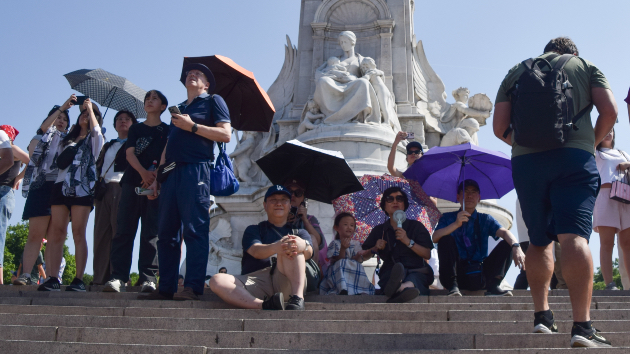
People shield from the sun under umbrellas next to the Victoria Memorial outside Buckingham Palace as the UK is hit by another heatwave. (Vuk Valcic/SOPA Images/LightRocket via Getty Images)

(LONDON) — More than 2,700 people are estimated to have died in England and Wales in recent months as a result of heat-related causes, a new report has found.

The excess deaths occurred as a result of heat waves in May and June, according to researchers at the London School of Hygiene & Tropical Medicine (LSHTM), Imperial College London and the Met Office.

Globally, heat is the leading cause of weather-related deaths, according the World Health Organization (WHO).

The heat wave that occurred between May 21 and 29 was likely responsible for around 550 deaths, while the heat wave that occurred from June 18 to 28 was likely responsible for about 2,200 deaths, the analysis found.

Both heat waves broke long-standing temperature records, according to the report.

In the U.K., the temperature threshold for an official heat wave is lower than in much of the U.S.

A heat wave is defined as a period of at least three consecutive days with daily maximum temperatures meeting or exceeding the heat wave temperature threshold, according to the Met Office. The threshold varies by county and ranges from 77 to 82 degrees Fahrenheit.

Across much of the U.S., the temperature threshold is at least three consecutive days with daily maximum temperatures at 90 degrees or greater.

The most heat-related deaths occurred southeast of England, with 549 in total. London saw 453 deaths and the West Midlands reported 368 deaths, researchers said. They suggested that people in areas less frequently exposed to extreme heat may be more vulnerable.

“It is vital that action on adapting Britain’s homes, workplaces, and critical infrastructure to extreme heat outpaces these health risks, especially if we are to protect those most vulnerable to its impacts, such as older people, babies, and children,” Malcolm Mistry, assistant professor in climate and geo-spatial modeling at the LSHTM, said in a statement.

About 42% of heat-related deaths that occurred in the U.K. during those months were exacerbated by human-caused climate change, researchers said.

“Climate change is further boosting the temperature of essentially every heat wave we observe today,” Flavio Lehner, a climate scientist at Cornell University, said in a statement to ABC News. “In other words, had the same weather pattern occurred 50 or 100 years ago, it would have also resulted in a heatwave, but one that was a bit cooler.”

It’s not only daytime high temperatures that are a concern. Heat waves are becoming even more dangerous as overnight low temperatures are still too high for people to recover from the heat stress they experience during the day, according to the WHO.

Western Europe, the region most impacted by the historic heat wave in late June, experienced its hottest June on record last month, according to Copernicus, Europe’s climate change service.

Many June and some all-time records for daily maximum temperature were broken in several countries, according to Copernicus.

France’s nationwide average temperature hit 30 degrees Celsius, or about 86 degrees Fahrenheit, on June 24 — the highest-ever temperature recorded, according to weather officials at Meteo-France, the national weather service. High temperatures in Paris recorded in the triple digits in the days after.

High temperatures also impacted cities like Madrid and Rome, according to Copernicus.

There were more than 5,000 excess deaths in Germany and another 4,700 deaths in France, Belgium, Spain and the Netherlands between June 20 and 28, Reuters reported.

Rising atmospheric and ocean temperatures “reflect a climate system continuing to accumulate heat” that result in increasingly intense heat waves and a persistently warm ocean, Samantha Burgess, strategic lead for climate at the European Center for Medium-Range Weather Forecasts, said in a statement.

“June 2026 underscored how profoundly the climate is changing,” Burgess said. “Western Europe recorded its warmest June on record, and continued record warmth in the global ocean.”

Matthew Glasser and Joe Simonetti contributed to this report.

Copyright © 2026, ABC Audio. All rights reserved.
Trump secretly switched planes in Turkey amid security concerns, official says

(CNN) — President Donald Trump secretly slipped out of Turkey last month on an alternate military plane, which he boarded while hidden inside a catering truck, as part of an elaborate ruse prompted by an Iranian threat, according to a US official.The clandestine security plan — first reported by the Washington Post and confirmed by CNN — underscored the lengths American officials went to in order to protect Trump from being assassinated by Iran.Trump had flown to Turkey on a new plane gifted by Qatar and meant to be used as Air Force One. But while he was on the trip, officials announced he would fly out on an older presidential plane, which CNN and others had previously reported was due to security concerns.That, though, was apparently part of the subterfuge. After boarding the older aircraft, a moment caught on camera, Trump secretly got off via the catering vehicle and moved to a smaller Air Force C-32A. The Qatari-gifted plane, the older aircraft used as Air Force One, and the C-32A then all departed separately for the UK. Once there, Trump got on board the Qatari-gifted plane and flew home.For the last month, much of the public discussion about the plane swap had been centered around the security capabilities of the Qatar-donated plane. Trump had boasted about the new aircraft — even though officials felt it was not as secure as other planes because it had to be retrofitted to serve as Air Force One — and the president seethed privately over coverage of its deficiencies, CNN previously reported.Now, attention is likely to shift to reporters and staffers unknowingly being aboard a decoy plane — and the nature of the threat that prompted such dramatic security measures.When asked about the reports of the secret plane switch, White House spokesperson Steven Cheung told CNN, “The new Air Force One is a state-of-the-art aircraft that has been fitted with high-level security protocols that ensure the safety of the President and his staff. As the President has said recently, there are many enemies of America who have their sights on him, and we use every tool at our disposal to address those threats.”Details from the presidential travel pool — a group of journalists who travel with the president and document his movements — provide a closer look at the unusual sequence of events surrounding Trump’s departure from Turkey following a consequential NATO Summit.Trump was aboard the old Air Force One in Ankara as of 8:26 p.m. local time, according to a pool report.Air Force One was wheels up at 8:43 p.m. local time, according to a subsequent pool report, 17 minutes later.The pool was also “advised to keep our window shades in the press cabin closed,” according to a print pool note from Politico’s Megan Messerly. This is extraordinarily unusual, and seemed indicative of a security situation; Trump would later say it was “because you’re probably on a dangerous flight because of the sleaze bags that we have to deal with.”A supplemental pool note from ABC’s Michelle Stoddart on Tuesday, sent in light of the secret plane revelation, noted that a Secret Secret agent came back to the press cabin to remind the media to keep the shades closed. When a photographer attempted to lift a shade, they were quickly told to lower it again. And when the press inquired with White House staff about why, they only said it was a request from Secret Service.Video shows what appeared to be a catering truck parked next to Air Force One at Ankara’s Esenboga Airport during that time, about seven minutes before the aircraft begins taxiing.The plane then was “wheels down” at RAF Mildenhall in England at 10:29 p.m. local time. But it wasn’t until roughly 20 minutes later that the pool notified news networks that an underwing shot — a camera angle from underneath the wing of the plane — was being set up to capture the president deplaning.That is an unusually long period of time — and it’s enough that Trump theoretically would be able to get off the smaller plane and back on Air Force One before cameras could capture it. For comparison, CNN was part of the pool on Sunday, when it took roughly eight minutes between wheels down and the underwing shot to be established.Trump was seen stepping off Air Force One about one minute after the pool alerted that the underwing shot was up.That timing was notably faster than what CNN crews typically experience. Usually, it takes several minutes for the president to deplane after the pool crew has assembled under the aircraft. The pool is generally in position before the first Air Force One door is opened and the stairs for the president are put into place.CNN reviewed pool video from Mildenhall that showed the stair car already in position and the aircraft door already open when the pool shot came up. There also appeared to be more security personnel on the tarmac than CNN crews are accustomed to seeing.Trump later boarded the new Qatari-gifted Air Force One at 11:01 p.m., according to pool notes. The pool captured video of the president walking from one aircraft to the other.CNN’s Kaitlan Collins and photojournalist Khalil Abdallah noted that when they traveled as part of the pool covering Davos and had to turn around and board a new aircraft due to what officials described as a minor electrical issue, the White House did not allow the CNN crew to film Trump transferring between planes. Instead, the crew was instructed to wait until he had boarded the new aircraft.During the flight on the Qatari gifted plane, Trump was asked what prompted the aircraft switch.Trump had said the change was to give US service members stationed at the base “a chance to tour the Aircraft.” Pressed on whether there were any other issues, Trump quickly responded, “no issues.”Trump was also asked why reporters had been instructed to lower the window shades on the aircraft.He said it was “because you’re probably on a dangerous flight.”“They didn’t ask me to close mine, but if they did, I would’ve done it,” Trump added.“But if I go, you go. Right?” Trump said. “Perhaps someday you want to change professions”Trump ultimately landed at Joint Base Andrews and deplaned Air Force One at 1:23 am ET.“He saluted and quickly loaded into the Beast,” a pool note said.This story was updated with additional reporting.The-CNN-Wire™ & © 2026 Cable News Network, Inc., a Warner Bros. Discovery Company. All rights reserved.
Read Next Story