The universal nostalgia for ‘Take Me Home, Country Roads’

The first line of John Denver’s song “Take Me Home, Country Roads” calls West Virginia “Almost Heaven,” and when you’re up in the mountains, that description can feel pretty accurate.

Almost Heaven, West Virginia
Blue Ridge Mountains, Shenandoah River
Life is old there, older than the trees
Younger than the mountains, growing like a breeze 

Country roads, take me home
To the place I belong
West Virginia, mountain mama
Take me home, country roads 

But these winding country roads were immortalized by someone who had never driven them.

Correspondent Conor Knighton asked, “Had you ever been to West Virginia before you wrote the song?”

“No,” said Bill Danoff. “Well, in my dreams!”

Danoff, along with his then-girlfriend and bandmate Taffy Nivert, played a rough draft of “Country Roads” for their pal John Denver after a gig one night in Washington, D.C.

“John’s biggest contribution to anything at that point was just his enthusiasm: ‘Well, let’s finish it!'” Danoff laughed. “You know, at 1:00 in the morning, 1:30, you know? ‘Let’s get it!'”

The three stayed up late collaborating on the version that hit the airwaves 55 years ago.

Danoff said, “When it came out in ’71, you know, the Vietnam War was really rockin’. And we had, oh, hundreds of thousands of troops over there. So, coming home was a big, big deal.”

It was a song about home, just not Danoff’s home. Knighton asked, “You’re from Massachusetts. Could it just as easily have been, ‘Almost heaven, Massachusetts’?”

“Yeah, except I didn’t like that word!” Danoff replied. “West Virginia” sounded good. And as it turned out, a lot of other people thought so, too. 

The song was John Denver’s first hit, and, despite some questionable geographic accuracy (the Blue Ridge Mountains and Shenandoah River in the lyrics are barely within the state’s borders), West Virginians embraced it in a big way.

Students at West Virginia University sing the song after victories. 

It’s also a staple at wedding receptions. But the enduring appeal outside of the state has been more surprising. From television’s “The Office” to Germany’s Octoberfest, the song is known throughout the world.

Throughout this year’s World Cup, it was the anthem of the U.S. team. 

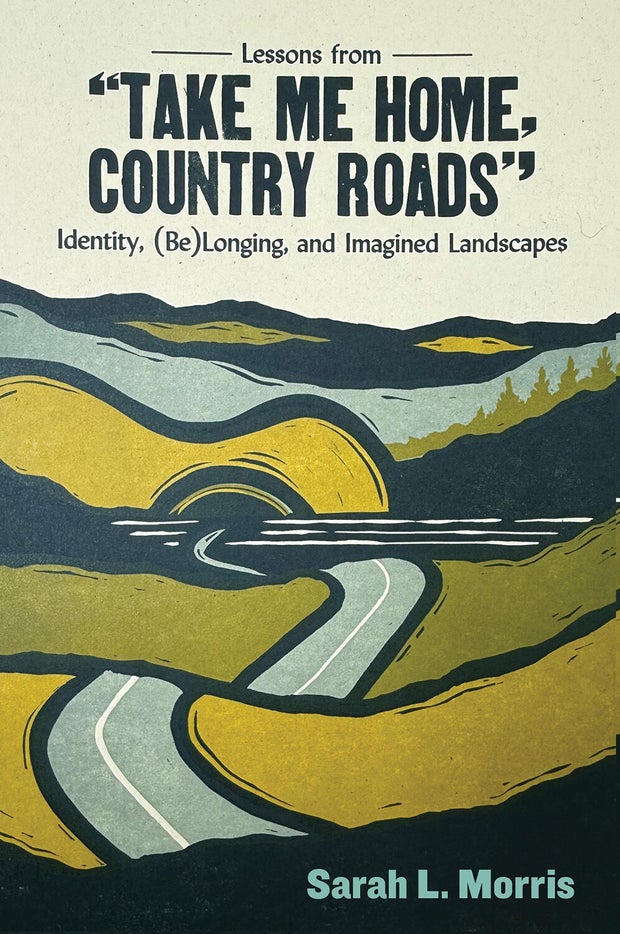
“We can think about the song as being about any place – it names West Virginia, but it doesn’t have to,” said West Virginia University assistant professor Sarah Morris. She has written about the global impact of “Take Me Home, Country Roads.”

“People take the song and re-appropriate it so that it’s about the place that’s home to them,” Morris said.

“So, they just swap in their own geographic references?” Knighton asked.  

“Change the geographic references, change the lyrics, change the location. But it doesn’t really change the song, and it doesn’t change the meaning of the song.”

This Toots and the Maytals version was a hit in Jamaica:

In Hawaii, it’s “West Makaha.”

From France to Brazil, there are countless reinterpretations. The song is hugely popular in Japan. The plot of the anime film “Whisper of the Heart” centers around a teenage girl who translates “Country Roads.”

The feeling of longing, of homesickness, is universal. “It’s the rare song that isn’t just singing about something, it’s causing it,” said country star Brad Paisley. He grew up in Glen Dale, West Virginia. He’s been playing “Country Roads” ever since he learned to play guitar, but the song gained new meaning for him when he left for Nashville.

“I think once you move away, the song takes on way more just character and depth,” Paisley said. “You hear that on the radio and you’re not in West Virginia, like, you hear that in your car and it comes on, and when you hear that iconic acoustic guitar part – ‘driving down the road I get a feeling that I should have been home yesterday.'”
take-me-home-country-roads-cover-west-virginia-university-press.jpg

West Virginia University Press

Morris said, “Leaving and homecoming has always been something that West Virginians have experienced. But we’ve been at a loss in our population since 1950. So, I think it’s a perennial mood for West Virginians.”

Including Knighton.

“I grew up in the capital city of Charleston,” he said. “I learned to ride my bike on country roads. I left the state after high school, but I’m still nostalgic for it. It’s like the song says – ‘All my memories gather round her.'”

Morris said, “One of the things that I’ve been thinking about is a Welsh concept called hiraeth – this deep longing for someplace that you can’t quite name, that’s home but maybe more. It’s maybe a place that you’ve never been, or the home that you’ve only dreamed of. It’s this deep pull toward place.”

Those thousands of fans in stadiums thousands of miles away from the Mountain State, aren’t necessarily singing about West Virginia. They were singing about home. Danoff said, “The place really is immaterial. It’s ‘the place I belong.’ I think that’s the key line. That’s what people are looking for in their lives.”

An earlier version of this story was originally broadcast on December 26, 2021. 

For more info:

      
Story produced by Aria Shavelson. Editors: Remington Korper and George Pozderec. 
Record share of kindergartners missed required vaccines last year as Trump executive order takes aim at state mandates

(CNN) — A record share of kindergartners in the United States had an exemption for a required vaccination last school year, as the Trump administration continues to make moves to reduce the number of vaccinations recommended for children.An executive order signed by President Donald Trump last week aims to reshape the federal government’s approach to vaccines. The order offers recommendations to “give parents more information and options” — but the authority to set and enforce vaccine requirements still lies with states, and a growing share are utilizing existing policies that allow exemptions.The administration signaled that it will push states to rework their vaccine requirements to incorporate the new federal guidelines, effectively upending longstanding practices aimed at improving childhood immunization rates. It’s unclear exactly how officials plan to reinforce this, but the Department of Justice, the Department of Education and the Department of Health and Human Services have been directed to tie compliance with federal funding.The new executive order emphasizes the administration’s aim to “maximize parental choices over vaccinations for their children,” specifically noting that states should “provide religious and medical exemptions” to vaccine requirements.All 50 states have their own laws requiring certain vaccines for students to attend school, and all allow students to be exempted from school vaccine requirements for medical reasons. The vast majority of states also allow vaccine exemptions for non-medical reasons, which may be categorized as religious or personal.Utilization of these exemptions is more common than it’s ever been. Data published Monday by the US Centers for Disease Control and Prevention shows that 4.2% of kindergartners had an exemption for at least one required vaccine during the 2025-26 school year.This left about 157,000 new schoolchildren without full coverage for at least one state-mandated vaccine last school year, CDC data shows – nearly 20,000 more than the year before.The share of students with a vaccine exemption is the highest on record and twice as high as it was a decade ago. Last school year, only 0.2% of exemptions were for medical reasons, a share that has held steady for years.Exemptions increased in all but nine states, and nearly half of states report exemptions exceeding 5%, according to the CDC.According to the National Conference of State Legislatures, only four states do not allow exemptions that are not for medical reasons: California, Connecticut, Maine and New York.New York removed the option for religious exemptions for school vaccines in 2019 after measles outbreaks in the state grew to some of the largest the US had seen in decades.The new CDC data shows that the measles-mumps-rubella (MMR) vaccination rate among kindergartners fell only slightly last school year, from 92.5% to 92.4%, but that’s still well below the 95% coverage needed to provide herd immunity and prevent outbreaks.State authority to set vaccine policy has been challenged before but broadly upheld by the US Supreme Court.States are still reviewing the new executive order, but many – including those that follow federal guidance for vaccine policy and those that have broken from federal recommendations – say that it does not require any changes at the state level.“Federal recommendations do not change the requirements in Texas,” the state health department said in an email to CNN.Others responded to the president’s action with a commitment to science-based vaccine policy.“Vaccines are our most effective defense against vaccine-preventable illnesses,” Dr. Puthiery Va, director of the Maine Center for Disease Control and Prevention, said in a statement. “In Maine, vaccines remain available at no cost to eligible children through the Maine CDC’s Immunization Program. Maine’s school and child care immunization requirements remain unchanged by federal actions to date.”Changes to any state vaccine exemption laws would need to be passed by state legislatures, many of which will not meet again until January.But courts can get involved, too. Mississippi started allowing religious exemptions in 2023 after a federal court order, and a move to allow religious exemptions in West Virginia is facing legal challenges. Before these changes, both states were known to have exceptionally high childhood vaccination coverage under some of the strictest laws.Public health experts say that building trust in the safety and effectiveness of vaccines is key to reversing the decline in childhood immunization rates.“If more and more parents choose not to vaccinate their children for non-medical reasons, we will no doubt see a rise in disease outbreaks,” Dr. William Moss, an associate professor with Johns Hopkins Bloomberg School of Public Health, has said.Measles cases in the US have reached a 35-year-high this year, the vast majority of which are in people who have not been vaccinated with the MMR.But the new executive order advises that the MMR be separated into three individual shots — a dramatic change that goes against broad scientific consensus and a suggestion that could raise doubts.States have typically aligned their policies for vaccine requirements with recommendations from the CDC and its Advisory Committee on Immunization Practices (ACIP). But ACIP has undergone sweeping changes under US Department of Health and Human Services Secretary Robert F. Kennedy Jr., and actions by the federal agency and the advisory board to overhaul the childhood vaccine schedule — including a reduction in the number of diseases covered by routine vaccinations — have led many states to break from this longstanding practice.According to KFF, 28 states have announced that they will no longer follow federal vaccine recommendations. Most have indicated that they will instead follow recommendations from the American Academy of Pediatrics, an independent medical association. “For decades, the U.S. childhood immunization schedule was developed through a rigorous scientific process required by law that evaluates the safety and effectiveness of vaccines and how they should be given to patients. This transparent, expert-led process has helped prevent serious diseases, reduce hospitalizations, and save millions of lives,” the Governors Public Health Alliance said in a statement. The coalition includes more than a dozen governors who represent about a third of the US population.“President Trump’s Executive Order directing changes to longstanding federal vaccine recommendations circumvents that process and defies scientific consensus. It also risks causing confusion and endangering our children,” the alliance said.“Parents should know that vaccines currently available in the United States remain available and that the Executive Order does not change that. Governors and state public health leaders hold the power to continue working with healthcare providers, schools, and local health agencies to ensure that parents have access to trusted information and can make informed decisions regarding the health of their children.”The-CNN-Wire™ & © 2026 Cable News Network, Inc., a Warner Bros. Discovery Company. All rights reserved.
Read Next Story