▶ Watch Video: Europe’s Euclid space telescope launched by SpaceX
The Euclid space telescope has spotted the oldest quasars — the brightest objects in the universe — ever discovered, deepening a cosmic mystery that has been puzzling scientists.
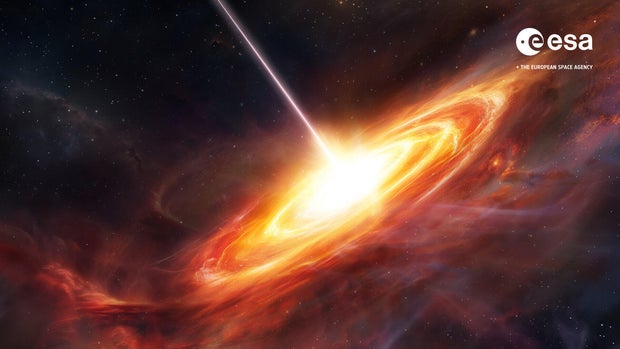
Quasars are powered by supermassive black holes at the heart of early galaxies gobbling up surrounding matter in a colossal feeding frenzy that can shine trillions of times brighter than the sun.
Because they are so incredibly bright — and looking deep into space also means looking back in time — scientists have been hunting for ancient quasars to learn more about the little-understood infancy of the universe.
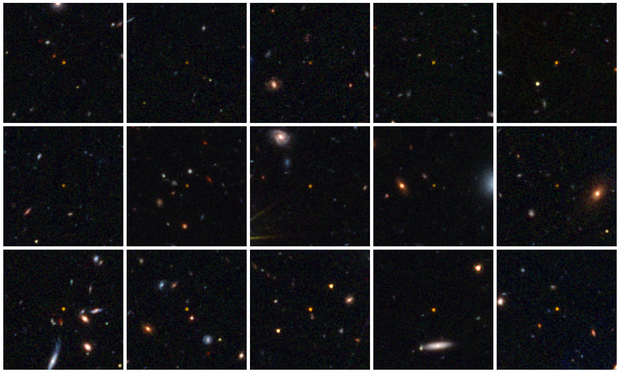
In a study published on Monday, an international team of astronomers announced they had discovered 31 quasars, including the two oldest observed yet, using the European Space Agency’s Euclid telescope, which is at a stable hovering spot around 1.5 million kilometers from Earth.
The light from the oldest pair comes from when the universe was roughly 670 million years old, just five percent of its current age of 13.8 billion years.
This beats the team’s previous record for oldest — and therefore most distant — quasar announced in 2021 by around 20 million years.
European Space Agency
Previous quasar hunts were mostly carried out with ground-based telescopes, but the launch of Euclid in 2023 “has transformed this field,” Daming Yang, the lead author of the study in Astronomy & Astrophysics, told AFP.
In just two years, Euclid has doubled the number of ancient quasars known to science, added Yang, a PhD student at Leiden University in the Netherlands.
“Euclid is a true game-changer,” Yang said in a statement. “Before, we could only find a handful of the very brightest ancient quasars, but Euclid lets us search far more efficiently across huge areas of sky to capture much fainter light. It’s a unique tool for quasar hunting.”
Cosmic quandary
The newly discovered quasars date back to what is known as the epoch of reionization. This when the first stars and galaxies began to form, bringing an end to the cosmic dark ages.
“We can use quasars as a lighthouse to study the gas between us and them, so that we can trace how the universe was reionized through this cosmic history,” Daming Yang said.
The quasars are also the latest example of a problem that has been increasingly baffling scientists.
As more powerful telescopes allow us to see further back in time, galaxies and other cosmic objects have turned out to be far bigger than had been thought possible at such an early age.
“Every step further back in time makes the puzzle more perplexing,” study co-author Joseph Hennawi said in a statement about the newly discovered quasars.
“These monsters — weighing billions of times the mass of our sun — somehow already existed when the universe was in its infancy,” he said. “We don’t yet have a good understanding of how they grew so massive, so fast.”
European Space Agency
Hoping to find an answer, the scientists are searching for even older quasars.
The far-seeing James Webb space telescope also recently observed the newly announced quasars, Daming said, and the team will soon begin sifting through the data it collected.
The team eventually hope to stitch together “a quasar chronicle of the first billion years,” Hennawi said.
Euclid’s cosmic mission
Euclid launched in 2023 on a mission to chart one-third of the sky in the hopes of shedding light on the enduring mysteries of dark matter and dark energy.
Just last month, scientists announced the Euclid telescope had captured the largest and most detailed photo ever taken of our galaxy’s crowded heart, a dazzling image packed with 60 million stars, the European Space Agency said Wednesday.
In 2024, Euclid captured dazzling photos of the cosmos, including an image of a massive cluster of galaxies called Abell 2390. The image of the cluster, which is 2.7 billion light years away from Earth, encompasses more than 50,000 galaxies.
Another jaw-dropping image, captured in 2023, provides a spectacular wide-angle view of the Perseus galaxy cluster, revealing at least 1,000 gravitationally-bound galaxies with another 100,000 or so sprinkled across the more distant background — many of them never before seen.
Launched from Cape Canaveral on July 1, 2023 atop a SpaceX Falcon 9 rocket, the $1.5 billion Euclid is stationed about a million miles from Earth on the far side of the moon’s orbit.
Over the course of its six-year mission, the observatory will image the entire sky around the Milky Way, monitoring galaxies and galaxy clusters dating back 10 billion years.