
Teen Colt Gray pleads guilty to committing mass shooting at his Georgia high school

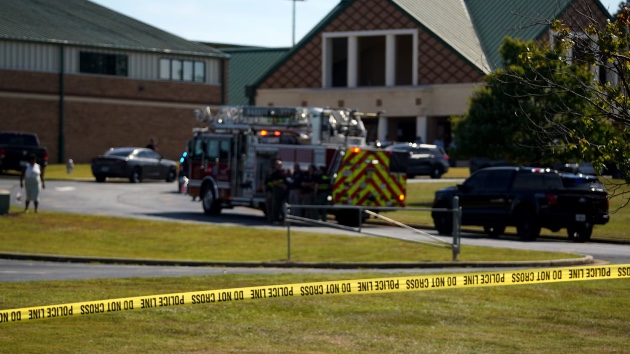
A police line is put up in front of Apalachee High School after a school shooting took place on September 4, 2024 in Winder, Georgia. (Megan Varner/Getty Images)

(WINDER, Ga.) — A teenage boy accused of carrying out a mass shooting at his Georgia high school pleaded guilty Friday to all 55 counts against him, including murder and aggravated assault.

Colt Gray, 16, agreed to a non-negotiated guilty plea, the judge said, meaning there is no plea deal; the state will present its argument for an appropriate sentence, and the defense will do the same.

The judge said the minimum sentence is life with parole and the maximum is a life sentence without parole.

Gray was 14 years old in September 2024 when he opened fire at Apalachee High School, killing two students and two teachers and injuring several others.

Breanna Schermerhorn, whose son, 14-year-old Mason Schermerhorn, was killed, said in a victim impact statement Friday, “Mason was so much more than a victim.”
“Mason was kind, compassionate, funny and fiercely protective of others,” she said. “As a child with exceptional needs, he understood what it felt like to struggle and be overlooked by others. Instead of becoming bitter, he became an advocate.”

“He made people that were typically unseen feel seen, accepted and safe,” she said.

“I had no doubt in my mind if Colt had actually attended school as he should have, that Mason would have befriended him,” Breanna Schermerhorn said.

She said Gray “knew that pulling that trigger was wrong, he knew that every choice he made that day would forever alter countless lives.”

One of Mason Schermerhorn’s sisters, Alanna Schermerhorn Wallace, said through tears that she lost the life she knew and her sense of safety on the day her brother was killed. She said she’s always scanning for exits and monitoring the people around her and is triggered by loud noises and unexpected sounds.

Another sister, Lilianah Ahmed, said through tears, “From a very young age, Mason wanted to be a family man. He wanted to have a wife, kids. He wanted to go to school and pursue a career. … All these different parts of himself he didn’t get to explore because of Colt.”

“My brother died alone and scared. [Gray] was the last person to see Mason alive, and he took him from us,” Ahmed said.

She also called her brother “the success story that Colt could have been.”

Shayna Aspinwall, whose husband, Richard Aspinwall, was killed, described him as a beloved dad, teacher and coach.

“Every holiday, birthday, anniversary and ordinary day is a reminder of what has been stolen from us,” she said. “… Now our daughters, who were 5 and 2 at the time, must grow up without their father. They will miss his guidance, his encouragement, his hugs, and all the milestones he should have been here to witness.”

Shayna Aspinwall asked the judge to not sentence Gray to life with the chance for parole, saying the parole hearings would be “continued torture” for her family.

Ismael Angulo, whose brother, 14-year-old Christian Angulo, was killed, also asked the judge to sentence Gray to life without the possibility of parole, as he described “every day as a nightmare.”

“The defendant’s family will still get to see their son, talk to him and know he is breathing. My mother, my father don’t get that privilege,” he said. “… There is no fairness in that reality. Christian was a beautiful, innocent soul who was robbed of his dreams.”

Gray was accused of carrying out the shooting with a rifle his father, Colin Gray, gifted him as a Christmas present, officials said. This March, Colin Gray was convicted of charges including second-degree murder and manslaughter, becoming the first parent in the U.S. convicted of murder due to the alleged acts of their child.

This is a developing story. Please check back for updates.

Copyright © 2026, ABC Audio. All rights reserved.

Gianni Infantino is in a mire of his own making. With the threat of a European boycott, can he ride out the storm?

(CNN) — Gianni Infantino lives to fight another day – for now.Despite the continued, unprecedented backlash within and outside of FIFA to his ill-conceived and ultimately ill-fated FFE plan, the Swiss – at least on the surface – remains defiant.In any other walk of life, he’d have packed his bags. Soccer governance, though, operates in an alternative reality.Not willing to go of his accord, he clings on to power, emboldened to muddle through the biggest, self-made storm that has engulfed him and his organization in his 10-year tenure.An apologetic statement this week and commitment to not letting history repeat itself has, though, done little to placate the intensifying scrutiny of his leadership.With European soccer’s governing body, UEFA, doubling down on its threat of a boycott of FIFA competitions and battle lines being drawn up across the global footballing landscape, the question still looms: Is Infantino’s latest gambit a stay of execution, an attempted fightback or the start of a prolonged war of attrition?Fragmented landscapePrior to this summer’s World Cup, it was reported that more than 200 of the 211 national associations that make up FIFA had pledged their support to Infantino for his reelection next year.And up until this point the 56-year-old has appeared Teflon.Concerns surrounding his close ties with US President Donald Trump, outrage at exorbitant ticket prices and immigration policies at the World Cup through to still unanswered questions around the overturning of Folarin Balogun’s ban during the tournament all have been largely brushed under the carpet.The fight over the plan to sell off parts of the World Cup and other signature FIFA events to private businesses has tested that bulletproof presidency. And while there’s since been an unrelenting, concerted effort by UEFA to oust Infantino, from a loss of confidence in his leadership to the threat of legal action against him and his associates, there’s not been the united front that had been anticipated when it comes to change.UEFA commands a great deal of power and clout on and off the pitch, but it’s struggling to shake off the perception of this being another attempted European coup.Put simply, it cannot fight this battle alone.Not only does it need global support to maintain its momentum, it too needs to offer a genuine alternative to the status quo.Herein lies the problem.Power strongholdsOutside of Europe, so far only Jordan – one of a handful of countries not to have signed a letter of support for Infantino’s reelection prior to this crisis – has publicly called for Infantino’s resignation.North and Central America and Caribbean governing body CONCACAF and the Asian Football Confederation (AFC) have both criticized the FIFA president and rejected the plan.Yet several countries within both confederations have already publicly pledged their loyalty to Infantino, while some are in no rush to commit either way.In a game of fine margins, which way those nations swing could prove crucial.And it’s not just the splitting of votes within confederations where Infantino is pinning his hopes of preserving his position.Like that of his predecessors, João Havelange and Sepp Blatter, Infantino is seeking to rally his core supporters in his traditional power base of Africa.Less wealthy associations within and outside the confederation have relied heavily on FIFA funds via Infantino’s FIFA Forward program, the precursor to FFE, which was introduced by him in 2016.South America’s CONMEBOL has already said it won’t upset the apple cart as it continues its push for a 64-team World Cup in 2030.Meanwhile, the executive committee of the smallest and least wealthy regional confederation, Oceania (OFC), will meet Wednesday to discuss its approach.Numbers gameAlthough severely weakened, Infantino still has his allies and, as it stands, the belief that he has the requisite votes needed to win March’s presidential election.And, at least for now, despite the threat of revolt, internal pressure within FIFA appears to have abated.While some senior figures have spoken out, others have fallen in line.To date, Carlos Cordeiro, formerly Infantino’s senior advisor, is the only high-profile official to have quit.The ball, therefore, is in UEFA’s court as to what to do next.It has several options at its disposal but which one it takes could prove crucial in determining the trajectory of how this saga unfolds.The problem, though, is none of the routes is easily achievable.Short term it could look to initiate an Extraordinary Congress and by default a no-confidence vote in Infantino.UEFA has the numbers to trigger such an action but there’s no guarantee of success.A forcing of an emergency meeting of the FIFA Council is also an avenue but again getting the necessary support may prove too difficult.All indicators, therefore, point toward a challenger being put up to face Infantino in March’s election – the first time an election would be contested since Infantino himself succeeded the discredited Sepp Blatter in 2016.CONCACAF president Victor Montagliani is widely viewed as the most likely rival if enough votes can be generated.The Canadian, though, is yet to publicly comment on the privatization plan fallout or provide an alternative vision to that presented by Infantino.Candidates have until November 18 to put their names forward for the contest.Nuclear optionThis, though, buys Infantino time to ride out the storm, regroup and rebuild.He could offer a route for reform, open up FIFA’s cash reserves or dangle the carrot of new funding. All options are on the table.The question that could cut through all of this is whether UEFA follows through with its threat of a boycott and non-cooperation, both of which could make FIFA ungovernable for Infantino.Not satisfied by Infantino’s walkback, it is a lever that Europe can pull – albeit a dangerous one at the same time.History hasn’t always looked kindly on such a move.A first major test of UEFA’s will is whether its national teams participate in next month’s U-20 Women’s World Cup in Poland.Six nations, including the host, are set to compete although UEFA is yet to publicly confirm how it intends to navigate this.CNN has approached FIFA and Poland’s FA for comment.Time is of the essence and the hopes and dreams of players in the balance.Beyond the pitch, tetchiness from FIFA’s lucrative sponsors amid the constant negative publicity could also prove telling.For now, though, soccer’s civil war appears to be heading toward an entrenched standoff of ideas and values.And, as ever, it rests on the game’s true custodians – the fans and players – to keep the very soul of the game alive and intact.The-CNN-Wire™ & © 2026 Cable News Network, Inc., a Warner Bros. Discovery Company. All rights reserved.
Read Next Story