
Suspect in deadly Berlin LGBTQ+ parade vehicle crash killed, police say

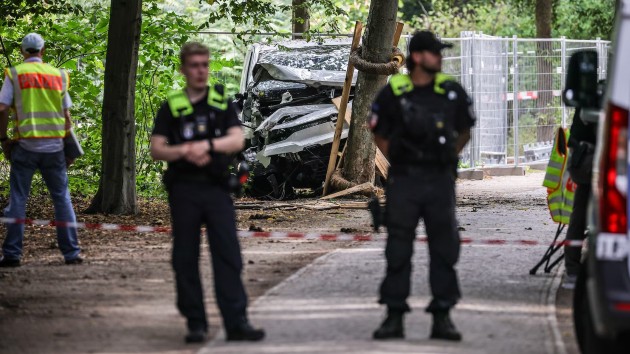
German police stand near a white van that suspect Abdul B. allegedly used in last night’s vehicle crash during the Christopher Street Day Berlin pride parade on July 26, 2026 in Berlin, Germany. (Omer Messinger/Getty Images)

(LONDON) — The man suspected of allegedly driving a vehicle into a crowd during Berlin’s LGBTQ+ celebrations on Saturday, killing one person and injuring several others, has been killed, police said.

“Around 6 p.m., the suspect in yesterday’s attack in the Großer Tiergarten was located in an allotment garden complex in Spandau,” according to a statement from Berlin police.

“According to current information, he reportedly ran toward our officers with a stabbing weapon, prompting our SEK Berlin unit to open fire,” the statement continued. “Despite immediate resuscitation efforts by the Berlin Fire Department, he died at the scene.”

Berlin police earlier Sunday released a photo of the man, whom they identified as Abdul B., using only an initial for his surname, as is common under German privacy law.

“Abdul B. is alleged to have injured several people with a moving vehicle in the Tiergarten area at approximately 10 p.m.,” according to a joint statement released by the Berlin Police and Public Prosecutor’s Office.

“Everything we are seeing here indicates that this was an Islamist terrorist attack,” German Interior Minister Alexander Dobrindt said at a press conference Sunday.

Dobrindt also updated the number of injured from 17 to 29, “including several who sustained serious injuries.”

The suspect rammed into the crowd with a vehicle, Dobrindt said, after which “he then attacked other pedestrians with a bladed weapon, believed to have been a machete, seriously injuring them.”

Dobrindt confirmed earlier police reports that the suspect, whom he described as a “German citizen of Lebanese descent who was born in Germany,” had “an extensive criminal record, showed signs of radicalization, and was associated with the radical Islamist scene.”

“He was previously sentenced in Berlin to one year and ten months in prison. The sentence was commuted to parole, and prosecutors appealed the decision,” Dobrindt said. He did not provide details about why the suspect was sentenced to prison.

“The search for the suspect is currently the top priority,” according to Dobrindt.

Details about potential motives for the attack were not immediately released.

Hundreds of thousands of people had come to Berlin to celebrate Christopher Street Day, one of Europe’s largest LGBTQ+ celebrations, according to the city.

The two-day event was scheduled on Saturday to include a parade, which was to begin in Mitte, in central Berlin, wind its way south into Schöneberg, then turn back northward toward Brandenburg Gate.

The vehicle crashed into the crowd in Tiergarten Park, according to law enforcement, an area along a footpath within the park and near to the parade’s end.

“One or more people are believed to have subsequently fled the vehicle,” police initially said. “Furthermore, several people are reported to have been injured with stabbing weapons.”

Several of those who were injured had life-threatening injuries, the Berlin Police told ABC News.

The suspect was described by police as having a “slim build.” They said he was about 1.9 meters tall, or about 6 feet, 3 inches, with black hair. He was wearing a black hoodie and white pants, police said.

“If you encounter this person, under no circumstances should you approach them or have any direct contact with them,” police said. “They may be armed and dangerous! Immediately contact the police emergency number 110.”

The police on Saturday called off the rest of the celebrations for the night after the incident at the park.

German Chancellor Friedrich Merz on Sunday described the vehicle crash as a “heinous act,” adding that “people from all over the world were peacefully celebrating” during Christopher Street Day.

“They wanted us to treat each other with kindness and tolerance,” he said on social media. “This is an attack on our society.”

ABC News’ Rashid Haddou, Felix Franz, Jamie Dorrington and Ivan Pereira contributed to this report.

Copyright © 2026, ABC Audio. All rights reserved.

South Carolina to hold first 2028 Democratic presidential primary

▶ Watch Video: Democrats expected to approve South Carolina as first primary in 2028, but other states pushing back Democrats on Saturday approved a new presidential nominating calendar for 2028, cementing South Carolina's place as the first official Democratic primary state, as the party looks to elevate states that better reflect its diverse coalition of voters.The vote came during the Democratic National Committee's summer meeting in Austin, where members signed off on a schedule that begins with South Carolina on Jan. 22, followed by Nevada on Feb. 1. New Hampshire, New Mexico, Michigan and Virginia round out the early-state lineup throughout February, all voting before Super Tuesday.The new calendar goes into effect amid a tug-of-war within the progressive and establishment wings of the party. It also continues a shift away from a tradition that for half a century gave states that are predominantly composed of White voters — Iowa and New Hampshire — outsized influence at the start of the nominating process. Strategists say the new calendar gives greater influence to Black and Latino voters, who make up key parts of the Democratic coalition. "If you're not strong with Latino voters or if you're not strong with Black voters, you know you can only get so far in this calendar," CBS News contributor and Democratic strategist Chuck Rocha said, adding that the schedule shows Black voters "the respect that they're due."Not everyone in the party is on board. Democratic leaders in Iowa and New Hampshire — previously the first and second states to hold primary contests, respectively — excoriated the new map as soon as the DNC's Rules and Bylaws Committee recommended it, arguing that it diminishes the role of states that have long taken on the responsibility of shaping the presidential nomination battlefield. "New Hampshire's First in the Nation primary is a tested proving ground in a closely contested swing state that forges better candidates and better presidents — and despite what DNC insiders say, that hasn't changed," New Hampshire's U.S. congressional delegation said in a statement. "As a state with highly engaged voters, we put candidates through their paces and thoroughly vet them. And our small size means that actually meeting and talking to voters takes precedence over super PACs or mega-donor-fueled campaigns."Momentum for South Carolina's ascension in the calendar traces back to 2020, when a victory there shifted momentum in the presidential primary that year to Joe Biden after he performed poorly in Iowa, New Hampshire and, to a lesser extent, Nevada. Under pressure from Biden and his allies, the DNC moved South Carolina's primary to first for the 2024 calendar. That cycle, New Hampshire defied the DNC's revised schedule and held its primary before South Carolina, citing a state law that mandates it hold the first primary. In response, the party stripped the contest of its sanctioned status. DNC Chair Ken Martin has signaled that if New Hampshire jumps ahead again in 2028, punishment will be more severe. "This is a calendar this party is actually going to protect," Martin told reporters after the DNC's Rules and Bylaws Committee met last month to propose a new schedule. The new calendar could impact the ideological battle within the Democratic Party between establishment moderates and more progressive candidates, including far-left democratic socialists. With no obvious 2028 front-runner, the newly approved schedule gives South Carolina, Nevada and the other four early states disproportionate influence over which faction can build early momentum in the 2028 presidential primaries. Among the states granted early slots, only Nevada and New Mexico offer clear advantages to progressives. Michigan has shown openness this cycle to progressives, with the primary victory of Abdul El-Sayed in the Senate race, but historically has elected more moderate candidates. New Hampshire voters have over time shown an openness to outsiders, but they typically have a more independent streak rather than a steep ideological lean. Progressives face an uphill battle in South Carolina, which has fewer of the White voters with college degrees who tend to support further-left candidates, and Virginia, which has long favored more moderate candidates. The decision to elevate states with large Black and Hispanic populations also comes as Democrats fight to stop the GOP from gaining ground with those two groups in general elections. President Trump won 48% of the Hispanic vote in 2024, up 12 points from four years earlier, and he won 15% of Black voters, almost double his share in 2020, according to the Pew Research Center. His share of non-Hispanic White voters remained stable, at 55%.
Read Next Story