Suspect in deadly Berlin LGBTQ+ parade vehicle crash killed, police say

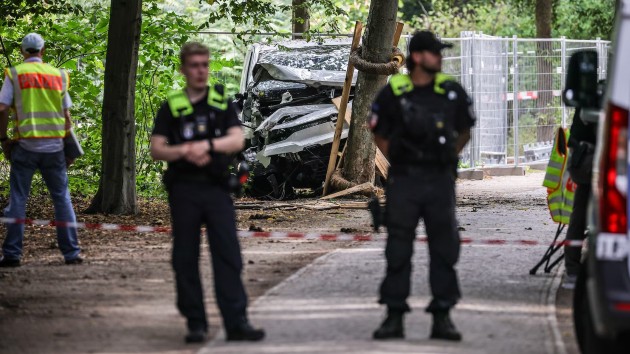
German police stand near a white van that suspect Abdul B. allegedly used in last night’s vehicle crash during the Christopher Street Day Berlin pride parade on July 26, 2026 in Berlin, Germany. (Omer Messinger/Getty Images)

(LONDON) — The man suspected of allegedly driving a vehicle into a crowd during Berlin’s LGBTQ+ celebrations on Saturday, killing one person and injuring several others, has been killed, police said.

“Around 6 p.m., the suspect in yesterday’s attack in the Großer Tiergarten was located in an allotment garden complex in Spandau,” according to a statement from Berlin police.

“According to current information, he reportedly ran toward our officers with a stabbing weapon, prompting our SEK Berlin unit to open fire,” the statement continued. “Despite immediate resuscitation efforts by the Berlin Fire Department, he died at the scene.”

Berlin police earlier Sunday released a photo of the man, whom they identified as Abdul B., using only an initial for his surname, as is common under German privacy law.

“Abdul B. is alleged to have injured several people with a moving vehicle in the Tiergarten area at approximately 10 p.m.,” according to a joint statement released by the Berlin Police and Public Prosecutor’s Office.

“Everything we are seeing here indicates that this was an Islamist terrorist attack,” German Interior Minister Alexander Dobrindt said at a press conference Sunday.

Dobrindt also updated the number of injured from 17 to 29, “including several who sustained serious injuries.”

The suspect rammed into the crowd with a vehicle, Dobrindt said, after which “he then attacked other pedestrians with a bladed weapon, believed to have been a machete, seriously injuring them.”

Dobrindt confirmed earlier police reports that the suspect, whom he described as a “German citizen of Lebanese descent who was born in Germany,” had “an extensive criminal record, showed signs of radicalization, and was associated with the radical Islamist scene.”

“He was previously sentenced in Berlin to one year and ten months in prison. The sentence was commuted to parole, and prosecutors appealed the decision,” Dobrindt said. He did not provide details about why the suspect was sentenced to prison.

“The search for the suspect is currently the top priority,” according to Dobrindt.

Details about potential motives for the attack were not immediately released.

Hundreds of thousands of people had come to Berlin to celebrate Christopher Street Day, one of Europe’s largest LGBTQ+ celebrations, according to the city.

The two-day event was scheduled on Saturday to include a parade, which was to begin in Mitte, in central Berlin, wind its way south into Schöneberg, then turn back northward toward Brandenburg Gate.

The vehicle crashed into the crowd in Tiergarten Park, according to law enforcement, an area along a footpath within the park and near to the parade’s end.

“One or more people are believed to have subsequently fled the vehicle,” police initially said. “Furthermore, several people are reported to have been injured with stabbing weapons.”

Several of those who were injured had life-threatening injuries, the Berlin Police told ABC News.

The suspect was described by police as having a “slim build.” They said he was about 1.9 meters tall, or about 6 feet, 3 inches, with black hair. He was wearing a black hoodie and white pants, police said.

“If you encounter this person, under no circumstances should you approach them or have any direct contact with them,” police said. “They may be armed and dangerous! Immediately contact the police emergency number 110.”

The police on Saturday called off the rest of the celebrations for the night after the incident at the park.

German Chancellor Friedrich Merz on Sunday described the vehicle crash as a “heinous act,” adding that “people from all over the world were peacefully celebrating” during Christopher Street Day.

“They wanted us to treat each other with kindness and tolerance,” he said on social media. “This is an attack on our society.”

ABC News’ Rashid Haddou, Felix Franz, Jamie Dorrington and Ivan Pereira contributed to this report.

Copyright © 2026, ABC Audio. All rights reserved.

A whisper from the rubble led to baby’s rescue after Colombia earthquake

(CNN) — When the deadly 7.4 magnitude earthquake struck Colombia on Monday, Brian Osorio Zuluaga ran out of his office in Cali and rushed home on his motorbike.The sight of a collapsed five-story residential building forced him to stop.“It was a large complex, covering an entire block,” Osorio told CNN.The quake was the strongest to hit Colombia in more than a decade and sent residents and neighbors of the building, La Torres del Limonar, fleeing into the street, “some in sleepwear or pajamas; some crying, others in shock,” Osorio said.He approached the rubble and began shouting into the wreckage for survivors, despite warnings about a possible gas leak.He suddenly asked those around him for silence. A faint sound rose out of the debris — barely a whisper.“Yes, I’m here. I’m with a baby,” a man’s voice replied.Osorio described how he and several others began moving debris with their hands to reach the pair. But a large concrete slab blocked their way.“On the first attempt, we couldn’t lift it,” he said. Then, “we all lifted together — one, two, three, up.”The slab was too heavy to toss aside, and Osorio was worried there could be more people trapped underneath. Some volunteers held it aloft as others cleared a path to the baby.“You can see the baby’s little head there — which, at the time, looked sort of purplish because he couldn’t breathe,” Osorio said. “Once we started removing the rubble, the baby began to… breathe, and his color started to come back.”Video of the remarkable rescue filmed by Osorio shows the tiny infant in a dusty bodysuit being carefully pulled out of the wreckage. A man, his arm bloodied, can be seen lying awkwardly on his side, still half-trapped under a concrete plank.Osorio said he was handed the baby, a boy, and gave him to a police officer, who took him to an ambulance. They then turned their attention to freeing the trapped man.In the rubble, Osorio said he saw clothes, shoes, and a stuffed animal covered in dust. He thought about the people who might still be trapped.“All those thoughts go through your mind,” he said.The bravery of everyone who rushed to help was what saved the lives of both man and baby.“Unity is strength, because no one person alone could have lifted that piece of rubble; it was so large and so heavy,” he said.“It’s better to act than to stand still,” Osorio added. “Every bit helps.”Rescue efforts enter third daySearch and rescue operations entered their third day early on Wednesday, as emergency responders raced to find more survivors after the powerful quake struck western Colombia, killing more than 200 people, according to a CNN count based on reports from officials.The quake struck at the heart of the country’s coffee-growing region and catapulted communities into a state of national disaster as world leaders offered aid and assistance.The European Union has mobilized its satellite service Copernicus and is providing funding to help the response, the bloc’s foreign policy chief Kaja Kallas said.In Cali, a woman was pulled from under a mountain of rubble on Tuesday to cheers as firemen carried her out on a stretcher following a complex, multinational rescue operation.And in Pereira, a CNN team on the ground saw rescue workers and volunteers form a human chain to remove debris and help save those trapped from an apartment building.“There’s folks who have jumped in and you can see they’re wearing everything from athleisure wear to shorts, tennis shoes — they’re not prepared for this,” CNN’s senior national correspondent David Culver said from the site. “We have seen scenes like this scattered throughout Pereira. This is one of the hardest-hit areas.”But in the epicenter of Monday’s earthquake, Chocó, an indigenous leader told CNN that help has yet to reach the area, Colombia’s poorest region.Victor Chamapuro, leader of the Wounaan Indigenous Reserve “Buenavista” in Chocó’s Litoral del San Juan, said “all our houses are on the ground.”“Where are we going to sleep now? We have to be alert now, we’re sleeping outside,” he said.Chamapuro called on authorities to send food and medicine, saying one person in the community was injured.The “Buenavista” reserve can only be reached by boat on a five-hour journey from the port of Buenaventura, on Colombia’s Pacific coast.Video sent by Chamapuro from the reserve shows flattened buildings that appear to be built from timber and corrugated iron sheets. Others are still standing but with varying levels of damage.The earthquake is one of the first major challenges for Colombia’s new far-right President Abelardo de la Espriella, who took office only last week and has promised to strike hard at criminal groups and leftist militants in Colombia.De la Espriella on Tuesday announced economic relief measures for those affected by the quake, and financial support for people who have lost their homes to rent temporary housing.The-CNN-Wire™ & © 2026 Cable News Network, Inc., a Warner Bros. Discovery Company. All rights reserved.
Read Next Story