
Suspect in deadly Berlin LGBTQ+ parade vehicle crash killed, police say

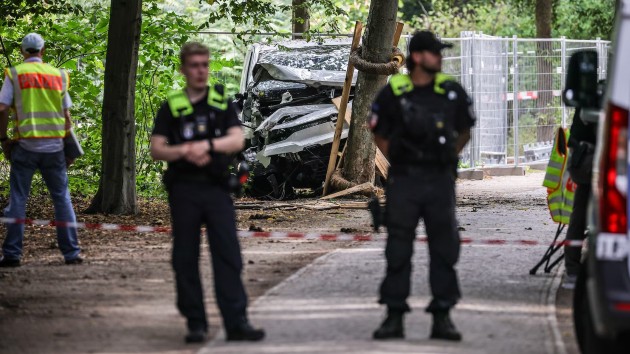
German police stand near a white van that suspect Abdul B. allegedly used in last night’s vehicle crash during the Christopher Street Day Berlin pride parade on July 26, 2026 in Berlin, Germany. (Omer Messinger/Getty Images)

(LONDON) — The man suspected of allegedly driving a vehicle into a crowd during Berlin’s LGBTQ+ celebrations on Saturday, killing one person and injuring several others, has been killed, police said.

“Around 6 p.m., the suspect in yesterday’s attack in the Großer Tiergarten was located in an allotment garden complex in Spandau,” according to a statement from Berlin police.

“According to current information, he reportedly ran toward our officers with a stabbing weapon, prompting our SEK Berlin unit to open fire,” the statement continued. “Despite immediate resuscitation efforts by the Berlin Fire Department, he died at the scene.”

Berlin police earlier Sunday released a photo of the man, whom they identified as Abdul B., using only an initial for his surname, as is common under German privacy law.

“Abdul B. is alleged to have injured several people with a moving vehicle in the Tiergarten area at approximately 10 p.m.,” according to a joint statement released by the Berlin Police and Public Prosecutor’s Office.

“Everything we are seeing here indicates that this was an Islamist terrorist attack,” German Interior Minister Alexander Dobrindt said at a press conference Sunday.

Dobrindt also updated the number of injured from 17 to 29, “including several who sustained serious injuries.”

The suspect rammed into the crowd with a vehicle, Dobrindt said, after which “he then attacked other pedestrians with a bladed weapon, believed to have been a machete, seriously injuring them.”

Dobrindt confirmed earlier police reports that the suspect, whom he described as a “German citizen of Lebanese descent who was born in Germany,” had “an extensive criminal record, showed signs of radicalization, and was associated with the radical Islamist scene.”

“He was previously sentenced in Berlin to one year and ten months in prison. The sentence was commuted to parole, and prosecutors appealed the decision,” Dobrindt said. He did not provide details about why the suspect was sentenced to prison.

“The search for the suspect is currently the top priority,” according to Dobrindt.

Details about potential motives for the attack were not immediately released.

Hundreds of thousands of people had come to Berlin to celebrate Christopher Street Day, one of Europe’s largest LGBTQ+ celebrations, according to the city.

The two-day event was scheduled on Saturday to include a parade, which was to begin in Mitte, in central Berlin, wind its way south into Schöneberg, then turn back northward toward Brandenburg Gate.

The vehicle crashed into the crowd in Tiergarten Park, according to law enforcement, an area along a footpath within the park and near to the parade’s end.

“One or more people are believed to have subsequently fled the vehicle,” police initially said. “Furthermore, several people are reported to have been injured with stabbing weapons.”

Several of those who were injured had life-threatening injuries, the Berlin Police told ABC News.

The suspect was described by police as having a “slim build.” They said he was about 1.9 meters tall, or about 6 feet, 3 inches, with black hair. He was wearing a black hoodie and white pants, police said.

“If you encounter this person, under no circumstances should you approach them or have any direct contact with them,” police said. “They may be armed and dangerous! Immediately contact the police emergency number 110.”

The police on Saturday called off the rest of the celebrations for the night after the incident at the park.

German Chancellor Friedrich Merz on Sunday described the vehicle crash as a “heinous act,” adding that “people from all over the world were peacefully celebrating” during Christopher Street Day.

“They wanted us to treat each other with kindness and tolerance,” he said on social media. “This is an attack on our society.”

ABC News’ Rashid Haddou, Felix Franz, Jamie Dorrington and Ivan Pereira contributed to this report.

Copyright © 2026, ABC Audio. All rights reserved.
Why Karoline Leavitt might be impossible for Trump to replace

(CNN) — Donald Trump hardly needs anyone else to serve as his mouthpiece.The most clamorous president in modern history always gets his message out — in a daily riot of online posts, interviews and rancor with reporters.The departure of a press secretary therefore might seem like a trifle to the messenger in chief. But the exit of Karoline Leavitt, announced Wednesday, represents a significant personal and political loss. The vacuum she’ll leave will emphasize her role as a vital member of the president’s brain trust.But she is far more than a spokesperson. Leavitt understands the Trump id. She’s been a leader in his second-term assault on Washington institutions of accountability — in this case, the Beltway press. Just like the boss, she broke the mold of her position. And with relentless trolling of reporters, she’s exposed the fractures of traditional journalism in the social media age.Leavitt said on social media on Wednesday that since the birth of her second child, a daughter, on May 1, she’d realized she couldn’t be the mom her kids deserve while devoting the “constant time, energy, and attention,” her job requires. Trump, perhaps softening the blow to himself of the departure of a 28-year-old he praised as one of his “most trusted aides” announced that Leavitt will continue to serve as an outside adviser.A Herculean assignmentBeing Trump’s press secretary is no easy ride. The term “message discipline” is an oxymoron in this administration. No one, including himself, knows what the president will say from one minute to the next. He changes policy on a dime, contradicting his top officials and himself.And Trump is a master media manipulator. He’s demonized, flattered and played reporters for decades. He relished the role of 1980s New York tabloid villain as he built his brand as a real estate tycoon and celebrity. He intuits the media’s craving for constantly evolving headlines and uses it as a tool of distraction.Trump’s zeal for conflict, disdain for etiquette and willingness to say outrageous things forged alchemy when his political ascent coincided with the explosion of social media. He used the new technology to inject his volcanic personality into the nation’s political bloodstream, bypassing the traditional media used as a conduit by his predecessors.So maybe he doesn’t even need another press secretary.He’ll struggle to replace Leavitt’s combination of skills. She speaks MAGA more fluently on camera than anyone but the president. Her briefings are less attempts to explain policy or to deliver coded messages to foreign leaders than demonstrations of Trumpian defiance.The president’s supporters dearly love Leavitt. Her blasts at famous reporters recall the rebel yells of Trump’s first campaign. She rarely answers a question straight — preferring to attack the motives or mindsets of reporters thrust into the role of extras in the Trump show.Last month, Leavitt sat by the president’s side at the White House Correspondents’ Association Dinner that was rescheduled after a gunman tried to rush into the annual event in April. That evening, which Trump spent insulting journalists in vicious and personal terms, will now serve as a valedictory metaphor for her tenure.It’s also somehow fitting that Leavitt announced her resignation in the middle of a storm over whether the White House used reporters on Air Force One as a decoy during the president’s secret flight from Turkey during a security scare last month.Grave questions about press freedomsLeavitt’s tenure will be remembered as devastating to the quaint notion that the press has a vital role in holding presidents to account.Her operation took over control of the pool system long administered by the independent correspondents’ association. She decided who got into presidential events and flew on Air Force One. She added streaming services, local conservative radio hosts, and podcasters and MAGA personalities to the permanent press corps.Critics saw an attempt to introduce propagandists who’d go soft on Trump. His supporters cheered what they saw as an overdue dilution of what they regard as the liberal elite media.In one enormous controversy epitomizing the administration’s contempt for regular media, Leavitt — under Trump’s direction — banned the Associated Press from certain White House press events, and an agency reporter was excluded from Air Force One. AP, which has thousands of clients in the US and worldwide, had declined to change its style guide to mirror Trump’s executive order renaming the Gulf of Mexico to the “Gulf of America.”Leavitt’s briefings soon made the “alternative facts” pioneered by Trump’s first-term media team appear tame by comparison. She opened briefings with highly torqued monologues hyperbolically lauding Trump’s achievements. The performances were reminiscent of prime time shows on conservative TV — a world in which she’d surely find a lucrative future once her kids grow up.Tensions develop between every administration and the media. Relations between President George W. Bush’s team and reporters were often brittle. Acrimony between reporters and President Barack Obama’s aides belied conservative notions that journalists were in the tank. And President Joe Biden’s press shop was especially prickly. But Trump has threatened the constitutional role of the press in the republic as never before.Democratic Rep. James Walkinshaw said on CNN’s “The Arena” on Wednesday that he didn’t doubt Leavitt’s sincerity in citing family reasons for her departure. But he added: “It’s a tough job. It’s a job where, to be Donald Trump’s spokesman, you have to willfully deny reality on a daily basis.” The Virginia lawmaker added: “I think her legacy will be one of further degrading the relationship between the White House and the press.”While Leavitt’s briefings are made-for-TV showdowns, she’s often more collegial with media members away from the cameras. She’s usually available to reporters, and her bond of trust with Trump means she’s in the room with the commander in chief at pivotal moments. This privilege is important to journalists and builds credibility for top spokespeople. And there are fears that with Leavitt gone, they will find it even more difficult to report on the decision-making of an erratic and nearly unchecked president.Unless the president picks a replacement who is already deep in his inner circle, Leavitt’s successor may lack the authenticity that made her an authoritative voice for the administration. Most White Houses groom one or more deputy press secretaries for the top job, which typically grinds down incumbents within a few years. The lack of a visible succession plan for Leavitt will fuel speculation that Trump may just take on the entire task himself.Leavitt will always be a heroine to Trump’s base. And her influence may outlast the second Trump administration, since West Wing teams often build on the techniques of those who came before. A future president, Democratic or Republican, might balk at voluntarily handing back power to the press.In his second term, Trump often looks like he’s wielding power to ensure nothing can ever be the same again.He had a loyal and effective partner in Leavitt.The-CNN-Wire™ & © 2026 Cable News Network, Inc., a Warner Bros. Discovery Company. All rights reserved.
Read Next Story