SpaceX’s Super Heavy-Starship blasts off on 13th test flight

▶ Watch Video: SpaceX launches 13th flight test of Starship rocket

SpaceX launched its 13th Super Heavy-Starship rocket Friday, with the giant booster chalking up an on-target but “hard” splashdown off the Texas Gulf Coast due to engine issues while the Starship upper stage carried out a successful suborbital hop to the Indian Ocean. 

Powered by 33 methane-fueled Raptor engines, the 397-foot-tall two-stage rocket blasted off from SpaceX’s Starbase, Texas, launch site at 5:51 p.m. ET, putting on a spectacular show for area residents and tourists as it climbed away atop some 16 million pounds of thrust. 
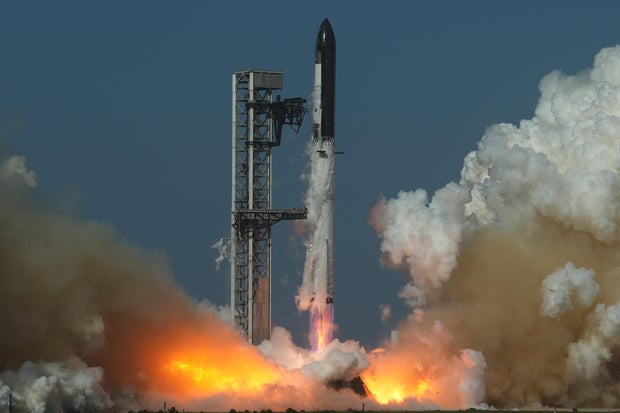
SpaceX Starship Launch
SpaceX’s mega rocket Starship lifts off for a test flight from Starbase, Texas, Friday, July 24, 2026. 

Eric Gay / AP Photo

A launch attempt July 16 ended with a last-second computer-commanded abort when four Raptors failed to start properly. After an analysis of telemetry, six engines were replaced and the launch was reset for Thursday, only to have low clouds prompt a 24-hour delay.

But the weather cooperated Friday, all 33 first-stage engines fired up normally, and the rocket thundered away through a mostly clear sky.
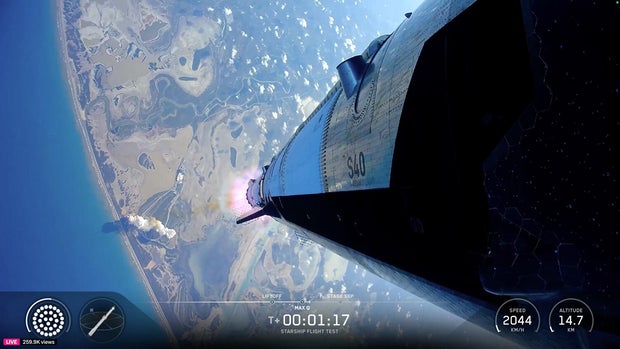
072426-1minute17.jpg
A spectacular view looking down the side of the Super Heavy-Starship a little more than 1 minute after liftoff from SpaceX’s Starbase facility on the Texas coast.

SpaceX

It was the second test flight of a third-generation Super Heavy-Starship, building on lessons learned during the initial flight of a “V3” rocket in May when the booster missed its landing target, and the Starship suffered an early engine shutdown on the way to space.

This time around, the booster performed as planned throughout its ascent and again during a flip to line up for a “boostback” burn to reverse course and head back toward the coast.

But the boostback burn ended early, SpaceX later said. Then, as the booster dropped toward the Gulf, only 10 of 13 engines restarted to slow the rocket down for splashdown. Only five engines appeared to be running when the booster hit the water at a higher speed than expected.

The booster is designed to fly itself back to its launch gantry where huge mechanical arms, known as “chopsticks,” can pluck it out of midair. But that requires a relatively slow final descent. For good reason, it now appears, SpaceX opted for initial version-3 splashdowns in the Gulf as a safety precaution.
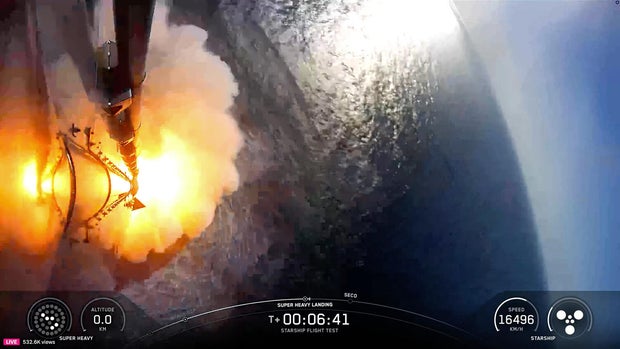
072426-splash.jpg
A camera on the first-stage booster captured the moment of splashdown in the Gulf.

SpaceX

The Starship upper stage, meanwhile, continued its climb to space with all six of its Raptor engines operating smoothly.

Once coasting along its suborbital trajectory, the Starship deployed 20 third-generation Starlink internet satellites in a real-world test of the rocket’s Pez-like payload dispenser, releasing the satellites one at a time from a slot near the nose of the vehicle.

Six of those satellites were equipped with cameras to inspect the Starship’s heat shield tiles and general condition to help engineers assess the usefulness of such video for determining the health of future Starships before reentry.

In a final test, the Starship briefly reignited one of the Raptor engines to demonstrate its ability to restart in space, which will be required for future flights to the moon.

The spacecraft then faced the blazing heat of a belly-first reentry before flipping upright and settling to a dramatic rocket-powered splashdown northwest of Australia 1 hour and 5 minutes after launch.

The Starlinks, on the same suborbital trajectory as the Starship, were expected to fall back into the atmosphere and burn up — or as SpaceX puts it, “demise” — before reaching the sea.
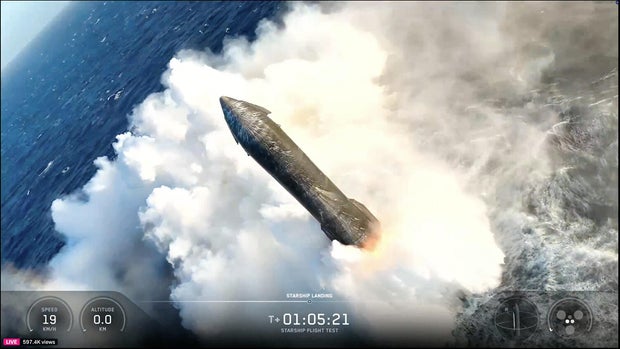
072426-splash2.jpg
A SpaceX drone captured a dramatic view of the Starship settling to a gentle splashdown in the Indian Ocean an hour and 5 minutes after launch from Texas.

SpaceX

Engine issues aside, the Starship’s performance was welcome news to NASA, which is counting on a variant of the upper stage to serve as a lunar lander for astronauts in the agency’s Artemis program.

For moon missions, SpaceX will need to launch up to 15 or so Super Heavy-Starship tankers to refuel the lander before it can head for the moon to await the arrival of astronauts in a Lockheed Martin-built Orion capsule.

From there, the 165-foot-tall lander will carry two crew members down to the surface, landing vertically near the moon’s south pole. The astronauts will then ride an external elevator down to the surface and back up again when their exploration is complete.
072426-splash3.jpg
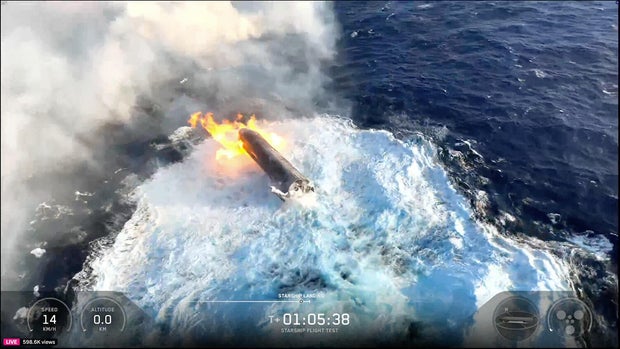
For the first time, the Starship remained fully intact after splashdown, floating serenely on the surface of the Indian Ocean with many of its onboard cameras still working. 

SpaceX

With the first such landing targeted for 2028, SpaceX must ramp up its Super Heavy-Starship test schedule to get the vehicle certified for human spaceflight and to demonstrate the reliability required to safely launch more than a dozen tankers within days of the lander’s launch.

As of now, the moon lander variant has not yet flown, and no Starship of any kind has yet been put into Earth orbit. Many NASA veterans have criticized the complexity of the mission architecture and the number of flights that will be needed to get a single lander to the moon.

The Government Accountability Office said in a report released Thursday that SpaceX faces major challenges getting the Super Heavy-Starship ready for operational use.

“SpaceX’s progress in developing its cryogenic fuel management technologies is a top risk for the program,” the GAO said. “At present, SpaceX’s plan for (moon missions) requires on-orbit propellant transfer between multiple Starship vehicles in low-Earth orbit before the HLS (Human Landing System) Starship can be sent to and dock with the Orion spacecraft in lunar orbit.”
031026-lander-comparison.jpg
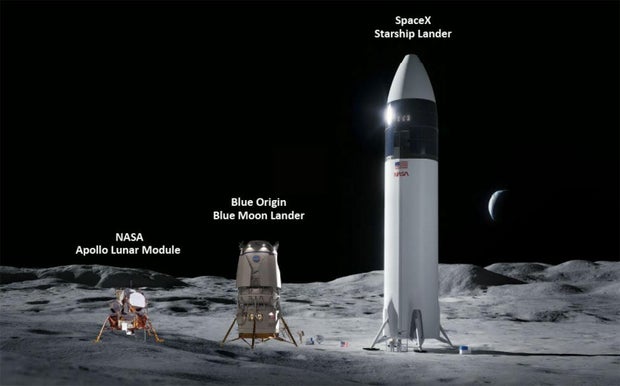
A NASA graphic shows SpaceX’s Starship moon lander in comparison with competitor Blue Origin’s Blue Moon lander and the Apollo program’s long-retired Lunar Excursion Module, or LEM, used to carry six two-man crews to the moon’s surface between 1969 and 1972.

NASA

Another concern is completing development of the upgraded Raptor engines, the GAO said, “addressing issues identified through testing.”

“Furthermore, SpaceX is more than a year behind its original schedule for key events,” the GAO said. “These include the critical design review, the long duration and propellant transfer demonstrations and the uncrewed lunar landing flight test.”

The agency said moon lander officials “also stated that they anticipate encountering technical challenges in the development of the third version of the Starship vehicle, which SpaceX plans to use for the first Starship orbital test flights.”

NASA managers are hedging their bets.

Blue Origin, owned by Amazon founder Jeff Bezos, is also working on moon landers for NASA to carry both cargo and Artemis astronauts to the lunar surface. The spacecraft will be launched by the company’s New Glenn rocket. That lander, too, will require refueling in space.

If the Starship lander isn’t ready in time to meet NASA’s landing target, the agency may be able to use Blue Origin’s lander instead.

But during preparations to test-fire the main engines of the third New Glenn rocket, the launcher exploded in a spectacular fireball, virtually vaporizing the rocket and seriously damaging its pad. The company hopes to resume test flights by the year’s end, but few details have been provided. 

In the meantime, NASA is pressing ahead with preparations for an interim Artemis flight next year in low-Earth orbit. Four astronauts will be launched in an Orion capsule to test the rendezvous and docking procedures that will be needed in lunar orbit for a moon landing mission.

The crew will dock with a Blue Origin lander, open hatches and float inside as part of the test flight. They then will rendezvous and dock with a Starship. But in that case, a modified production model will be used instead of an actual moon lander. It will have no crew accommodations and the astronauts will not go inside.


Julián Álvarez fue silbado y se fue sin saludar a la afición: ¿qué sigue en la novela del argentino?

No fue un domingo cualquiera para Julián Álvarez. En realidad, no lo ha sido ningún día desde aquella frase que pronunció durante la Copa del Mundo: “lo mejor para todos es una transferencia”, cuando se hablaba de un fuerte interés del FC Barcelona por contratarlo. El fichaje no se hizo —porque el Atlético de Madrid no quiso negociar— y aquellas siete palabras, pronunciadas a un océano de distancia de España, le ganaron la enemistad de toda la afición del Atlético de Madrid, el club que pagó por él más de US$ 87 millones hace dos temporadas.La afición le hizo pagar esas palabras este domingo, en la primera vez que el delantero argentino pisó el estadio Metropolitano, cuando ingresó en el segundo tiempo de un partido que el Colchonero empataba 1-1. Pero ni la urgencia del resultado ni la necesidad por los goles de Álvarez —acaso su mejor centroatacante— para revertirlo le hicieron olvidar a las gradas rojiblancas las palabras del número 9, que recibió una silbatina generalizada al momento de ingresar al campo (ya había sido reprobado por el estadio durante el calentamiento).Álvarez no tuvo un buen ingreso y, aunque su equipo acabó rescatando un empate con 10 jugadores cerca del final, el goleador argentino se llevó la imagen final, sin participar del tradicional saludo que hace el Atlético, dando la vuelta al campo para agradecer a la afición. El delantero se fue a los vestuarios en soledad. Un gesto que, como dice el dicho, vale más que mil palabras.“Me comentaba la gente del club, que el club decidió que él no se acerque a saludar con sus compañeros a la gente. La decisión no fue de Julián Alvarez, fue del club, que tomó la decisión de alejarlo y separarlo para que se vaya hacia el vestuario”, dijo su director técnico, Diego Simeone, tras el juego.Queda exactamente una semana del mercado de fichajes en Europa, por lo que la presencia de Julián Álvarez en el Atlético de Madrid sigue estando en el aire para el resto de la temporada. El problema es que la reacción de la afición este domingo parece mostrar un punto de no retorno en la relación con el futbolista, que tampoco ha salido a expresar una disculpa o una explicación a sus dichos durante el Mundial.Un problema aún mayor es que, pese al deseo de ser transferido que tiene el jugador, el club no tiene ninguna intención de desprenderse de él y, conforme van pasando los días, el mercado se va achicando, porque al conocer las altas demandas de la directiva del Colchonero, los interesados salen a buscar alternativas, apurados por la fecha límite del 1 de septiembre.Por supuesto, el Atleti, a medida que pasan las horas, tiene cada vez menos deseos de abrirle la puerta de salida, porque se quedaría con muy poco tiempo para salir a buscarle un reemplazo al futbolista estrella que tiene la plantilla. Hallar un sustituto para el jugador que marcó 49 goles y dio 17 asistencias en 107 partidos con el club supondría muchos millones arriba de la mesa, posiblemente teniendo que pagar un valor más alto que de lo que dicta el mercado.Los destinos para Julián Álvarez son muy pocos. El Atleti ya dejó claro que no va a negociar con clubes españoles, porque no quiere reforzar a la competencia. Fuera de España, solo se conoció el interés del Arsenal y uno más pequeño del PSG. Ninguno prosperó, en parte por el deseo del jugador de vestirse de blaugrana.Los Gunners, campeones de la Premier League y subcampeones de la Champions League, podrían hacer el intento, a pesar de que en el ataque ya tienen muchas alternativas. Por eso se había barajado la idea de que los londinenses pusieran dinero y algún futbolista —como Viktor Gyökeres, por ejemplo— en la mesa de negociación, algo que le cerraría a la directiva española, ya que el jugador se iría a otra liga y tendría garantizado un nombre de reemplazo. Sin embargo, si la idea no prosperó es porque o no hubo acuerdo por el monto de dinero, o porque el futbolista no tiene grandes deseos de volver a una liga de la cual ya se fue —jugó en el Manchester City de 2022 a 2024—.La posibilidad de los parisinos se mencionó mucho al comienzo del mercado de fichajes, pero fue perdiendo fuerza con el correr de los días. Mucho más desde que los bicampeones de Europa se hicieron con los servicios de Ferran Torres, el héroe de la final del Mundial 2026, que ya empezó a pagar la confianza de Luis Enrique con goles, marcando un doblete en su presentación, también este domingo.Entonces, el futuro de Julián Álvarez parece estar entre tres destinos: quedarse en el Atlético, ya sea para revertir la situación o para esperar la ventana de transferencias de enero; reflotar la idea de volver a la Premier League, pero con la camiseta del Arsenal —un equipo que quizás tampoco seduce tanto por el estilo de juego que tienen los dirigidos por Arteta—; o que el FC Barcelona finalmente abra la chequera y ponga muchísimos millones arriba de la mesa, 500 millones de euros, para ser exactos, que es su cláusula de recisión. Una cifra jamás pagada por un futbolista, y por mucha diferencia.“Primero, juntos siempre somos más fuertes. Eso siempre nos caracterizó siendo el Atlético de Madrid distinto al resto. Julián es un jugador nuestro”, dijo Giuliano Simeone —autor del empate 2-2— a la prensa tras el partido.“Tenemos que estar todos juntos tirando para el mismo lado, porque, si no, nos vamos a dividir y eso no es bueno. Julián es jugador nuestro y vamos a apoyarlo siempre”, agregó el mediocampista.Su padre, el entrenador del equipo, también defendió a Julián Álvarez, pero con un poco más de cautela.“No estoy para dar consejos. Tengo que centrarme en mi trabajo, que es deportivamente hacer lo mejor para el Atlético de Madrid. Si el Atlético de Madrid quiere ganar algún título necesitamos estar juntos, tener delanteros importantes y para eso necesitamos trabajar en consecuencia todos de lo que necesitamos”, dijo en la rueda de prensa.“Creo que fui bastante claro. Necesitamos estar juntos. Cuando estuvimos juntos siempre hemos podido hacer cosas importantes”.The-CNN-Wire™ & © 2026 Cable News Network, Inc., a Warner Bros. Discovery Company. All rights reserved.
Read Next Story