
SpaceX joins the Nasdaq 100, clearing way for potential investment influx. Here’s what to know

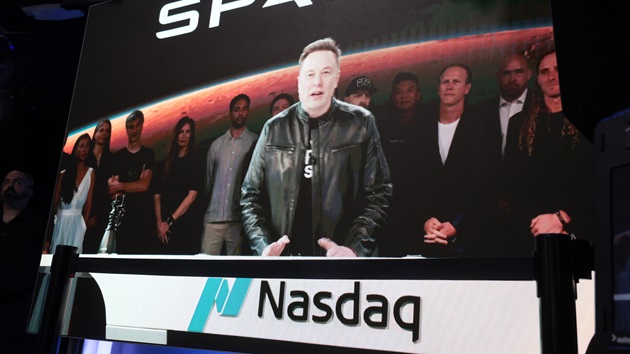
SpaceX founder and CEO Elon Musk speaks via video at the Nasdaq Marketsite in Times Square during the launch of the SpaceX initial public offering (IPO) on the Nasdaq on June 12, 2026, in New York City. (Spencer Platt/Getty Images)

(NEW YORK) — Elon Musk-led rocket and AI company SpaceX joined the Nasdaq 100 on Tuesday, clearing the way for a potential influx of investment as funds pegged to the major index were expected to add the firm.

SpaceX will all but certainly become a part of many individuals’ 401(k) accounts soon. Those accounts often hold index funds, which track indexes like the Nasdaq 100.

Until recently, newly listed companies were barred from major indexes until after an extended waiting period. But the Nasdaq issued a rule change in May permitting “fast entry” to the Nasdaq-100 for some major IPOs. Over the ensuing weeks, some other top exchanges also tweaked their rules.

Entry into the index marked the latest development for SpaceX after a roller coaster in the company’s shares following an initial public offering (IPO) last month. The stock price soared roughly 50% in the initial three days after the public listing on June 12, before shedding just about all of those gains within days.

SpaceX shares dropped nearly 6% in early trading on Tuesday, putting the price at about $151. The SpaceX IPO, the largest ever, opened trading last month at $150 per share.

The IPO made Musk the first trillionaire, vaulting the world’s richest person further ahead of other financial titans. After SpaceX shares tumbled on Tuesday, Musk’s net worth fell to $973 billion, according to Forbes. The second-wealthiest person alive, Google founder Larry Page, holds a net worth of $303 billion, Forbes said.

The IPO pulls in fresh funds for the Texas-based firm, which oversees Musk’s ambitions in the fast-growing but cost-intensive AI industry. The company aims to raise as much as $75 billion from its public listing.

SpaceX builds and operates spacecraft, including thousands of satellites deployed in support of its Starlink satellite internet service. In February, the company merged with xAI, a Musk-led AI company that offers a chatbot in competition with the likes of OpenAI’s ChatGPT and Anthropic’s Claude.

The company’s revenue jumped to $18.7 billion in 2025, soaring 33% compared to the previous year, a financial filing showed. Nearly a quarter of that revenue came from Starlink, which counted millions of subscribers. Still, SpaceX failed to turn a profit, registering a loss of $4.9 billion last year.

Copyright © 2026, ABC Audio. All rights reserved.

JD Vance and the Trump team keep moving the goalposts on Iran

(CNN) — One of the Trump administration’s biggest problems in extracting itself from the Iran war is the list of very absolutist goals that President Donald Trump and his team laid out.The goals have included complete Iranian surrender, regime change, Iran never getting a nuclear weapon and ending Tehran’s support for its Middle East proxy groups like Hezbollah.As the war — now in its sixth month — has dragged on, this list of goals has conspicuously shifted and been pared back. And Vice President JD Vance appears to have pared it back recently in a remarkable way, offering the latest indication that the administration might be preparing to settle for less — maybe even a lot less.Appearing on Fox News on Thursday, Vance was asked how the war might end. And he laid out two goals.“It’s ensuring that the Gulf countries continue to send oil and gas to the world economy so that we have energy price stability,” he said, adding: “That’s goal number one: Keep oil and gas cheap for Americans all over our country.“And then, obviously, goal number two is ensure that Iran never gets a nuclear weapon.”This is not the administration’s old list of goals — and the order Vance placed them in is striking.When asked about Vance’s comments on Friday, White House press secretary Karoline Leavitt maintained that “both goals are equally as important to the president.”The administration has almost always characterized Iran never getting a nuclear weapon as the overriding concern.And even if the goals are truly equal in the administration’s mind, including oil and gas prices at all — and not other items — is a notable shift.In fact, Trump explicitly rejected this as a goal back in May. When asked if he considered Americans’ financial situation when trying to resolve the war, Trump responded, “Not even a little bit.” He signaled that denuclearization was so important that he didn’t factor in anything else.(Trump echoed that line on Friday, saying he would “never apologize” for Americans paying a little more for gas, given the stakes in Iran.)I wrote in March about how the administration frequently listed four goals for the war — but how the four goals frequently differed depending upon who was speaking.Some lists included ending funding for proxy groups, for example, while others did not. Some mentioned destroying Iran’s missile infrastructure, while others omitted that. Some mentioned getting rid of Iran’s air force and navy, but others only mentioned the navy.It was like the administration was workshopping the list in real time.But the key point here is that none of those lists included keeping oil and gas prices low in the United States.And given the Strait of Hormuz was open before the war started, that particular goal could just be read as a return to the pre-war status quo — with denuclearization being the only goal that would represent a new achievement.Indeed, the new emphasis on low gas prices from some in the administration seems like the latest sign of relaxing the goals to prepare for a conclusion to the war that comes up well shy of Trump’s initial aims.By May, it became clear the administration was no longer going to emphasize certain goals.By June, the Trump administration entered into a memorandum of understanding with Iran that barely mentioned previously central US goals.And for the last two-plus months, Trump has been saying things that sounded a lot like he might scale back his nuclear demands.While the administration previously emphasized Iran turning over its enriched uranium, Trump’s spoken about how perhaps enough damage was done to its nuclear program and its nuclear materials are buried too far underground to be accessed. The president has also talked about how the US government could simply monitor from space to make sure Iran didn’t try to retrieve them.He’s even claimed that Iran was already denuclearized.In other words, Trump sounded a lot like a guy who knew he might not be able to cow Iran into accepting a really restrictive nuclear deal.His administration talking about energy prices as “goal number one” — even if Trump isn’t — would fit neatly with this progression away from the hard-and-fast goals that the administration set out to achieve.If a return to the pre-war status quo really is “goal number one” right now, that says a lot about how little this war has accomplished.The-CNN-Wire™ & © 2026 Cable News Network, Inc., a Warner Bros. Discovery Company. All rights reserved.
Read Next Story