
Sons say they learned father was killed by ICE through video, news reports

▶ Watch Video: Extended interview: Sons of Lorenzo Salgado Araujo, man killed by ICE in Houston, speak out

Houston – Ronaldo Salgado said he learned his father, 52-year-old Mexican immigrant Lorenzo Salgado Araujo, had been shot by an Immigration and Customs Enforcement officer last week through a video posted online that depicted him “screaming” for help.

“He was actively bleeding. He was screaming for someone to help him,” Ronaldo Salgado told CBS News during an interview in Houston this week. “I just felt a lot of fear at that point. And I was running around the site trying to look for answers but those answers never came.”

His younger brother, Lorenzo Salgado Jr., said he found out his father had died while on an airplane on the way to Houston to try to see him.

“Maybe an hour into the flight, I opened the same article that reported that the person had been shot,” Lorenzo Jr. recounted. Then, he added, “the article updated to read, ‘shot, killed.'” 

“I was going back and forth between the bathroom to like clear my nose,” Lorenzo Salgado Jr. said. “And I really tried to stop the tears from falling because I didn’t want anyone’s attention. I really just wanted to get home and be with my family.”

Lorenzo Salgado Jr. noted he was not able to say goodbye to his father, who had lived in the U.S. for over three decades.

Ronaldo Salgado, meanwhile, said he feels deeply guilty about what unfolded last week.

“I’m always going to feel some sort of guilt that I could have been there sooner, that I could have done something,” he said, breaking down in tears. “I fear that I will always live with that guilt, because who knows what would’ve happened if I had been there or if I had arrived at the scene much sooner.”

Conflicting accounts 

The Department of Homeland Security said Salgado Araujo weaponized his work van during a traffic stop on July 7 in Houston, prompting an ICE agent to shoot and kill him. That allegation has been disputed by Salgado Araujo’s family and the three men who were in the van, including his brother. They remain detained by ICE in Texas, facing deportation.

While DHS has said Salgado Araujo was in the U.S. illegally, it has also admitted he was not the target of the ICE operation that preceded his killing. Salgado Araujo’s relatives and friends have also said he lacked a criminal record, which has not been disputed by DHS.

Federal officials at DHS and the Justice Department are investigating the fatal shooting, though an FBI probe is reviewing a potential assault on a federal agent. The Harris County District Attorney and the Texas Rangers have also announced separate investigations into the killing. 

Harris County District Attorney Sean Teare told CBS News he’s “more than prepared” to file charges against ICE agents if he finds criminal wrongdoing on their part. He has sharply criticized ICE’s tactics, arguing that “either these agents are completely untrained, or [they are] intentionally putting themselves in situations where they can justify firing into cars.”
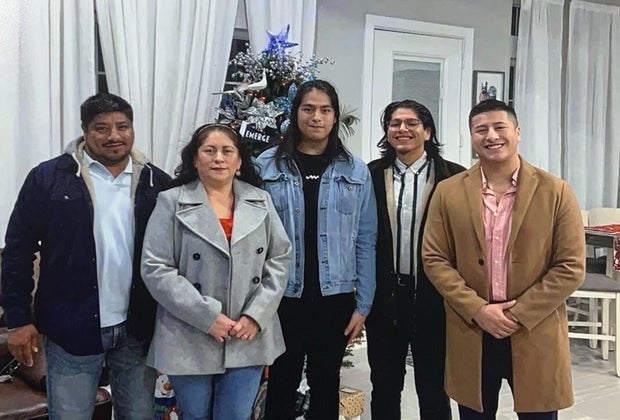
salgado-family-photo.jpg
Lorenzo Salgado Araujo, on the far left, is pictured with members of his family.

Ronaldo Salgado

On Tuesday, the FBI revealed in court papers that it was investigating whether drugs were in the van. In an application for a search warrant granted by a judge, an FBI agent said he spotted several bags inside the van that contained a “white crystal-like substance” he believes is consistent with methamphetamine. At the time, the agent said that law enforcement had not yet entered the van, but had taken photos of the bags from outside the vehicle. The FBI agent wrote: “The United States is currently gathering all facts related to this incident, including what may have caused the occupants of the vehicle to flee.”

But Teare told CBS News Thursday that the allegation by federal officials that the van contained drugs is “inconsistent” with information he’s received.

“Based on what we’ve learned about the passengers, it’s inconsistent that drugs were in the van,” he said. 

There is no indication that ICE’s decision to pursue the Ford Transit van ahead of the fatal shooting was related to concerns about drugs. 

Less than a week after Salgado Araujo was killed, an ICE officer fatally shot another immigrant in Maine, also during a traffic stop. The killing of 25-year-old Colombian immigrant Johan Sebastián Durán Guerrero escalated concerns over ICE’s tactics, prompting the agency on Tuesday to pause most vehicle stops, pending a review.

But that pause was short-lived. On Wednesday, after President Trump publicly criticized the moratorium, ICE agents were told they could continue to make vehicle stops and arrests.

“Drawn by the promise” of America

Ronaldo Salgado said his father came from “humble beginnings” in Mexico and immigrated to the U.S. to ensure his family, including his children, did not have to deal with the same challenges and backbreaking work he faced.

“He wanted people to achieve the American dream, just like he gave us the opportunity to achieve the American dream, to become college educated, to become family men, men of good character,” Ronaldo Salgado said.

Lorenzo Salgado Jr. said his father was a man who was proud of his family, loved music and valued “honest work.”

“He was drawn by the promise that in America you can, if you put in the work, you’ll get paid what you deserve, and the idea that in America, you can build yourself up from nothing to become someone, and to give your family a better future,” he added.

Both brothers are American citizens. Since their father was killed, they have been helped and represented by the American Civil Liberties Union of Texas and the League of United Latin American Citizens.

Asked what justice would look like for them as it relates to their father’s killing, Lorenzo Salgado Jr. called it a “difficult question.”

“I think we’ll have justice when my mom feels ready to go outside, without fear,” he said. “When people don’t have to live in shadows, and of course, the first step there, like my brother said, is completing an investigation completely transparent and in full.”

Trump’s Patriot Games are billed as a youth sports contest. They’re also a test of patriotic branding

(CNN) — The premise sounds almost fictional: one boy and one girl from every state, territory and some tribal nations, flown to a private campus in Ohio to compete in a televised athletic contest called the Patriot Games — a Trump-backed youth competition with obstacle courses, patriotic testimonials and inevitable comparisons to The Hunger Games.Except unlike the dystopian book and movie franchise where kids are pitted in a televised battle of survival, the stakes in the Patriot Games won’t be life and death. The male and female winners will each receive $125,000 in college scholarship money.For 16-year-old Tylee Herrmann, the pitch was simple. In her video application, she gave her age, her school in Arizona and her reason for wanting to compete: she wanted to help “bring patriotism back to the US.”“I feel like a lot of times right now, we feel disunified,” Herrmann, the Cherokee Nation representative, said in an interview with CNN. “I think we need something to bring us all together, because we’re the United States of America, and we need to be a little more united.”However, Herrmann says she’s already experiencing how controversial the Patriot Games can be.“There’s definitely been a number of people that just stopped talking to me,” said Herrmann, referring to her decision to compete in the games.“I have a significant number of people that I know say that they hate the country because they hate the government,” Herrmann said, adding that “patriotism doesn’t belong to a political party.”Hear more from the contestants on the latest episode of CNN’s ‘One Thing’ podcast.Streaming live over the weekend on ESPN with a primetime special airing on ABC Aug. 13, the Patriot Games are the latest example of the Trump administration elevating the politics of athleticism and toughness in celebration of America’s 250th birthday.They come amid a long summer of spectacles put on by Freedom 250, the President Donald Trump-backed group that organized the UFC fight night on the White House lawn featuring a military flyover, plus the Great American State Fair on the National Mall and the immense July 4th fireworks display in Washington, DC.Last year, Trump vowed that the games would feature “the greatest high school athletes.” However, the event appears to be shaping up to be more of a highly produced display of youth patriotism than athletic excellence.CNN interviewed five Patriot Games competitors and reviewed numerous application videos posted online to YouTube and other platforms that showed students showing off skills such as backflips and parkour training.Yet, athletic ability wasn’t the sole factor considered for participation in the competition, and those selected appear to have largely similar backgrounds. Contestants were asked to film a video answering a series of prompts about why they wanted to compete and to explain how sports have shaped their identity. They were also asked to list places outside their home state where they had a “meaningful personal, family, cultural, military, or community connection,” according to the application.Applicants were required to list their biological sex. When announcing the games last year, Trump pledged that at the games, “there will be no men playing in women’s sports.”Contestants ages 14 to 17 include children of active-duty military and JROTC participants, as well as homeschooled students. Of the kids featured in the Freedom 250 Instagram page, many attend private Christian schools. They also appear to be overwhelmingly White; the application for the Games did not ask to specify race.Some students were chosen to represent states where they don’t reside. The pick for Puerto Rico is a young man from Texas. New Jersey’s ambassador attends a private Christian school in Texas. The female competitor for Massachusetts, 16-year-old Bobbi Vickers, attends school in California.Vickers said she was initially surprised not to be representing California.“I get a bunch of questions like, why are you representing Massachusetts and not your home state?” she told CNN. “But I think it’s really cool because a lot of my family is from there and my favorite basketball team is actually the Boston Celtics.”Herrmann said she applied as both an Arizonan and as a citizen of the Cherokee tribe. She said the Freedom 250 organizers did a background check and verified with the Cherokee tribe that she’s a member.In videos posted to Instagram, many of the competitors touted their Christian faith and thanked Trump personally for the opportunity, while others have posted about their interest in athletic pursuits like basketball, lacrosse or weightlifting at the gym.One student representing North Carolina is a member of a local chapter of Club America, a high school program launched by Turning Point USA – the organization founded by the late activist Charlie Kirk. In an interview with conservative YouTube personality Adam Francisco, the student was asked about WNBA player Sophie Cunningham’s comments about barring transgender women from women’s sports. The video, posted to Instagram, was captioned, “High school athletes get it, why doesn’t the left?”Freedom 250 spokeswoman Danielle Alvarez touted the games as a celebration of “America’s next generation of leaders, competitors and champions” in a statement. “Freedom 250 is proud to bring Americans together through unforgettable signature events — from the Freedom Trucks and July 4 celebrations to the 2026 Patriot Games — that celebrate our country and inspire the next generation.”Trump’s affinity for sportsTrump first teased the Patriot Games during his bid for a second term in 2023. In a campaign video, he outlined plans for America’s 250th birthday and declared that “major sporting contests for high school athletes” would allow young people from “every state to show off the best of American skill, sportsmanship, and competitive spirit.”Sports have featured heavily in Trump’s second term. He became the first sitting president to attend a Super Bowl in person in 2025, and has appeared at the NBA finals, US Open, Daytona 500, and the World Cup Final. Trump was also instrumental in expediting plans for the Freedom 250 IndyCar street race in downtown Washington, DC, later this month.“He has done more than any president that I can think of to try to graft sports onto his own identity,” said Michael L. Butterworth, director of the Center for Sports Communication & Media at The University of Texas at Austin.The games are set to take place at the SPIRE Academy, a boarding school and sports training facility in Geneva, Ohio, which hosted a Trump campaign rally in 2016. According to the Freedom 250 Instagram account, Trump plans on visiting the games’ finale on Tuesday. They are one of two contests backed by the administration aimed at promoting patriotism in young Americans – a demographic that has largely soured on Trump and the country. According to a June 2026 Gallup poll, just 14% of adults aged 18 to 34 said they were “extremely proud” to be an American.The first contest was the Presidential 1776 Award in June, where high-school aged finalists answered questions about American history and government for a chance to win a scholarship worth up to $150,000. The broadcast drew 1.63 million live viewers on CBS, the Department of Education  said last month. But that contest has since become mired in controversy.The family of Aangad Singh, a 15-year-old from Connecticut has publicly cast doubt on the results, telling NOTUS last month  they believe some of his answers were incorrectly scored and that he should have been one of the three winners. Along with Democratic lawmakers from the House and Senate, they’ve asked the Education Department to provide more information about the scoring.Democratic Sen. Chris Murphy released a video last week where he alleged that Singh, who is the son of Indian immigrants, was sidelined to uplift contestants who better aligned with Trump’s agenda. All three of the finalists were White, and one identified as a Trump supporter in an interview with CNN.“How do you justify running a merit-based competition based upon how much you know about American history, and then denying a kid a place in the winner’s circle, perhaps simply because his parents are immigrants,” Murphy asked.‘That’s kind of a gamble for me’Competitors for the Patriot Games were told that there would be a points-based system, awarding athletes who finish with the best marks in each round the most. Some of the students who spoke to CNN expressed confusion about how individuals would be scored during the team events, such as dodgeball.“I don’t know how that’s going to work, that’s kind of a gamble for me,” said 17-year-old Liam Nies from Ohio. “No two teams are equal, so it’s really if you get the better team or you don’t.”In an interview with CNN, Nies said that he heard about the Patriot Games from “Granny Bibbins,” Instagram influencer Arleta Kay Didier, who promotes traditional values and says in her bio that she’s hoping to “inspire the next generation of Moms.”Tatum Palmer from Oregon told CNN she also learned of the games from Didier, while Missouri’s Madison Glise said she was encouraged to apply by her mother, a member of the Air Force, after everyone at her military base received an email about them.Part of Nies’s application was showing off his ability to do a backflip – he does one a day and posts a video on Instagram about it. He spent much of his childhood living in Belgium before moving back to the US for middle school.He said his perception of America as a kid in Belgium was “big cowboys everywhere and just hillbillies.” Now, “I have a different view on America,” Nies said. “I think I’m just more noticeable of the opportunities that we have here.”Dozens of video applications posted to YouTube show various reasons why young people wanted to participate. An applicant from South Carolina detailed her experience as a stage 4 cancer survivor and her love for swimming and track. A New York track and volleyball athlete said he wanted to ease college tuition costs for himself and his twin brother. A 14-year-old, wearing a black “Freedom” t-shirt popularized by Kirk, said he wanted to participate to “show everyone why Oklahoma is the real red state.”For Herrmann, the games could help her go to her dream school: Liberty University, an evangelical Christian school in Lynchburg, Virginia. She wants to get her master’s in business by the time she turns 20. Her goal is to work in government one day – maybe even an elected position like a congressman or a senator.“If it happens, I would love to be the president,” she said.CNN’s David Rind contributed to this report.The-CNN-Wire™ & © 2026 Cable News Network, Inc., a Warner Bros. Discovery Company. All rights reserved.
Read Next Story