
Smithsonian official set to testify before Congress amid sharp White House criticism of museum

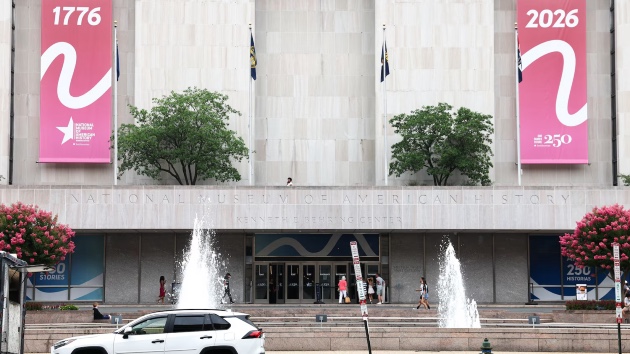
The Smithsonian American History Museum on July 07, 2026 in Washington, DC. (Finn Gomez/Getty Images)

(WASHINGTON) — The director of the Smithsonian’s National Museum of American History (MNAH) is scheduled to testify before two congressional House committees this week amid sharp criticism from the White House over the contents of the Washington, D.C. museum.

Anthea Hartig is set to face grilling by lawmakers on Tuesday morning in a House Subcommittee on Delivering Government Efficiency hearing titled “Rewriting American History: Examining the Smithsonian’s Efforts to Reshape the Past,” according to a committee press release.

She is also expected to testify in a related hearing on Wednesday before the Committee on House Administration, a committee spokesperson confirmed to ABC News. ABC News has reached out to the Smithsonian for confirmation.

Hartig was named in a scathing White House Domestic Policy Council report released on July 4, accusing the MNAH and its leadership of engaging in “extreme political activism” and presenting “a radical view of American history.”

Asked about the report, a spokesperson for the Smithsonian told ABC News on July 5 that the institution remains committed to impartial learning.

“For more than 180 years, the Smithsonian has served the American public with nonpartisan and independent scholarship, and we remain committed to doing so,” the spokesperson said.

Hartig’s testimony this week would mark the first time that a top leader at the Smithsonian gets grilled publicly by Congress after President Donald Trump targeted the institution in his March 27, 2025 executive order, “Restoring Truth and Sanity to American History.”

The executive order directed Vice President J.D. Vance, in consultation with the president’s advisers on domestic policy, “to remove improper ideology” from Smithsonian institutions, arguing that materials that cast America in a “negative light” have no place in federal cultural institutions.

The White House last year launched an investigation into the Smithsonian, which oversees 21 museums, galleries and the national zoo, and released the July 4 report targeting the American history museum as part of this probe.

The report accuses the museum of “anti-White activism,” “illegal alien activism,” and “transgender activism.” It also includes many photos of materials the White House has identified as problematic.

Smithsonian Secretary Lonnie Bunch, who has not addressed the report publicly, disputed its findings in an internal letter to staff that was obtained by ABC News.

Bunch wrote that Smithsonian leadership is “carefully” reviewing the report’s findings, but said that the report’s assessment is “not a fair characterization.

“While there will always be room for improvement, this report is not a fair characterization of the work and totality of the National Museum of American History,” Bunch said in the letter. “At the Smithsonian, our work is driven by scholarship, accuracy, and an uncompromising commitment to tell the fullness of America’s story.”

“As public servants and the keepers of this institution, we are charged with helping a nation find understanding, hope, and clarity and as part of that duty, we are dedicated to excellence, reflection, and growth,” Bunch added.

The report was published by the White House Domestic Policy Council. Vince Haley, the group’s director, said in a statement to ABC News that “No American wants the Smithsonian’s National Museum of American History to be a system of ideological activism.”

“Unfortunately, the report demonstrates that is exactly what the Smithsonian’s flagship museum has become,” he said. “It is our hope and expectation that the Smithsonian will eventually rise once again to that noble obligation — to tell America’s story for our children, the world, and future generations of Americans,” he added.

ABC News’ Mariam Khan contributed to this report.

Copyright © 2026, ABC Audio. All rights reserved.

Tens of thousands without power and more than 100 homes damaged as Tropical Storm Lala moves away from Hawaii

(CNN) — Tropical Storm Lala, which brought dangerous flooding, strong winds and a massive power outage throughout Hawaii, is beginning to exit the islands as the eye starts to pull away from Kauai.More than 150,000 customers are still without power across the islands Sunday night after hurricane-force wind gusts were reported in Hawaii, Honolulu and Maui counties.At least 100 homes were damaged and lost in the storm, Hawaii Gov. Josh Green said during a Sunday news conference.In an update early Sunday, Mayor of Hawaii County Kimo Alameda said some homes were swept off their foundations and that the county’s civil defense was working with local agencies, along with the National Guard and Coast Guard, on a search and rescue.The effects of the storm are likely to exit the Hawaiian Islands by 8 a.m. local time Monday. Green announced that all state and county offices, schools, courts and Judiciary offices would be closed on Monday.Tropical storm warnings are no longer in effect, but a flood watch remains overnight for Kauai, Oahu and Maui counties. Heavy rainfall is continuing but becoming more sporadic as the outer rainbands pass over the islands.The Hawaii emergency management agency warned people to continue exercising caution after Lala passes “as deadly hazards remain, including flooded areas and downed power lines.”Dangerous flash flooding as Lala moves westGreen on Saturday evening attributed a death from a car accident to the storm but said Sunday it was unclear whether it was connected to Lala.Another person was found dead amid the storm, but it is also unclear how the person died and whether the death was storm-related, Green said.In a video update Saturday night, Darryl Oliviera, Hawaii County’s acting civil defense administrator, said occupants of a vehicle stuck in floodwaters were being rescued, though he did not provide further details.Rescue crews were able to save lives in their response by pulling an elderly woman out of a tree when her house washed away, Green said.A “river of water” went through Naalehu on Hawaii, washing away “quite a lot,” the governor added.In the southeastern side of Hawaii, also known as the Big Island, parts of the Pāhala Highway collapsed overnight into Sunday –– cutting off critical access to an area where one of the region’s only hospitals is located.Green said the wreckage on the highway created a new waterfall and caused damage to small bridges, while also cutting off power.Aerial footage of the highway shows parts of it destroyed by what appears to be a massive landslide, where water and rocks have piled on.Deborah Funai Brown, a lifelong resident of Pāhala, told CNN affiliate KHNL/KGMB that she witnessed a highway collapse, calling the event — which has left up to 2,500 residents trapped— “catastrophic.”“We’ve always been stuck in the middle of nowhere so you kind of feel forgotten about when you’re out here, like you’re on an island by yourself,” Brown told the outlet.The collapse occurred after floodwaters from the Pa’au’au Stream breached a rock wall and surged onto the highway, causing it to buckle.Lala, which strengthened to a Category 1 storm Saturday, made its closest approach to Hawaii’s Big Island at around 5 p.m. local time, with its eyewall brushing the southern portion from roughly 30 miles away, according to the National Hurricane Center.Videos obtained by CNN show streets flooded by torrential rainfall on the Big Island, which got over 30 inches of rain. More than 190 flights in and out of Hawaii been postponed over the weekend, while 52 were canceled, Green said, though airports across the state remained open.Emergency responders were expected to be busy dealing with urgent matters as the storm passed Hawaii, with damage assessment expected to begin on Monday, the governor said.A record number of road closures and prolonged power outages had been reported, according to Alameda.Those widespread power outages and road closures have had major impacts on residents, Major General Stephen F. Logan, adjutant general for the state of Hawaii, told CNN’s Brian Abel.The biggest challenge for crews working to restore power in affected areas is clearing downed trees that fell during the storm, Logan said.He added state officials are confident they can take care of the massive cleanup effort after the storm but active-duty military are standing by in case they need assistance.Rain, wind ongoing as storm passes throughAs Lala moves west, its most serious threat is the torrential rain, which could spur additional flash flooding and mudslides across the island chain. The National Hurricane Center warned of life-threatening flooding and mudslides, especially in steep terrain.Large waves generated by Lala will continue to impact exposed shores of the Hawaiian Islands through Sunday night, with a gradual ease expected from east to west by Monday, the Hawaii Emergency Management Agency said. It warned of possible coastal flooding and beach erosion.Landfalls — when the center of the eye moves over land — on the Hawaiian islands have happened only a handful of times in the modern record. The last tropical system to make landfall was Tropical Storm Olivia in 2018, which came ashore on Maui, the island’s first landfall since recordkeeping began in the 1950s.The last landfalling hurricane was in 1992, when Category 4 Iniki hit Kauai, becoming the strongest storm to directly strike the state on record.Hawaii residents cope with hurricane impactsAcross Hawaii, residents evacuated to designated shelters and scoured packed grocery stores as officials across several counties announced closures as the storm approached.In Hilo, grocery stores and gas stations were busy as people stocked up on essentials, CNN affiliate KHNL/KGMB reported. Hawaii County offered sandbags for residents around the island. Around 130 people had fled to shelters Saturday, according to the mayor.Many roads across the county continue to be closed due to downed trees, utility lines and landslides, according to the mayor’s office.“While road crews are working hard to clear debris as conditions allow, we need all residents and visitors to heed all warnings, move into safe shelter, and stay off the roadways,” Alameda said.And in Oahu, officials opened eight hurricane refuge areas as public facilities like the Honolulu Zoo shuttered.Tropical storms approaching Hawaii typically hit cooler ocean temperatures before reaching the islands, but Lala remained over warmer waters due to an ongoing marine heat wave extending to California and a developing Super El Niño.El Niño is helping fuel increased storm potential in the central Pacific this year with warmer ocean temperatures and weaker winds in the upper atmosphere, which can normally break up storms. The National Oceanic and Atmospheric Administration has forecast an above-average central Pacific season, with five to 13 cyclones expected.Randy Collins, director of emergency management for the city and county of Honolulu, urged residents to be extra careful once the storm has passed and cleanup starts.“Many casualties happen after the disaster. … As people are cleaning things up, they’re working with heavy equipment, chain saws, generators, they’re working around downed power lines and so forth. That’s when the casualties come,” he said. “I just want to encourage everyone as they are cleaning up to ensure that you are doing so in a safe manner.”This story has been updated with additional information.The-CNN-Wire™ & © 2026 Cable News Network, Inc., a Warner Bros. Discovery Company. All rights reserved.
Read Next Story