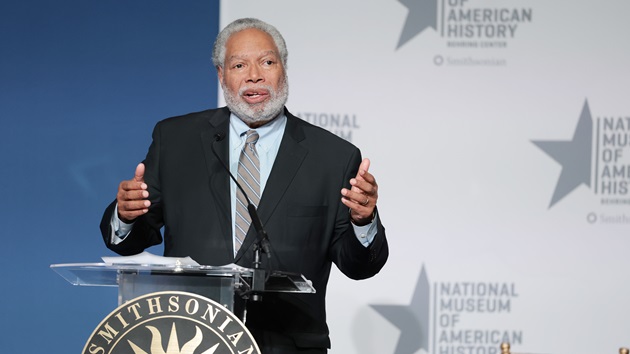
(WASHINGTON) — Smithsonian Secretary Lonnie Bunch disputed the scathing July 4 report released by the White House, which accused the National Museum of American History and its leaders of presenting a “radical view” of American history.
In an internal letter to staff that was obtained by ABC News, he wrote that Smithsonian leadership is “carefully” reviewing the report’s findings. Bunch has not addressed the report publicly.
“While there will always be room for improvement, this report is not a fair characterization of the work and totality of the National Museum of American History,” Bunch said in the letter. “At the Smithsonian, our work is driven by scholarship, accuracy, and an uncompromising commitment to tell the fullness of America’s story.”
“As public servants and the keepers of this institution, we are charged with helping a nation find understanding, hope, and clarity and as part of that duty, we are dedicated to excellence, reflection, and growth,” Bunch added.
In the letter, Bunch thanked staff members for their “dedication” to their work and their “belief” in the institution’s mission.
“Every day, we are honored to tell America’s stories and hold that responsibility with the utmost regard, respect, and fidelity. We remain committed to fulfilling our mission for generations to come,” he said.
The report was published by the White House Domestic Policy Council. Vince Haley, the group’s director, said in a statement to ABC News that “No American wants the Smithsonian’s National Museum of American History to be a system of ideological activism.”
“Unfortunately, the report demonstrates that is exactly what the Smithsonian’s flagship museum has become,” he said. “During this 250th anniversary year of our heroic founding, the least we owe our Founding Fathers is an honest and inspiring account of who they were, what they did, and what they built. It is our hope and expectation that the Smithsonian will eventually rise once again to that noble obligation — to tell America’s story for our children, the world, and future generations of Americans.”
Bunch’s letter comes days after the Domestic Policy Council released the scathing 162-page report accusing the Smithsonian Institution of engaging in “extreme political activism” and presenting “a radical view of American history.”
The report particularly took aim at the Smithsonian’s National Museum of American History (NMAH), accusing its leadership of adopting “an ideological framework that no longer treats the American story as a shared national inheritance to be taught or celebrated, but as a political instrument to divide, dispirit, and discourage our citizens.”
The report accuses the museum of “anti-White activism,” “illegal alien activism,” and “transgender activism.” It also includes many photos of materials the White House identified as problematic.
Asked about the report, a spokesperson for the Smithsonian, which oversees 21 museums, galleries and the national zoo, told ABC News in a statement on Sunday that the institution remains committed to impartial learning.
“For more than 180 years, the Smithsonian has served the American public with nonpartisan and independent scholarship, and we remain committed to doing so,” the spokesperson said.
The report comes amid an ongoing White House review of the Smithsonian as well as a separate internal review launched by the Smithsonian into its own exhibits and processes.
The White House review was launched in response to President Donald Trump’s March 27, 2025 executive order, “Restoring Truth and Sanity to American History.”
The executive order directed Vice President J.D. Vance, in consultation with the president’s advisers on domestic policy, “to remove improper ideology” from Smithsonian institutions, arguing that materials that cast America in a “negative light” have no place in federal cultural institutions.
“The serious concerns raised in this report are not about a few exhibits or a few controversial labels,” the report says. “As it stands today, it would benefit most Americans, especially parents bringing their children for a tour, if the Smithsonian’s flagship history museum had a label at every entrance that reads: ‘Warning: the exhibits in this museum were prepared by people who don’t want you to love your country.'”
Sarah Weicksel, executive director of the American Historical Association (AHA), previously told ABC News that the White House is seeking to create “a narrowly sanitized version of the American past” at federal cultural institutions “that fits comfortably” into Trump’s executive order.
The AHA, which represents 10,000 historians across various educational and cultural institutions in the U.S., including the Smithsonian, has publicly defended the Smithsonian and urged the White House to “respect and value the expertise of the historians, curators, and other museum professionals who conduct the review and revision of historical content according to the professional standards of our discipline.”
“History is under attack right now, and we are seeing our expertise devalued in the public sphere,” Weicksel told ABC News Live in an interview on Monday. “It is really upsetting to see the executive branch intervening in our work.”
ABC News’ John Santucci and Sabina Ghebremedhin contributed to this report.
Copyright © 2026, ABC Audio. All rights reserved.